People in lower strata struggle to make ends meet amid consumer price rises fueled by soaring headline inflation against subdued wage growth in Bangladesh.
Official data show the gap between earning and spending by low-income people, in addition to wealth gap between the super-rich and the ultra-poor following overconcentration of riches shown in independent economic reviews.
As a result of the gaping pay-and-price gap, economists say, limited-income-group people who are mostly breadwinners of their families are losing purchasing power fast.
In worrisome domino effect thereof the poverty rate, education dropout, and malnutrition are reverting among the feared fallouts, they observe.
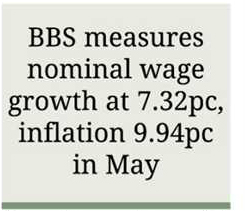
Bangladesh Bureau of Statistics (BBS) in its latest publication shows that the wage rate fell well short of consumer-price inflation for May 2023.
The rate of nominal wage growth at the national level in May was 7.32 per cent on a point-to-point basis although the rate of inflation stood at 9.94 per cent -- a gap of nearly 2.62 -percentage points.
Agriculture sector's nominal wage growth at the national level was recorded at 7.41 per cent, industry at 6.91 per cent and service at 7.66 per cent.
However, Rangpur division wage-rate growth (overall) beat the national-level inflation as the rate of growth was recorded at 11.39 per cent or up by 1.45 percentage during the month under review.
In Dhaka division -- wherein lies the capital city of affluence and misery in a section -- the wage rate grew at the slowest pace among the divisions as its rate was just 5.85 per cent in May.
Chattogram wage rate was 6.85, Rajshahi 7.11 per cent, Khulna at 7.5 per cent, Barishal at 7.71, and Sylhet at 6.97 per cent against the national level inflation rate of 9.94 per cent
The BBS designed Wage Rate Index (WRI) as an important gauge for the trend and changes in the aggregate wages of the wage-earners. The wage index is intended to measure the movement of nominal wages of low-paid skilled and unskilled labourers over time in different sectors of the economy. It is also used to measure changes in real wages.
Economists familiar with the developments told the FE that the wage growth and the inflation rate had no gap in the past, and in some cases, wage growth used to outstrip the rate of inflation. But the gap now widens, rendering it hard for many to make two ends meet.
"The poor have lost their purchasing power as the inflation erodes the real income," says Dr M. Masrur Reaz, chairman at the Policy Exchange of Bangladesh.
The poverty rate may widen as a result of the gap. And malnutrition as a result of poor diet may increase too, he told the FE in explaining the cascading impact of stubborn inflation.
He notes that the government may provide support to the poor to offset the bites of inflation spikes -- and specifies how. The government may provide subsidies on utility bills, including power bills. The OMS and public transportation facility may widen for the poor.
Dr Masrur says the Rangpur division wage rate is higher than that of the inflation rate as the agricultural service sector made huge profits this time. "A part of the revenue was channeled to the people involved in the agriculture service sector."
Dr Mustafa Kamal Mujeri, executive director at the Institute for Inclusive Finance and Development (InM), says if the rate of inflation exceeds the rate of nominal wage growth, then their real income gets eroded. Such a situation leads to lowering the standard of living of the people, especially the limited-income group of people.
"The poor people avoid the expense of healthcare services as a result of shrinking real wages," he tells the FE in explaining the chain effects.
It also might lead to dropping out from education (for lower-income groups of people).
Dr Mujeri mentions some social-protection programmes that exist in the country but the monthly or yearly annuity is very much poor to cope with the rising prices of essentials.
He feels that Bangladesh now needs a universal social-protection system that is based on fair targeting to combat such shocks, from global and domestic crunch.
The BBS measures the wages as the amount of money received either in cash or in kind in a day for standard daily working hours or earnings of a low-paid labourer who works on an hourly basis.
The wage index is intended to measure the movement of wages of low-paid skilled and unskilled labourers over time in main sectors of the economy, such as agriculture, industry, and services.
The wage Rate Index or WRI has been rebased from 1969-70=100 to 2010-11=100 under these main three sectors of the economy in respect of 44 occupations comprising 11 occupations from agriculture, 22 from industry, and 11 occupations from the services sector.
jasimharoon@yahoo.com
© 2026 - All Rights with The Financial Express

