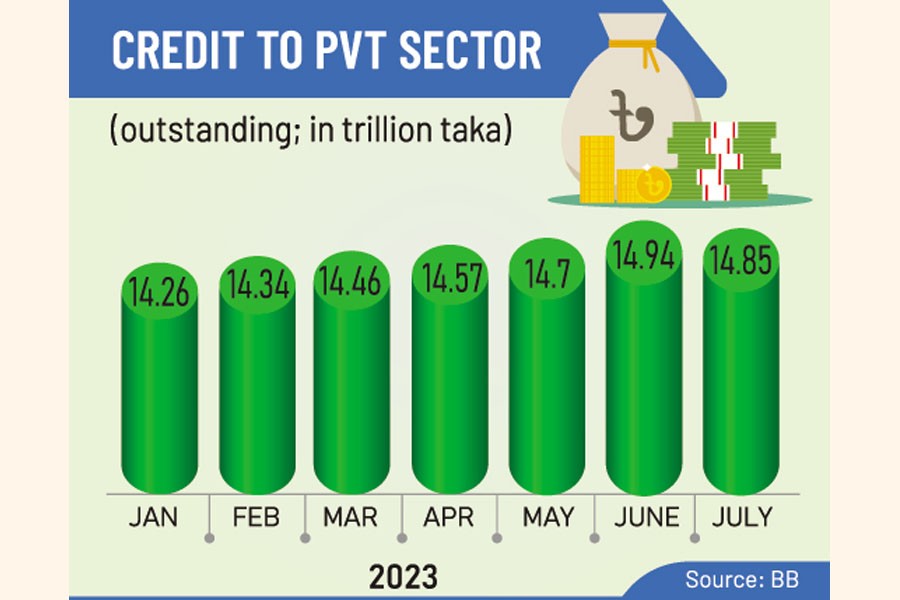
Formal credit flow into private sector continues shrinking amid central bank's fist tightening to fight inflation through curtailing import with costly dollar, sources say.
Officials and bankers say private businesses also seem to be reluctant in taking funds from the banks in this election year to avoid possible poll-related instability.
And such cautious business planning could be another reason behind the downturn in private-sector credit usage.
According to latest statistics from the Bangladesh Bank (BB), private-sector-credit growth dropped to 9.82 per cent in July compared to the corresponding month last year-the lowest since October 2021 when it was 9.44 per cent.
The data show that credits going to the private sector at the end of July amounted to Tk14.85 trillion, in a decline by Tk 90 billion from its previous month's figure of Tk14.94 trillion.
The credit flow had been on an upturn since early last fiscal year (FY'23), reaching 13.95 per cent in July and 14.07 per cent in August.
An ebb tide started thereafter, with figures recording 13.91 per cent, 13.91 per cent, 13.97 per cent, 12.89 per cent, and 12.62 per cent in September, October, November, December and January respectively.
The private-credit growth further plummeted in the subsequent months, with figures of 12.14 per cent in February, 12.03 per cent in March, 11.28 per cent in April, 11.10 per cent in May and 10.57 per cent in July, show the BB data.
In the latest half-yearly MPS or monetary policy statement up to December next, the private-sector credit growth is projected at 10.90 per cent by upcoming December and 11 per cent till June next year.
Seeking anonymity, a BB official pointed out various factors contributing to the credit squeeze, including the central bank's belt-tightening measures to safeguard foreign-exchange reserves and control inflationary pressures amid price spirals.
The official said trade financing, which constitutes around 40 per cent of the total funds flowing into the private sector, has been notably impacted by the BB's strict monitoring of import-related banking activities, as evident in the private-sector credit data.
Talking about the monetary target of such credit, the central banker said the BB has shifted its monetary-policy stance from monetary targeting to interest-rate targeting. Under such new regime, the central bank made projection of such fund-flow.
"There is a misperception that still persists among many regarding the target. We do not set any target. If there is demand, the banks can give more credits to the private sector. There is no such limit," he added.
Managing Director and CEO of Mutual Trust Bank Limited (MTB) Syed Mahbubur Rahman says industrial growth is measured on the performance of some key indicators like the growth of import of capital machinery and industrial term loans.
"Import of capital machinery dropped significantly over the months amid the persisting belt-tightening initiatives. Consequently, disbursement in trade financing has also diminished."
Under the ongoing volatile macroeconomic situation locally and internationally, private-sector players are not showing that much inclination to undertake new projects or expand their businesses," the senior banker said.
"And this is an election year, which may trigger some election-related instability. So, they (private entrepreneurs) might feel this is not a proper time to invest in new ventures or products."
According to the BB data, the import of capital machinery has dropped around 31 per cent in July 2023 from its corresponding period of the past year.
Apart from import restrictions and poll-related fears, Abul Kashem Md. Shirin, managing director and CEO of Dutch-Bangla Bank Limited, says that the overall business scenario is not that good as the global orders kept falling in recent times.
"So, the private-sector players are not showing any interest to expand their business under this stress time, which is reflected in the data of private-sector credit," he adds.
Seeking anonymity, a senior executive of a private commercial bank said offshore financing experienced a sharp decline of almost 50 per cent across banks. "And the situation is almost the same for other banks. These are probably the reasons behind the poor disbursement of credit to the private sector."
Dr Ahsan H. Mansur, executive director of the Policy Research Institute (PRI), points out that the primary reason for the downward trend in credit flow to the private sector is the fall in deposit growth.
"If the liquidity situation in banks is good and the private sector does not get funds, then we can mention other reasons. Falling deposit is the main reason. The demand for funds by private entrepreneurs is still in place. It is banks who feel discomfort in giving loans under this challenging period of time," the eminent economist says in his critical view of the overall finance and economic situation.
According to BB data, deposit growth in the banking sector dropped to 8.40 per cent in June 2023 year on year, from 8.90 per cent.
jubairfe1980@gmail.com
© 2026 - All Rights with The Financial Express

