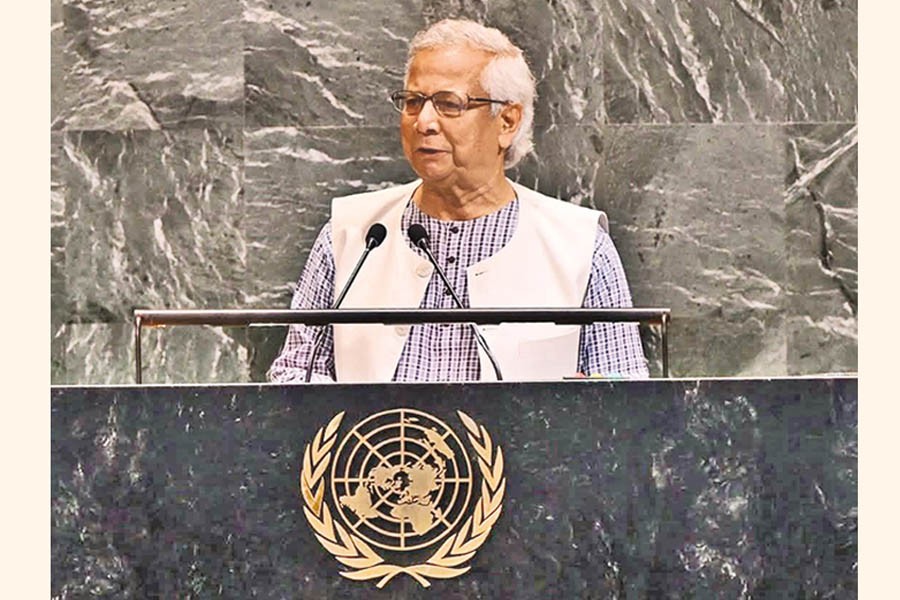
 Prof Muhammad Yunus speaks at the UNGA session on Friday —PID
 NEW YORK, Sept 26 (UNB): Seeking diversified and additional global funding for the Rohingyas, Chief Adviser Prof Muhammad Yunus on Friday urged the international community that there must be a political solution to the problems in Rakhine involving ethnic stakeholders there so that the Rohingya becomes part of the Rakhine society with equal rights.
"The International community, beyond new and enhanced funding for humanitarian assistance, must apply pressure on Myanmar or the non-state actor in Rakhine to bring positive changes there and seek political solutions urgently," he told the 80th United Nations General Assembly (UNGA).
The global attention turned to the iconic green marble podium in the General Assembly Hall, where presidents, prime ministers and monarchs are delivering national statements, setting out visions for peace, development, human rights and collective action amid mounting global challenges.
Prof Yunus said the neighbouring countries must assume their responsibilities.
Eight years on, the Rohingya crisis continues without any solution in sight, he said.
Bangladesh is hosting over 1.3 million Rohingyas in Cox's Bazar and Bhasan Char Island.
He said Bangladesh will remain available for any assistance or contribution needed towards stabilisation of Rakhine that the international community collectively agrees.
Prof Yunus said Bangladesh expects that the upcoming high-level Conference on September 30 will galvanise global resolve and generate concrete international support for the Rohingya, with the top-most priority of diversified and additional funding.
Parallelly, he said, it must agree on a process with time-bound deliverables as part of a globally accepted roadmap towards seeking permanent solutions to the Rohingya crisis.
The ongoing conflict in our neighboring country, Myanmar, Prof Yunus said, has created a situation of deep concern for the entire region.
"It threatens not only regional stability, but also the prospects for the safe return of the forcibly displaced Rohingya sheltered in Bangladesh," he said.
Besides, Prof Yunus said, Bangladesh faces a slow, but a regular flow of the Rohingya seeking protection.
Evidently, he said, deprivation of rights and persecution of the Rohingya rooted in cultural identity-based politics continue in Rakhine.
The reversal of the process of marginalisation of the Rohingya cannot wait any further, said the Chief Adviser.
Most of the discriminatory policies and practices that made them vulnerable can be reversed and remedial measures can be advanced without waiting for a comprehensive national political settlement in Myanmar, he said.
BNP Secretary-General Mirza Fakhrul Islam Alamgir, BNP leader Humayun Kabir, Nayeb-e-Ameer of Bangladesh Jamaat-e-Islami Syeed Abdullah Muhammad Taher, Bangladesh Jamaat-e-Islami leader Mohammad Nakibur Rahman, first senior joint member secretary of National Citizen Party Dr Tasnim Jara and NCP leader Akhter Hossen accompaned the Chief Adviser as part of the Bangladesh delegation to the UNGA.
Foreign Affairs Adviser Md Touhid Hossain, Law Adviser Dr Asif Nazrul, Energy Adviser Fouzul Kabir Khan, SDGs Affairs Principal Coordinator Lamiya Morshed, Press Secretary Shafiqul Alam were also present.
Prof Muhammad Yunus told the international community that Bangladesh is committed to building a balanced democratic order where no elected leader would be able to undermine democracy.
"Our goal is clear: to create a democratic order where power is balanced, where no autocrat can ever return, where no elected leader can destroy democracy, and where those who are meant to protect the people can never again prey upon them," he said.
Now, as the country prepares for the national elections in February next year, the Chief Adviser said they remain steadfast in carrying forward reforms that place citizens at the center.
"Our focus is unchanging: transparency, accountability, and the rule of law," Prof Yunus said.
To realise this vision, Prof Yunus said, they established eleven independent commissions on governance, the judiciary, elections, public administration, law enforcement, anti-corruption, women's rights and other vital areas.
These commissions consulted citizens, studied deeply and produced detailed proposals for reform, he said.
To anchor these reforms in permanence, Prof Yunus said they created a National Consensus Commission, which brought together more than thirty political parties and coalitions.
"Its aim was simple yet historic: to forge a collective pledge that transcends party lines. That effort succeeded. On the first anniversary of the July Uprising, we stood together on one stage and announced the 'July Declaration', a time-bound commitment to reform," he said.
That commitment means that no matter who wins the next election, the reform process will not stop, will not reverse, and will not be undone.
© 2026 - All Rights with The Financial Express

