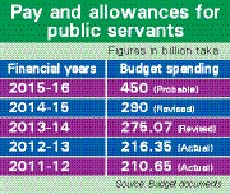
The pay and allowances of public servants are set to constitute the largest chunk of the revenue budget for the next fiscal year (2015-2016).
The government will be allocating an enhanced amount of Tk 450 billion on this account for over 1.3 million public servants.
Analysts, however, appeared sceptical about the gains from this fat outlay on account of pay and allowances since the productivity output of public servants is unlikely to get any boost.
The allocation to be proposed in the new budget is at least Tk 160 billion higher than that of the current year.
The government has promised to execute the recommendations of the National Pay Commission partially from the first day of the next financial year (FY).
Economists say this higher non-development expenditure on account of public servants will add to the tax burden of the people unless their (government staffs) efficiency level is improved on a par with the pay hike.
The new pay and allowance figures will occupy more than 22 per cent of the non-development part of the budget 2015-16, to be unveiled on June 04.
And this accounts for around 15 per cent as share of the total budget size which may hover around three trillion taka -- if not finally trimmed as per hints.
The economists contacted by the FE opined that the productivity of the government personnel is perceived very low in proportion to the pay and allowances to be given from July next.
They commented that this increased payment to the public servants might be tantamount to throwing away the tax payers' money into water unless the quality of services being rendered to the people is improved.
A large number of class-three-and class-four employees, they pointed out, occupy the public services that actually pay nothing for the public good.
However, 'interest' payments which have captured the top slot in the non-development expenditure since 2012-13 as a result of an unusual rise in the net sales of the national savings certificates might be placed under the second head in the next budget.
It (interest payment) was even more than 18.0 per cent of the non-development expenditure in the current fiscal year (2014-15).
Dr Ahsan H Mansur, executive director of the private think-tank Policy Research Institute of Bangladesh (PRI), says there will be large mismatch between the pay and the productivity of the public servants.
"This should be at least equal to the expenditure. But I'm sure that the productivity will be negative in case of public servants."
He observes there should be transparency and accountability in matters of public money as they money is being paid by the people from their hard-earned coffers.
The policy analyst is of a stark view that the lower-grade employees often cause hassles to people instead of delivering services.
Another economist, Dr AK Enamul Haque, said the government has possibly raised the pay and perks for retaining the qualified personnel in the service and reducing corruption that often hits top headlines in newspapers for charging bribe in exchange for service.
But he is sceptical. "Do we expect that the corruption will fall after implementation of the pay scale?"
Dr Haque, who teaches Economics at the East West University, argued the efficiency level must be enhanced or else the pay hike would just yield tax burden.
"In my view, to justify the enhanced salary, there should be a target for raising the efficiency."
He said the next budget should also give guidelines as to how to improve the efficiency of the public servants. However, the expenditure as a share of the country's gross domestic product stood at 2.3 per cent. Officers' share in the 2.3 per cent is 0.2 per cent.
This budget allocation of Tk 450 billion has excluded the public servants working with the autonomous and semi-autonomous bodies and corporations. But they will be paid from non-revenue funds, either their own funds or grants.
There are around 500,000 public servants more working with different autonomous and semi-autonomous and corporation offices and they will also enjoy the same facility.
The amount of pensions is not included in this allocation of Tk 450 billion.
jasimharoon@yahoo.com
© 2026 - All Rights with The Financial Express

