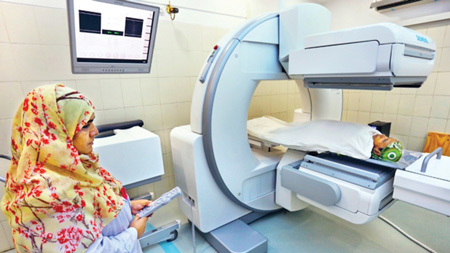
 A technician conducts the digital imaging of a patient at a city diagnostic centre. — Collected
Private hospitals and diagnostic centres are charging patients exorbitant fees at whim allegedly for lax government monitoring and absence of clear laws and regulations.
A patient coming to private diagnostic centre for pathological tests has to pay six to ten times higher than the fees charged by public hospitals, recent findings showed.
But shortage of manpower, lack of capacity and absence of regulatory measures made it difficult for government's department concerned to carry out proper supervision on such private healthcare facilities.
This correspondent has compared the costs of some medical tests -- Glucose (Random), Serum Creatinine, Serum Uric Acid, Serum Cholesterol, Serum Calcium, Serum Bilirubin (total) -- with the rates of different pathological laboratories. The world's best reagents used for these tests cost Tk 9.20, Tk 5.33, Tk 10.77, Tk 13.86, Tk 7.33 and Tk 16.36 respectively.
According to insiders, the cost of each of these examinations should range between Tk 20 and Tk 40 inclusive of all expenses.
Dhaka Medical College Hospital (DMCH) charges a patient for Glucose (Random) test Tk 80, for Serum Creatinine Tk 50, for Serum Uric Acid Tk 100, for Serum Cholesterol Tk 50, for Serum Calcium Tk 80, and for Serum Bilirubin (total) Tk 60, totalling Tk 430.
The DMCH follows a rate chart provided by the Directorate General of Health Services. All government hospitals and clinics follow the same rate chart.
Bangabandhu Sheikh Mujib Medical University (BSMMU) charges Tk 50, Tk 70, Tk, 100, Tk 150, Tk 100, and Tk 100 for these tests respectively, totalling Tk 570.
But major private hospitals charge much higher for the similar tests. The United Hospital chares a total of Tk 3030, Apollo Hospitals Tk 2910, Square Hospitals Tk 2760, LabAid Hospital Tk 2100 and Ibn Sina Diagnostic Tk 1316.
Ultrasonography of whole abdomen, a type of medical test, costs Tk 220 at DMCH while the figure jumps up to Tk 3800 in some private clinics and diagnostic centres.
"The private clinics and hospitals charge the patients at their whim. The costs of some tests are 10 to 15 times higher than the rational fees," M Iqbal Arslan, former general Secretary of Bangladesh Medical Association (BMA), told The Financial Express.
"A total anarchic situation is prevailing in the healthcare sector. There is not any minimum regulation in the private healthcare sector," said Mr Arslan, also a professor at the Department of Biochemistry and Molecular Biology and Dean of the Faculty of Basic Science and Para Clinical Science at BSMMU.
"Many private clinics and hospitals use date-expired and substandard reagents for tests; they do not maintain protocol for quality assurance and they even don't have qualified technicians, but nobody is there to monitor them," he added.
The private clinics and hospitals, however, defended themselves, saying that they charge higher fees as they have to pay commission on each test to doctors.
According to insiders, a doctor who recommends a medical test gets 30 per cent to 50 per cent commission on a test from a private hospital.
Contacted, Medical Director of Lab Aid Hospitals Brig-General Khan Md Asadullah Hel Galib (Retd) said: "We don't want to talk about the commission system for a test. This is an open secret, and everybody knows it."
He also said Lab Aid charges higher fees because they maintain quality of the tests and employ skilled technicians.
Mr AM Abul Kashem Rony, a senior Manager at the Apollo Hospitals, said they charge high as they add value to their services.
"We have world-class technicians, online delivery system and lifelong report-preservation system -- all these involve costs," he added.
Dr Iqbal Arslan admitted that commission system contributes to the higher charges of private healthcare.
He blamed the owners of private clinics and hospitals and pharmaceutical companies for creating such unhealthy environment in the healthcare sector.
"The commissions are basically a form of bribe. One company starts it and another must follow suit to survive. Such unhealthy competition has made our healthcare costlier," he said.
Bangladesh Private Clinic and Diagnostic Owners Association President Moniruzzaman Bhuiyan said the private hospitals are playing a key role in ensuring healthcare for the people as the government alone can't do it.
"The private clinics and hospitals maintain higher quality and invest huge money. So, they must make profit from their investment," he said.
About whimsical fees and charges, he said there are some clinics who charge such high fees, but it is the government who must regulate it.
"Private clinic owners should not be blamed for not having proper regulations and inspection and monitoring system in place. The government did not frame have regulations. It is their responsibility."
Officials at the Directorate General of Health Services, however, could not even give an exact number of private hospitals, clinics and diagnostic centres in the country.
The department has only a seven-member inspection team for around 13,000-14,000 private hospitals, clinics and diagnostic centres, according to unofficial figures.
Sometimes, the Rapid Action Battalion (RAB) and other law-enforcement agencies take action against irregularities in private healthcare services, but the efforts are far short of expectation.
Director of Hospitals and Clinics and Line Director of Hospital Services Management at the Directorate General of Health Services Dr Kazi Jahangir Hossain said they were trying to make a database on private hospitals, clinics and diagnostic centres.
"We hope we will be able to make a complete database within next six months," he said. Later, the department would increase manpower for monitoring.
There are allegations that doctors, private hospitals, clinics and diagnostic centres and government officials concerned created an 'unholy nexus' to put the country on the list of nations with the costliest private healthcare.
Mr Hossain responded to the allegations, saying that their department is not involved in it, but the allegation might be partly true. "If the government doesn't spend more money and strengthen the department, what can we do?"
The private healthcare services are regulated under the "Medical Practice of Private Clinics and Laboratories (Regulation) Ordinance 1982 which is not up-to-date to regulate such a large number of private health facilities.
The government several times took initiatives to amend and formulate new laws and regulations for private medical services but could not go ahead with the plan for reasons not known.
Some say private clinics and hospitals have become so powerful that they create obstacles to amending and formulating laws.
The health budget for the fiscal year 2017-18 is Tk 206.79 billion, an increase of Tk 31.63 billion from last fiscal year's. It is 5.2 per cent of the total budget. The figure was 5.1 per cent in the previous fiscal.
The World Health Organisation (WHO) recommended that the allocation for healthcare should be 15 per cent of the total budget.
In his budget speech, Finance Minister AMA Muhith said much of this health budget would be spent for establishing 392 community clinics and expansion of telemedicine services at district and upazila levels.
There was nothing specified about strengthening regulation and monitoring services in the budget.
In May this year, the Anti-Corruption Commission initiated an inquiry into clearances and the cost of medical tests as it suspected involvement of the city's posh private diagnostic centres in money laundering.
An official on the investigation team said the commission would investigate at least 10 diagnostic centres at Dhanmondi and Uttara as complaints were made against them.
He said the commission will gradually take steps about other diagnostic centres after completion of the inquiry.
bdsmile@gmail.com
© 2026 - All Rights with The Financial Express

