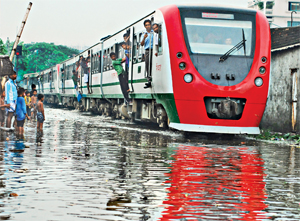
 A train plying the submerged railway-line at Gendaria in Old Dhaka following a spell of downpour that disrupted city life Wednesday. — FE Photo
People's sufferings knew no bounds as many streets in the capital got inundated and wayside shops swamped Wednesday as poor drainage system went haywire and floods around the city also blocked rainwater from flowing out.
Water-logging even for light rain in most parts of the capital gave rise to questions once again about the existing drainage system and its maintenance.
Residents and experts blamed poor and faulty drainage system and lack of coordination among the state utility service providers for the inundation problem.
Incursion by floods from the unprotected eastern front of the capital, in the wake of worsening flood situation in a number of districts, also accentuated the situation and plight of people, especially in low-lying areas.
People found themselves in difficulties when they approached kitchen markets, schools and offices as most of the main and busy thoroughfares went under ankle-to knee-deep water.
Even a little rain in the morning caused such debacle.
"The situation turned for the worst in the areas where development activities are being carried out by various state departments or agencies concerned," says a spot account of the scenes.
The haphazard works resulted in the dilapidation of the roads.
Road ruptures and stagnating rainwater rendered the streets unworthy for motor traffic as well as foot-journey along sidewalks.
With traffic movements facing a near-collapse, commuters were forced to spend their valuable time inside vehicles.
CNG-driven three-wheelers were also seen out of order and stuck- up on roads, further adding to the nagging jams.
The severely affected areas are Malibagh, Mouchak, Shantinagar, Maghbazar, Demra, Shahjahanpur, Badda, Rampura, Kathalbagan, Kolabagan, a part of Uttara, Azimpur, Mirpur, Kazipara, Shewrapara, Jatrabari, Sayedabad, Khilkhet and Old Dhaka.
Talking to the FE, Rafiqul Alam, a resident of Shantinagar area, said rain, water logging and chaotic mess of traffic paralysed their life.
Many put much of the blame on the dilatory construction works for building Mouchak-Malibagh Flyover stretching onto Eskarton and Tejgaon routes.
Sharmin Ahmed, a housewife who came to Viqarunnisa Noon School with her six-year-old daughter in the morning, said the road condition is too poor to use.
The rickshaw that carried them got stuck-up twice over potholes, created because of poor maintenance, in Maghbazar area.
"Luckily, we got unhurt," she says.
Kamrunnahar Lucky, a student, said she had to spend more than two hours to reach Purana Paltan from Badda area as the Malibagh-Kakrail road went under water even in light rain, showing a sign of poorly-managed drainage system in the city.
Contacted, meteorologist Abdur Rahman said 5.6 millimetres of rainfall had been recorded in the capital over the last nine hours till 3:00pm.
He had no good news to give yet for a respite, neither for people in the metropolis nor in the flood affected areas across the country.
"Light rain/thundershower is likely to occur over the next few days in Dhaka," he forecast.
The two major stakeholders of the capital's drainage system-Dhaka Water Supply and Sewerage Authority (Wasa) and bifurcated Dhaka City Corporation-blamed each other for the water-logging which takes its toll on city life in the monsoon.
Talking to the FE, Wasa Deputy Managing Director (Operation and Maintenance) Quamrul Alam Chowdhury said they receive insufficient funds for maintenance and development of drainage system. It hinders effort for preventing repeated water congestion during the rainy season.
"We have got budget allocation of Tk 50 million each fiscal year since 2005 for the drainage purpose and we have own funds worth Tk 100 million per fiscal," he told the FE.
He said retention ponds were supposed to be 10 to 12 per cent in a city, but there are now only three to four per cent in Dhaka. Generally, the rainwater passes through these retention ponds into canals.
Mr Quamrul said 6,000 to 7,000 tonnes of solid wastes are produced in the city but the city corporations are able to remove around 4,000 to 5,000 tonnes. The rest is dumped into the drains, causing drain blockage.
Seeking anonymity, another senior Wasa official alleged that the city corporations installed various sizes of drains in the capital and then connected those with the Wasa drainage system without prior consultation.
Their apathy to follow the guidelines put them in further trouble.
Chief Engineer of Dhaka South City Corporation (DSCC) Zahangir Alam denied the allegation, and redirected the blame.
He said the problem like water-logging largely arises because of poor maintenance of the drainage by the Wasa.
"Wasa makes such allegations only to hide their weakness. It is the mandated authority to remove water-logging and DCC is the owner of the roads," he said.
Talking about the tug-of-war, urban planner Ar Mubasshar Hussain said a moderate-to-heavy rainfall is enough to inundate main roads, lanes and by-lanes of both old and new parts of the capital.
"The state-owned service-providing entities should stop the blame game for the sake of public sufferings," he says.
The expert identified lack of coordination among the service providers as the main problem.
"They must work in a coordinated way to deal with civic amenities," he suggests.
Meanwhile, a BSS report said the flood situation deteriorated further following inundation of fresh areas Wednesday as water levels of the major rivers marked rise and were flowing above the danger marks (DM) at six points in the Brahmaputra basin.
The situation worsened in Kurigram, Gaibandha, Lalmonirhat, Nilphamari, Bogra and Sirajganj districts following huge onrush of water amid moderate rainfalls during the past 24 hours till 6 am on the day, officials in Water Development Board (WDB) said.
The Deputy Commissioners, UNOs, District Relief and Rehabilitation Officers (DRRO), other officials and local public representatives have been visiting the affected areas and distributing relief goods among the flood- and erosion-hit people.
According to sources in the district administrations, public representatives and local people, nearly four lakh people have been affected by floodwater so far and erosion takes severe turns along riverside areas in the affected districts.
Hundreds of the flood-hit people have taken shelters on the highlands, flood control embankments and other institutions and the district and upazila administrations have intensified relief activities.
The WDB authorities have been conducting emergency protection works at the damaged points of flood control embankments and health administration provides medicare services to the flood-hit people.
Executive Engineer of the Teesta Barrage Project Division of WDB Mahbubur Rahman told BSS this afternoon the Teesta rose by 9cm during past 24 hours and was flowing 34cm above the DM at Dalia point at 6am today inundating fresh areas in Nilphamari and Lalmonirhat.
However, the Teesta was flowing 12cm above the DM at the same point at 3 pm following some recession in the water level since this morning, he added.
According to WDB sources, the Brahmaputra was flowing above its DM by 13amat Chilmari and below its DM by 32cm at Noonkhawa and 13cm at Fulchhari while and Dharla was flowing only 3cm below its DM at Kurigram at 6am today.
The Jamuna was flowing above its DM by 34cm at Bahadurabad, 65cm at Sariakandi, 12cm at Sirajganj and 3cm at Aricha points while Ghaghot was flowing above the DM by 14cm at Gaibandha in the morning.
© 2026 - All Rights with The Financial Express

