Housing business still stays sluggish mainly for higher costs of property and lower purchasing power of people, as Bangladesh has yet to see tangible economic pickup.
Sector-insiders attribute this stunted growth in real estate to an exorbitant rise in flat prices also because of the persistently higher prices of building materials, in the wake of lingering global crises.
The prevailing higher cost of living for price rises is also contributing to this slowdown in the housing business, according to them.
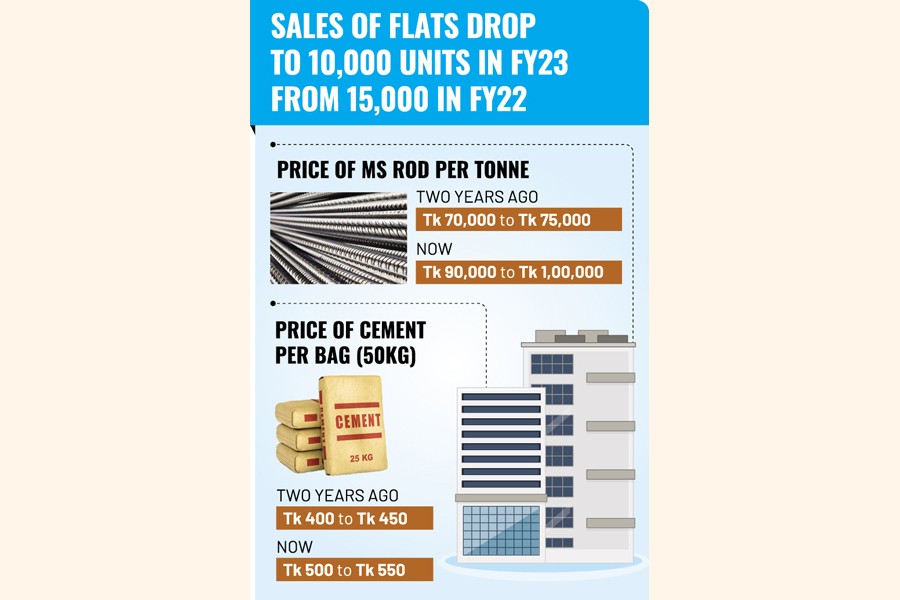
The Real Estate and Housing Association of Bangladesh (REHAB) disclosed that flat sales fell to 10,000 units in fiscal year (FY) 2022-23 from 15,000 units in 2020-21 and 2021-22 each.
Data available with the trade body of private property developers also revealed that REHAB members had sold 13,500 flats on average every year between FYs 2017 and 2020.
The industry sources believe the ongoing economic slowdown is taking a further toll on the sector, thus causing many smaller companies to go bust.
Amid uncertainties and fears of incurring losses by realtors, the number of new projects has declined significantly, they said.
Some developers have halted construction work or are forced to adjust the mounting project prices.
A flat buyer, Humayun Kabir, had to pay extras to continue with the building of an apartment he booked three years ago in Dhaka's Kazipara neighbourhood.
"I had to sit with the developer several times regarding price adjustment for a 1,000-square-foot flat," he says.
Now, Mr Kabir has to pay Tk 5,200 per square foot instead of Tk 4,500, which was fixed three years back.
The slump in real estate has multiplier impacts as there are more than 270 sectors linked with construction business, including key ingredients MS rod, cement, sand, brick and tiles.
"You won't get a single material whose price has remained unchanged in recent times, although things returned to normal after Covid-19," says a contractor, Matinur Rahman, who refrains from taking any new project.
He also spoke of incurring massive losses in some completed projects.
Quality mild steel (MS) rod per tonne has been selling between Tk 90,000 and Tk 100,000, depending on brands in recent weeks.
Data available with the Trading Corporation of Bangladesh (TCB) show that price of quality rod was between Tk 70,000 and Tk 75,000 per tonne two years ago.
Similarly, cement per bag (50 kg) now sells between Tk 500 and Tk 550, up from Tk 400-450 a couple of years back.
Bricks per truck (three thousand) now sell at Tk 35,000 to Tk 40,000, also higher than what was a year ago.
Industry people blame the Russia-Ukraine war close on the heels of the pandemic for disrupting the global supply chain, pushing up costs of sourcing raw materials.
Bangladesh has to depend on other countries for sourcing most of the raw materials. Even for brick manufacturing, operators have to rely on imported coal.
Talking to the FE, REHAB vice-president Kamal Mahmud said the cost of flats marked a 30-percent price increase on average in recent times.
"This massive rise in rates has caused serious trouble for not only middle-class buyers but also for developers," he remarked.
"The flat that was expected to sell at Tk 5,000 per square foot years ago now being sold at Tk 7,000," Mr Mahmud said.
High cost of living due to inflation has pushed the lower-middle or middle-class families into trouble, he said, adding that flats in Dhaka city are pricier now.
"Realtors are also in a fix for a lack of customers," Mr Mahmud went on to say.
The floor-area ratio (FAR) as per government's new DAP (detailed area plan) squeezes scope to build adequate flats in Dhaka city, leading to higher prices.
Even the government has increased property-registration fees for some important areas in the current fiscal, further fuelling cost hike. "Now, you will see a limited number of people in registry offices," added the REHAB leader.
saif.febd@gmail.com
© 2026 - All Rights with The Financial Express

