Bangladesh's gross foreign-exchange reserves now stand at $23.567 billion as measured in the International Monetary Fund (IMF) methodology, and the figure misses the mark set in the lender's lending recipe.
The central bank of the country published Thursday, for the first time, the figure as per the sixth edition of the Balance of Payments and International Investment Position Manual (BPM6).
The reserves in terms of the US dollar are equal to the country's four months' import bills.
Measured in Bangladesh Bank's traditional method of calculating foreign-currency reserves, however, the forex position stands at $29.97 billion.
"This is the gross reserve position as per BPM6. From now on, we will continue publishing both the figures," spokesperson for the central bank Mezbaul Haque told the FE.
The banker, however, said the central bank would not publish net reserve position.
In the wake of global economic crises--stemming from the pandemic and the Ukraine war in close succession--the country's export earnings had shown negative trends since February last year while remittance inflow also ebbing down, resulting in erosion of the foreign-currency reserves.
Under its domino effect of the crunch, the balance-of-payments deficit was continuing to widen with its further stress on the reserves. The government was thus forced to seek loans from the IMF, as also from other development partners, to replenish its coffer.
The IMF this past January granted $4.7 billion worth of loans with a string attached that includes a number of reforms, including publishing forex-reserve position in line with the BPM6.
To calculate gross international foreign-currency-reserve position Bangladesh Bank will have to exclude the reserve-related liabilities and reserves earmarked for quasi-fiscal activities.
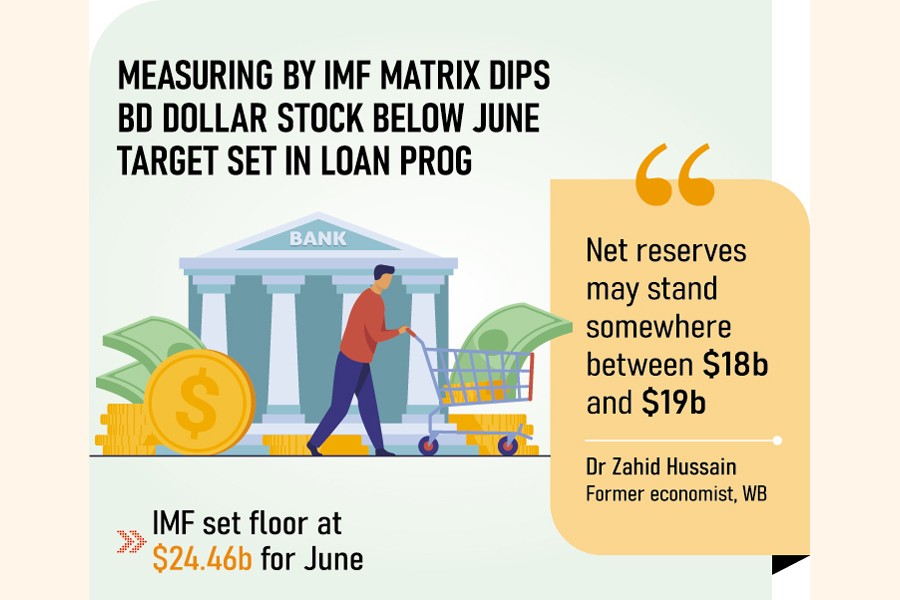
The gross reserves data, published Thursday, show Bangladesh falling short of target as set by the IMF, a floor at US$24.46 billion for the month of June.
The Washington-based development financier set the floor on reserve position as Quantitative Performance Criteria (QPC) in the loan programme. It will check the reserve position in the next loan review in September.
Dr Zahid Hussain, former lead economist of the World Bank's Dhaka office, told the FE on the day that the central bank published the new reserve position by excluding the foreign currencies which do not have monetary uses.
"The net reserve position will be much lower, somewhere in $18 billion to $19 billion," he said.
He notes that presently the central bank is selling $50 million or more every day to keep imports floating. "Unless the selling is stopped, the net reserve position will further fall in the days to come."
The economist strikes a note of caution that unless any policy comes to prevent falling reserve position, "we may fall in problem further".
To stop selling dollars to the banks the central bank has to take measures to increase supply of the greenback to the market from other sources. "Because, by selling US dollar, the central bank is supporting continuation of importing essential commodities."
Mr Hussain suggests that the central bank ease exchange rate further to stop selling dollars.
syful-islam@outlook.com
© 2026 - All Rights with The Financial Express

