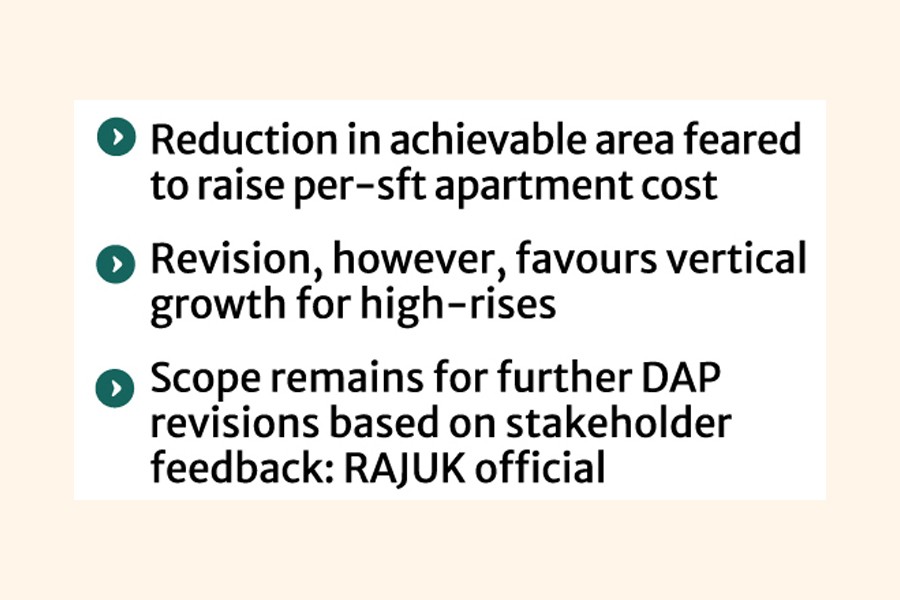
Realtors decry house-floor squeeze under the revised the Detailed Area Plan (DAP) arithmetic as they say it makes difficult for them to get optimum achievable FAR in the sprawling capital city.
The newly introduced, more complex calculation method for determining Floor Area Ratio (FAR) could result in a significant reduction in the achievable FAR in certain parts of the capital, Dhaka, potentially disrupting both the development sector and housing market.
While many areas in Dhaka have seen an increase in FAR by up to 120 per cent, there are four prominent zones-Dhanmondi Residential Area, Gulshan-Banani, Satarkul, and Nasirabad-where the FAR has actually been reduced under the revised plan.
In contrast, the revision has been hailed as a move that favours vertical growth. Several areas are set to see their allowable FAR more than double, opening the door to significantly taller buildings and higher population densities.
Zones like Khilkhet and Mirpur DOHS have seen some of the most substantial increases, with FAR projections rising from 2.0 to 4.4 and 2.5 to 4.8, respectively. In other peripheral areas such as Keraniganj and Savar, expected building heights are set to nearly double.
The revised DAP also introduces a range of incentives for developers. These include bonus FAR for those who commit to block-based developments or who provide more than the minimum open space around their buildings, offering greater opportunities for vertical expansion.
However, many developers argue that these incentives are insufficient to offset the complex challenges posed by the new house-building formula.
One of the primary concerns raised by real-estate developers is the difficulty in providing adequate civic amenities on plots of land as small as 2 acres (120 katha) after surrendering 45 per cent (54 katha) for open spaces.
Developers also note that plots smaller than 15 katha with a 30-foot road will only be eligible for minimal FAR bonuses unless they are located within Transit-Oriented Development zones.
Further complicating matters is the discrepancy between FAR allowances in central and peripheral urban areas.
Developers argue that the floor-area ratio in peripheral areas is significantly lower than in the central zones, creating an inequitable situation for those wishing to develop outside the core of the crammed city.
The FAR bonus for affordable housing has also been pared down from 0.75 to 0.5, while the minimum land requirement has increased from 5 katha to 15 katha.
Since the majority of individual plots in Dhaka fall below 15 katha, many properties will be unable to access this bonus.
Furthermore, a new stipulation requires developers to reserve 5.0 per cent of the total floor space for affordable housing-- a provision that many in the real-estate sector believe is unrealistic for most projects.
Real-estate officials have voiced concerns that the reduction in achievable FAR will raise the cost per square foot of housing, making apartments even less affordable for middle-income buyers.
There is also fear that the new regulations could slow private investment in urban redevelopment projects, potentially exacerbating Dhaka's housing crisis.
Speaking to The Financial Express writer, a top official from a leading real-estate company explains that while most areas has seen an increase in FAR, the inability to fully capitalize on bonus FAR means that developers cannot reach the maximum FAR, thus limiting the potential for profitable development.
He further elaborates that to calculate achievable FAR, developers must first identify the Area FAR and Plot FAR-where the lowest value serves as the Base FAR, and the highest value as the Maximum FAR. Bonus FAR can then be added to the Base FAR, but the total cannot exceed the Maximum FAR.
An official from the Rajdhani Unnayan Kartripakkha (RAJUK) mentions that while the revised DAP proposal has been approved by the advisory council of the current interim government, it has not yet been published as a gazette.
There remains an opportunity for further revisions based on stakeholder feedback, with the goal of ensuring the rational use of land in the city.
"The aim of the revised DAP is not to restrict development but to promote rational land use, adequate open spaces, and compliance with infrastructure capacity," the official said.
However, realtors stress that any changes to FAR regulations should be transparent and predictable to avoid confusion and unnecessary delays in project approval.
"Dhaka requires a clear and consistent planning framework that fosters compliance and encourages development, not one that discourages it," they have said.
newsmanjasi@gmail.com
© 2026 - All Rights with The Financial Express

