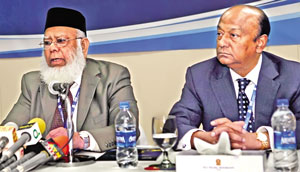
 ICCB President Mahbubur Rahman speaking at the press briefing at a city hotel on Sunday. ICCB Vice President Latifur Rahman is beside him. — FE Photo
The steady growth and resilience of Asia can continue to lead the global economic recovery through regional integration focused on consumption-led growth of China and India, an international business meet in Dhaka drew the conclusion.
Based on the continent's advances by means of tapping its potential, Asia should work in a synergy with the rest of the world to make it an inclusive and sustainable growth.
This clarion call was made by policymakers, business bodies, academics and businessmen from home and abroad during the two-day ICC International Conference that concluded in the capital Sunday. The International Chamber of Commerce-Bangladesh (ICC-B) organised the conclave
Discussants and delegates at the meet listed prospects and pinpointed a set of recommendations for increased trade and investment, regional cooperation, financial-sector development, improved governance, cleaner environment and better political dispensation.
"The objective of bringing the regional ministers, business leaders and academics on a platform to share their ideas is fulfilled," ICC-B President Mahbubur Rahman told a concluding press conference at a city hotel.
At the press meet, the organisers spelt out the outcome of the conference titled 'Global Economic Recovery: Asian Perspective'.
"Now we need to take the recommendations back, transform those into actions and to follow up to continue Asia's lead in global economic recovery," he said.
The post-conference press briefing was also attended by Latifur Rahman, vice-president of the ICC-B, Barrister Rafique-Ul Huq, member of the ICC-B executive board, Ataur Rahman, secretary-general of the ICC-B, Asif Ibrahim, chief coordinator of the ICC International Conference and former president of DCCI.
Asian recovery will be driven by continental growth, the discussants of the conference noted. But its sustainability will depend on recovery in the rest of the world.
Consumption expansion in China and India and relationship between these two countries will be critical in shaping the Asian agenda in the future, the delegates viewed.
Spelling out the crux of the discussions, the ICC-B president said political cooperation, regional integration and robust fiscal measures are a key to taking Asia forward.
Regarding trade, the discussants recommended that promoting interregional Asian exports is important, not just primary or intermediate inputs but also finished consumer and capital goods, he added.
Formulation of South Asian customs union may facilitate trade integration by reducing tariff and non-tariff barriers in South Asia, the conference recommended as the participants noted that such barriers impede trade integration.
They said attracting more investment from the region is important and that investment will pick up in tandem with recovery.
Small and medium enterprise (SME) promotion is the key to ensuring productive job creation, said another recommendation drawn from the deliberations.
The discussants stated that Asian regional cooperation can contribute to recovering from the ongoing global growth slowdown and could help deter possible future recurrence of global financial crisis.
Better connectivity can promote productivity and trade in South Asia.
Asian economies need to work together in carrying forward their significant attainments in promoting inclusive financing towards equitable socioeconomic progress, the conference recommended.
And governments and central banks in Asia may foster accelerated development of regional bond markets in order to harness regional savings into real-sector investment.
"Governments should create an enabling environment for businesses to flourish," the delegates stressed in unison.
They should also ensure effective accountability mechanisms to assist businesses in translating benefits of economic growth into a more inclusive and sustainable one.
Institutional reforms and reform of bureaucratic bottlenecks are suggested for ensuring an inclusive and sustainable development in developing countries.
Climate change will impact air quality and water, which would be the biggest challenges in the environmental domain in the region in the coming days, the discussants stated.
They were also of the opinion that good governance and inclusive politics are essential prerequisites for accelerated investment and growth.
China-India ties will be the key to shaping the developments in the new century, the discussants pointed out.
A total of 450 delegates and 40 speakers from over 10 countries took part in the conference.
azizjst@yahoo.com
md.ali.du@gmail.com
© 2026 - All Rights with The Financial Express

