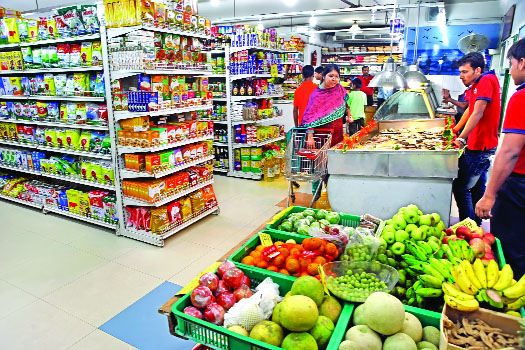
Transactions in retail markets and superstores selling consumer goods in the city have recorded a significant fall in recent months, traders concerned said.
But they remain clueless about the decline in the demand for even daily necessities.
"It appears that people have started consuming less at the cost of our daily turnover', said Md. Rajib uddin at vegetable seller at the Mirpur section 6 kitchen market.
But experts have attributed the decline in sale of essentials to the hike in the prices of the same, both food and non-food.
Traders at 13 kitchen markets (including three wholesale ones) and the operators at 10 chain stores in the city, interviewed between October 24 and October 28, told the FE correspondents that transactions, on average, had gone down by nearly 40 per cent over the last couple of months.
A total of 50 vegetable vendors, 10 wholesalers, 10 meat traders, 10 fish retailers, 20 grocers, 10 crockery sellers, 10 chain shop outlet managers and 50 consumers were interviewed by the FE.
Majority of the sellers reported that their daily transactions had declined by 20 to 40 per cent during the period while most consumers the FE interviewed said they were forced to cut their daily purchase of food products due to higher prices of the same.
However, traders at two kitchen markets said transaction has remained unchanged while sellers at only one market (Hatirpool Bazar) said overall sale increased slightly during the period.
The FE correspondents visited Mirpur Section-6 and Section-1 kitchen markets, Mohammadpur Krishi Market, Banalata Kitchen Market under New Market area, Nawabganj Bazar at Lalbagh, Companyghat Bazar at Hazaribagh, Santinagar Kitchen Market, AGB Colony Kitchen Market and Fakirapool Kitchen Market in Motijheel area, Hatirpool Bazar, wholesale markets like Karwan Bazar, Shyambazar and Swarighat, super shop outlets of Agora, Swapno, Minabazar, Lavender and Prince Bazaar.
Md Rajib Uddin said his daily sale usually was Tk 20-25 thousand which has come down to Tk 14-15 thousand for the last few months.
He said the sale on Fridays was Tk 30-35 thousand two and a half months back which is now hardly Tk 20-22 thousand.
"This doesn't mean that the number of consumers has declined; this is because the consumers have cut their consumption," he felt.
Md Ripon Ali, a fish trader at the same market at Mirpur section 6, said except Hilsa, sale of all fishes had gone down by 40 per cent for the last six months.
He admitted that prices of fish are extremely high.
"Increase in transportation cost and scarcity mainly responsible for the hike in fish prices specially those of indigenous varieties," he said.
Middle and lower middle class families normally come to this kitchen markets, he said.
Md Rabiul Islam Manik, an employee of an advertising agency, who came to Mohammadpur Krishi Market on October 28 last said his salary has remained unchanged at Tk 15,500 per month for the last one and a half years.
"I got my daughter admitted into a school this year in January. My house rent increased by Tk 700 since then," he said.
"We have squeezed our food intake like leafy vegetables, fruits, local fish varieties etc," said Manik, whose company sets up billboards in the city.
However, owners of meat and poultry bird shops said their sales have dropped nearly by 50 per cent.
Md Shafiqul Islam, a grocer at Nawabganj Bazar in the city said transaction at his shop reduced by nearly 25 per cent for last three months compared to previous months.
"My sale per day has dropped to Tk 50,000 now from Tk 65,000-70,000 few months back," he said.
"The sale of items like aromatic rice, noodles, other food items, soybean oil, many kinds of spices, liquid soaps, powdered milk etc has reduced significantly," he said.
One of the leading spice importers and wholesalers at Shyambazar in the city, Narayan Chandra Saha, said sale in the wholesale market has plunged.
He said prices of a few spice items, especially ginger and garlic, have witnessed a sharp increase for the past few months which is forcing the retailers to squeeze the volume of their consumption of those items.
However, apart from the kitchen markets, the modern super chain shops have also witnessed sharp decline in daily transaction.
The officials of the chain shops interviewed said sales of their outlets have recorded a massive fall though the similar shops in posh areas experienced very marginal decline.
Md Farukul Alam, manager of Agora at Shantinagar outlet, said sale has dropped by nearly 40 per cent for the last three months.
"Sale of perishable items like vegetables and fish witnessed a massive plunge due to an increase of makeshift shops here and there in the city and sales of other products dropped due to increase of their prices and decrease of buying capacity of people," he said.
He also said promotion of credit and debit cards is helping them slightly as many customers are visiting their outlets to avail this facility.
Supervisor of Lavender, chain shop at Gulshan-2, Md Ariful Hoque told the FE that sale of his shop dropped slightly during the period.
"Our customers are mostly foreigners and belong to the affluent section of the society for which our sale has not drop at a level compared to that of other chain shops," he said.
Secretary General of Bangladesh Supermarket Owners Association Md Zakir Hossain said: "Due to burden of losses and uneven competition, as many as 20 superstores have folded their operations in recent years and many others may follow suit."
"The super shops were also able to attract the middle and fixed-income group. But the visit by the members of the groups at our outlets fell significantly due to their diminishing buying capacity," he said.
"Nandan Supershop, Sadia Supermarket, Pacific Supermarket, Hut Bazar, PQS, A to Z Shopping Mall, Best Buy supermarket, City supermarket, Destiny Shopping Mall, Leeds Shopping Mall and Central Mart are among the supermarkets that shut their doors in the last couple of years," he said.
"Traditional grocery shop owners are paying a lump sum amount as government value added tax. On the other hand, super shop owners have to pay up to 4 per cent as VAT and corporate tax annually, throwing them into an uneven competition," he said.
Economist Prof M A Taslim said it is difficult to ascertain the causes for the decline in transaction during last three months.
He said the transaction might have gone down for multiple reasons like plunge in demands, consumers' switching to other products, squeeze in income of the people, and so on.
Prof Taslim, who teaches Economics at Dhaka University, observed that if the real earning of a low-income consumer had declined in contrast to the their food intake.
He said if the income of a person doesn't increase in proportion to the rate of inflation, then he or she finds it difficult to cope with the price situation.
tonmoy.wardad@gmail.com, badrulahsan71@gmail.com
© 2026 - All Rights with The Financial Express

