Drip-feeding dollar into the forex-strapped market by the central bank continues in what economists call risky deal amid depletion of Bangladesh's foreign-exchange reserves and slowing remittance and export incomes.
Officials said the US dollar sale by the Bangladesh Bank (BB) could not be controlled even as the country's foreign-currency reserves are shrinking at the cusp of global economic tantrums.
The nation's foreign-exchange reserves bear further pressure for such continuous funneling of the greenback into the banks, which remains a matter of serious concerns to some bankers and economists.
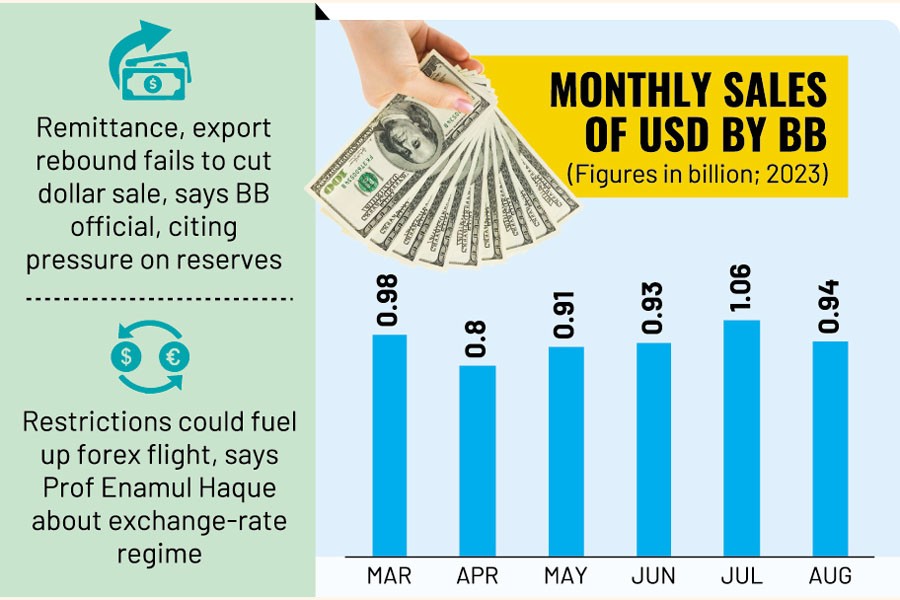
According to the latest data with the BB, the central bank sold US$0.92 billion in February last to the commercial banks to assist them in meeting their foreign- currency obligations. In March, the banks purchased $0.98 billion from the BB.
In the months thereafter, the monthly sales of the dollar came to $0.80 billion, $0.91 billion and $0.93 billion in April, May and June respectively.
In a crescendo July sales stood at $1.06 billion. In the last 28 days of this month, the sale volume of the US currency reached $0.94 billion.
Seeking anonymity, a central banker said the sales this month could go past the Julys tally as there are few more days still remaining and there are needs for necessary imports and payments.
The official has noticed the foreign-currency stock with the commercial banks improving in recent times because of factors like import restrictions, rise in remittance and submission of growing export proceeds.
This rebound was supposed to give some respite to the country's forex-reserves situation in this challenging period of time.
"But it was not happening as the rising trend in dollar sale by the BB from its reserves to the banks continues and it is putting more pressure on the reserves," the central banker says.
The BB official eyes more dollars to come in the form of budget-financing support from various global lenders in the days ahead.
"If those come in time, the pressure will be overcome. If not, it'll be a problem," the central banker says in his reckonings on the foreign-exchange situation.
Shortly after the Russia-Ukraine war broke out, Bangladesh came under immense pressure so far as its forex reserves are concerned from early last fiscal year (FY'23) because of quick fall of forex holding with the commercial banks in the wake of significant rise in import costs globally and less-than-expected levels of earnings from remittance and export receivables.
Since then, the central bank, as part of its market intervention, has intensified the sale of the greenback from its reserves to the banks in a bail-in to help them meet their foreign-currency obligations, sources at the BB said.
But, since January last, riding on various dollar-saving moves on part of the central bank under government austerity recipe, the foreign-exchange balances held by commercial banks have been on the up and up.
In October 2022, the forex stock in the banks dropped to $4.50 billion. The forex balances in the banks rose almost to $6.0 billion, the BB data showed.
Contacted for his view, professor at the department of Economics of East West University AK Enamul Haque said the banks started relying on the BB to meet their foreign-currency obligations later last year when the exchange rate of the dollar from the BB was cheaper than the interbank rate.
"Despite alignment of the BB exchange rate with the interbank rate," he said, "the demand for dollar from forex reserves by banks has not lessened yet. It means the demand for the greenback is increasing."
The economics professor voices a note of caution: "Under such situation, we need to focus more on increasing the supply instead of relying on restrictions because imposition of embargo could fuel up forex flight."
The country's gross forex reserves keep declining to reach $29.25 billion as on August 28, 2023, by official count.
jubairfe1980@gmail.com
© 2026 - All Rights with The Financial Express

