Readymade garment exports to the European Union (EU) faced the steepest decline among its major competitors during the first four months of 2026, amid weak demand and intensifying competition that are reshaping sourcing patterns across the 27-nation bloc.
Bangladesh exported apparel worth 6.09 billion euro to the EU during the January-April period of 2026, marking a 19.4 per cent year-on-year decline, according to EU official data released on Monday.
The sector fetched 7.55 billion euro in the corresponding period of 2025, data from Eurostat, the statistical office of the European Union, showed.
As a consequence, Bangladesh's share of total EU apparel imports fell from 24.4 per cent to 21.9 per cent, marking the largest market-share loss among the bloc's leading suppliers.
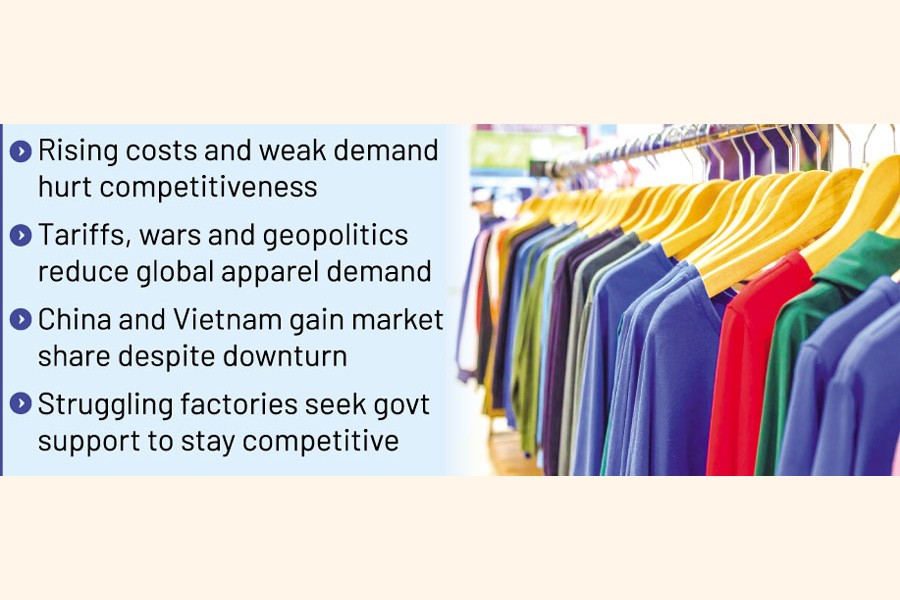
When asked, Bangladesh Garment Manufacturers and Exporters Association (BGMEA) President Mahmud Hasan Khan attributed the declining trend to a number of factors, including a volatile global situation, US reciprocal tariffs, high bank interest rates, poor port operations, uncertainty over LDC graduation and other related issues.
"Tariffs, wars and geopolitics have eaten up global demand, causing a decline in work orders," he said.
"The impact of reduced demand is almost the same for all manufacturing countries, but the key issue is competitiveness in a squeezed global market," he said, adding that Bangladesh is losing competitiveness for many reasons.
Echoing the BGMEA leader, Fazlul Hoque, former president of the Bangladesh Knitwear Manufacturers and Exporters Association (BKMEA), said Bangladesh needs to sustain itself through the current crisis to bounce back when the situation improves.
"Struggling factories need the support packages recently announced by the government to survive and sustain competitiveness," he added.
The country remained the EU's second-largest apparel source after China, but the gap between the two suppliers widened considerably during the period.
Overall, EU apparel imports fell by 10.4 per cent year-on-year to 27.8 billion euro, down from 31 billion euro during the corresponding period of 2025.
In contrast, China recorded a 4.6 per cent decline, earning 7.95 billion euro from garment shipments to the EU during the period.
However, China's share of EU apparel imports increased from 26.9 per cent to 28.6 per cent.
Vietnam emerged as the strongest performer among major suppliers in the European market, as its exports to the EU remained almost unchanged at 1.37 billion euro compared with 1.38 billion euro during January-April 2025, the data showed.
Vietnamese knitwear exports, however, increased by 2.3 per cent during the period.
Its market share in the EU rose to 4.9 per cent from 4.4 per cent.
Turkey, one of Europe's most strategically located sourcing hubs, also experienced a significant setback, recording a 16.9 per cent decline to earn 2.42 billion euro during the period.
Turkey's share of EU apparel imports dropped from 9.4 per cent to 8.7 per cent, suggesting that near-shoring advantages alone were insufficient to offset weak demand and heightened competition.
India's garment exports to the EU fell by 12.1 per cent to 1.64 billion euro from 1.87 billion euro.
Although export earnings declined, India's market share remained largely unchanged at around 6.0 per cent, indicating that Indian suppliers were able to maintain their competitive position despite weaker European demand.
Pakistani apparel exports to the EU fell by 17.9 per cent to 1.09 billion euro during the period, resulting in a fall in market share to 3.9 per cent from 4.3 per cent.
EU apparel imports from Cambodia declined by 12.1 per cent to 1.28 billion euro, while its market share remained almost unchanged at 4.6 per cent.
China and Vietnam emerged as the major beneficiaries of changing sourcing patterns, both increasing their market share despite the downturn in overall demand, industry insiders said.
Their ability to maintain or improve their positions suggests that European buyers are increasingly favouring suppliers capable of offering greater reliability, product diversity, manufacturing flexibility and supply-chain resilience.
Bangladesh's garment sector is already facing rising production costs, higher wages, sustainability-related investments and increasing compliance requirements from international brands.
Combined with weaker consumer spending across Europe, these factors have created a challenging environment for local exporters, industry insiders added.
Bangladesh's apparel exports to the United States, its single-largest export destination, also suffered a deeper setback during the first four months of this year.
Bangladesh exported garment products worth US$2.64 billion during the January-April period of 2026, registering an 11.21 per cent decline, according to official data from the US Office of Textiles and Apparel (OTEXA).
munni_fe@yahoo.com
© 2026 - All Rights with The Financial Express

