The eight member countries of the South Asian Association for Regional Cooperation (SAARC) have got three common standards for three different products.
The countries will now use these common standards instead of different national standards. This will help reduce the trade cost.
Of the three, two are product standards: Biscuits-Specification (SARS 0006) and Refined Sugar-Specification (SARS 0007). The third one is Code of Hygienic Practice for Dairy Industry (SARS 0008).
South Asian Regional Standards Organisation (SARSO) finalised the standards in its fifth governing body meeting held in Dhaka from February 28 to March 01.
"Though we have formulated and proposed 20 SAARC standards, only three finalised," said Dr Syed Humayun Kabir, director general of SARSO, told the FE on Sunday.
"Nine more standards will be finalised soon after some refinement as per decision of the technical management board," he added.
The fourth meeting of the technical management board also took place in Dhaka on February 27.
Dr Kabir said SARSO will formally announce the three SAARC standards and member countries will adopt these within few months.
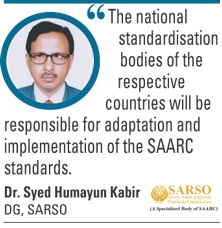
"The national standardisation bodies of the respective countries will be responsible for adaptation and implementation of the standards," he added.
Regarding the rest 17 standards, the SARSO chief said some nine standards required marginal modification. Once the modification is done, it will be declared final.
Of these, four were textile related standards -- Textile-Hessian (SARS 0009), Textile-Cotton Drill (SARS 0010), Textile-Cotton Twill (SARS 0011) and Textile-Jute twine (SARS 0012).
In the last year, SARSO formulated seven standards and finalised three, but these four remained for finalisation.
Moreover, SARSO adopted 13 ISO (International Standard Organisation) standards as SAARC standards. Of those, five are on building materials and eight on food and animal feed related different microbiological criterions.
Regarding the challenge of SAARC standard formulation, the SARSO director general pointed out the difficulties in harmonisation of the existing standards and regulations.
"When there is a difference between standard and regulation, generally regulation prevails as it is the legal binding of any country," he added.
"Thus, if any SAARC standard doesn't match with a regulation of a member country, the country may not accept the SAARC standard."
He, however, mentioned that careful review of existing standards and regulations has been done by the sectoral technical committees before formulating or harmonising any standard.
Another big challenge for implementation of the SAARC standard was lack of capacity in most of the member countries, as pointed out by Dr Kabir.
Currently, only four member countries (Bangladesh, India, Pakistan and Sri Lanka) have their accreditation boards. So, laboratories of these countries were not accredited by their respective national accreditation body.
That's why testing or standard certifications of these laboratories were not being accepted by other countries in many cases. Afghanistan, Bhutan, Maldives and Nepal do not have their accreditation boards.
At the 15th SAARC Summit held in Colombo on 2-3 August 2008, the governments of the member countries had agreed to establish the SARSO. The Agreement on the Establishment of SARSO entered into force in August, 2011. The body comes into operation in April, 2014 having the headquarters in Dhaka.
Regarding the challenge of SARSO, Mr Bipul Chatterjee, Executive Director of Jaipur-based CUTS International, said that due to resource constraints, SARSO is unable to reach out to the relevant stakeholders to popularise its mandate and show how beneficial it could be to foster regional trade.
"SARSO needs much more political push than what it is experiencing," he said while talking to the FE in Dhaka last month. "There is also not much awareness about SARSO among the business associations in South Asia."
The researcher viewed that the key determinant of trade now was the standards while tariffs no longer an issue.
"For most of the products on which South Asian countries are trading among themselves, tariffs have either gone or they are low," he added. "On the other hand, the standards, including asymmetry of information related to the application of standards, are hindering regional trade from achieving its potential."
asjadulk@gmail.com
© 2026 - All Rights with The Financial Express

