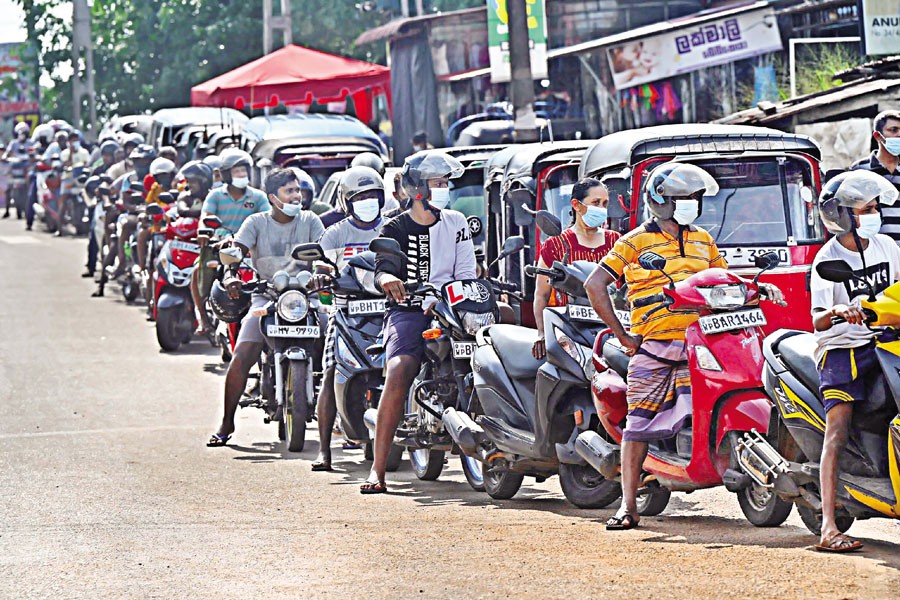
 Motorbikes and three-wheelers queue to fill their tanks up at a Ceylon Petroleum Corporation fuel station in Colombo on Tuesday — AFP
 COLOMBO/ LONDON, Apr 12 (Agencies): Sri Lanka's central bank said on Tuesday it had become "challenging and impossible" to repay external debt, as it tries to use its dwindling foreign exchange reserves to import essentials like fuel.
The island nation's reserves have slumped more than two-thirds in the past two years, as tax cuts and the COVID-19 pandemic badly hurt its tourism-dependent economy and exposed the government's debt-fuelled spending.
Street protests against shortages of fuel, power, food and medicine have gone on for more than a month.
"We need to focus on essential imports and not have to worry about servicing external debt," Central Bank of Sri Lanka's governor, P. Nandalal Weerasinghe, told reporters.
"It has come to a point that making debt payments are challenging and impossible."
Weerasinghe said the suspension of payment would be until the country came to an agreement with creditors and with the support of a loan programme with the International Monetary Fund (IMF). Sri Lanka starts formal talks with the global lender on Monday for emergency loans.
The country announced a default on its $51 billion foreign debt Tuesday.
Acute food and fuel shortages, as well as long daily electricity blackouts, have brought widespread suffering to the country's 22 million people in its most painful downturn since independence in 1948.
The government has struggled to service foreign loans and Tuesday's decision comes ahead of negotiations for an International Monetary Fund bailout aimed at preventing a more catastrophic hard default that would see Sri Lanka completely repudiate its debts.
Officials say the move will free up foreign currency to finance desperately needed food, fuel and medicine imports after months of scarce supplies.
Just under half of Sri Lanka's debt is market borrowings through international sovereign bonds, including one worth $1 billion that was maturing on July 25.
China is Sri Lanka's largest bilateral lender and owns about 10 percent of the island's foreign debt, followed by Japan and India.
The government has borrowed heavily from Beijing since 2005 for infrastructure projects, many of which became white elephants.
Sri Lanka also leased its strategic Hambantota port to a Chinese company in 2017 after it became unable to service the $1.4 billion debt from Beijing used to build it.
© 2026 - All Rights with The Financial Express

