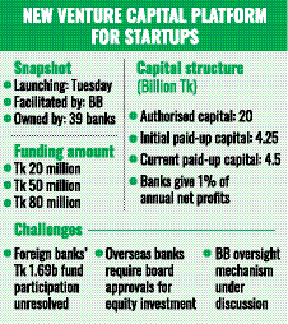
The widely-discussed Bangladesh Start-up Investment Company (BSIC), owned by 39 commercial banks, will officially be launched on Tuesday next with no concrete decision over the use of foreign bank funds.
The decision on keeping central bank representatives in the operational process for better use of the investment to facilitate promising economic ventures has not been made yet.
Under the guidance of the Bangladesh Bank (BB), the equity-backed public limited company with an initial paid-up capital of Tk 4.25 billion has been formed with contributions from 39 commercial banks to finance startups across the country, sources say.
To ensure access to equity financing for the least-focused business areas, the central bank is facilitating the company-formation process with the assistance of commercial banks, who will become shareholders of the startup venture through equity investment.
Equity investment refers to the purchase of shares or stocks in a company to become a shareholder.
By owning shares, investors gain a stake in the company's assets and profits.
Sources at the central bank say the proposed company will have authorised capital of Tk 20 billion, although it will begin operations with an initial paid-up capital of Tk 4.25 billion. The newly formed company will have a nine-member board comprising top executives from five commercial banks and four independent directors.
The board will be chaired by Mashrur Arefin, chairman of the Association of Bankers, Bangladesh (ABB), as well as managing director and chief executive officer of City Bank.
The four other commercial banks represented on the board are Eastern Bank, Mutual Trust Bank (MTB), Sonali Bank, and Pubali Bank.
Central bank officials say the banks created the fund with 1.0 per cent of their net profits for startup financing, which in most cases remains unused due to various factors.
But complexities arose over using the fund equivalent to Tk 1.69 billion of the nine foreign commercial banks operating here, as overseas banks need to get approval from their boards for equity investment, which is very complicated, they say.
Both the central bank and the company authorities are now exploring ways to use the funds of the foreign banks for startup financing, they also say.
Apart from equity funding, BB sources say, there is a refinancing scheme amounting to Tk 5.0 billion for startups, and commercial banks can avail the fund to promote such ventures.
More than 10 companies have already availed the low-cost credit, while some others are in the pipeline.
Terming the initiative timely in the current macroeconomic context, ABB Chairman Mashrur says there will be a rigorous screening and evaluation process.
Ultimately, these are investment decisions where funds will be provided as equity capital rather than loans, he says.
He also says they will primarily focus on entrepreneurs who have already validated their ideas to some extent and developed working prototypes or early-stage businesses.
Initially, proposals will be reviewed by the investment team, which will comprise both bankers with a venture capital mindset and venture capital professionals with strong global exposure, he says.
"We are eyeing big. We are eyeing taking Bangladeshi startups onto the global stage," Mashrur says.
He also says they are exploring practical and compliant structures through which foreign banks can participate more smoothly.
At present, the paid-up capital stands at approximately Tk 4.50 billion. This is expected to increase every year as shareholder banks will contribute an additional 1.0 per cent of their annual net profits, he says.
He says by the end of 2026, they expect the capital base to reach around Tk 7.0 billion, particularly if foreign banks join under special participation structures.
Regarding the Bangladesh Bank's inclusion in the monitoring activities, he says since BSIC is not legally a commercial bank under the BB's direct regulatory purview, they are exploring appropriate mechanisms through which some form of supervisory or audit-related oversight by the central bank may be incorporated.
When contacted, Chief Executive Officer of Standard Chartered Bank Naser Ezaz Bijoy says foreign banks are, at this point, in discussion with the banking regulator about the engagement model to support start-up initiatives.
Welcoming the development, Shahir Chowdhury, founder and CEO of Shikho, says the creation of a new venture fund backed by 1.0 per cent of bank profits is one of the most important steps to create momentum in the local startup ecosystem.
He says the country's startup funding largely depends on foreign capital.
If local investors come up to nurture promising economic ventures here, foreign funding entities will get encouraged further to finance startups, he also says.
"I am very hopeful about the company," he adds.
According to sources, startup operators aged over 21 will be eligible to receive funding in three categories: Tk 20 million, Tk 50 million, and Tk 80 million.
jubairfe1980@gmail.com
© 2026 - All Rights with The Financial Express

