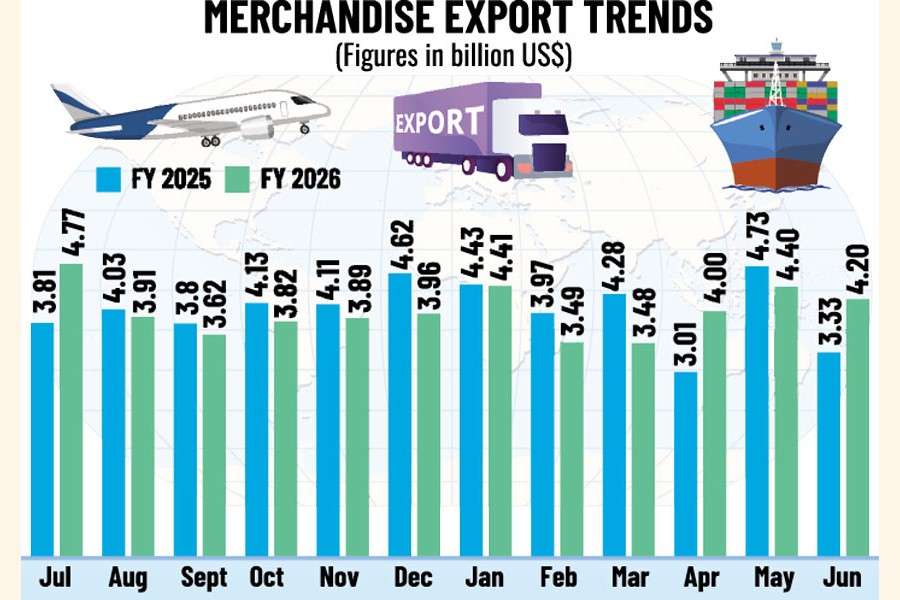
The country's merchandise export earnings in June 2026 bounced back, posting about 26 per cent growth year-on-year after almost a continuous decline until May of the last fiscal year.
However, the June performance failed to take overall earnings into the positive territory which recorded a meager 0.58 per cent negative growth to fetch US$48.0 billion in the just concluded fiscal year against US$48.28 billion in fiscal 2024-25.
In June 2026, Bangladesh received US$4.20 billion in export earnings against US$3.33 billion in June 2025, according to Export Promotion Bureau (EPB) data released Thursday.
Exports slipped into a year-on-year negative growth in August 2025, when the country recorded a 2.93-percent fall.
The climb-down was followed by a decline of 4.61 per cent, 7.43 per cent, 5.58 per cent, 14.25 per cent, 0.50 per cent, 12.03 per cent, 18.07 per cent and 7.07 per cent in September, October, November, December, January, February, March and May respectively.
However, the export receipts grew by 24 per cent and 32 per cent last July and April respectively.
Of the total June earnings, readymade garments fetched $3.38 billion, logging a 21.52-percent growth over $2.78 billion earned in the same month of 2025, the EPB data reveal.
As usual, readymade garments or RMG maintained its lead position, contributing $38.70 billion--notwithstanding a 1.64-percent negative growth--to the total export earnings in the past fiscal year of 2025-26.
Within this clothing segment, knitwear exports fell by 2.53 per cent to $20.62 billion, while that of woven garments declined by 0.61 per cent to $18.07 billion.
Asked about the latest trade situation, Mahmud Hasan Khan, president of Bangladesh Garment Manufacturers and Exporters Association (BGMEA), has said woven demonstrated greater stability than knitwear throughout the year.
"While the June growth figure appears striking, the actual export value remained close to the monthly average," he says, attributing this sharp uptick to a weak base effect.
In June 2025, there was a 10-day Eid-ul-Adha holiday which caused the earnings to slump to US$ 2.78 billion, he mentions, welcoming last month's performance as a recovery to normalcy rather than a structural breakthrough.
The overall annual decline, however, underscores the sector's persistent struggles, the BGMEA chief notes, adding that externally, US tariff uncertainties have disrupted sourcing patterns and industry's capacity planning, while China's redirected exports toward the European Union have intensified regional price competition.
At the same time, India and Vietnam continue to leverage their respective free-trade agreements with the EU, eroding Bangladesh's competitive edge in key markets.
On the domestic front, Mr Khan blames energy crisis, particularly an acute gas shortage, which has dealt a severe blow to the industry, forcing factories to operate well below optimal capacity, undermining efficiency and deepening financial distress.
Capital-machinery imports in the garment and textile sectors declined by 14.38 per cent and 29.19 per cent respectively during July-to-March period of 2025-26, signaling a worrying slowdown in capacity expansion, he notes.
The cost of doing business has also escalated alarmingly, with bank interest rates hovering above 14 per cent to 15 per cent, recurrent electricity tariff hikes, and the compounding burden of annual wage increments.
"These combined pressures have left many manufacturers in a precarious position, with a significant number already forced to shut down," the BGMEA president says, adding that the broader trajectory highlights an urgent need for structural reforms, particularly in energy, finance, logistics, and trade policy, to safeguard Bangladesh's position in an increasingly challenging global market.
Echoing BGMEA president's view, Fazlee Shamim Ehsan, executive president of Bangladesh Knitwear Manufacturers and Exporters Association (BKMEA), says factories had significantly more working days in June 2026 than June 2025 rather than higher export orders.
He attributes garment-exports decline to weak global demand and insufficient pricing from buyers despite significant increases (9.0 per cent) in wages, yarn (10 per cent), dyes and chemicals (15 per cent to 50 per cent) and energy and other production costs.
"As a result, many factories incurred losses or closed, which also contributed to the country's overall negative export performance," he says.
According to product-wise data, earnings from home-textile exports increased by 6.42 per cent to $928.42 million in fiscal 2025-26, up from $871.57 million in the fiscal 2024-25.
Leather and leather products fetched $1.22 billion, reflecting a 7.09-percent year-on-year rise.
The export receipts from the agricultural sector saw a 1.34-percent negative growth to $975.39 million.
Jute and jute goods fetched $883.69 million, up by 7.75 per cent year on year.
Export receipts from frozen and live fishes registered a slight increase to $443.42 million in the just-concluded fiscal year, 2025-26.
Pharmaceutical exports also grew by 11.88 per cent to $238.49 million in the last fiscal.
Munni_fe@yahoo.com
© 2026 - All Rights with The Financial Express

