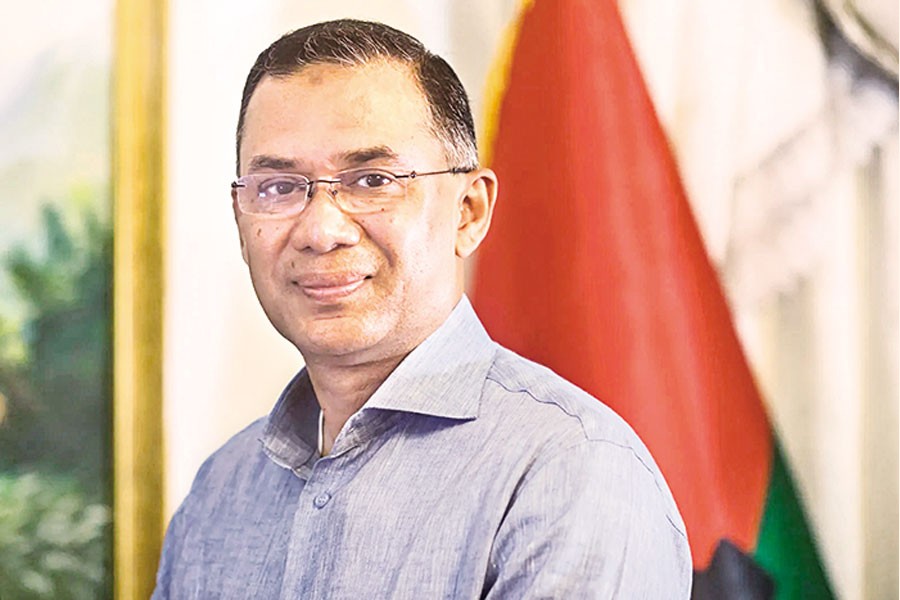
 Tarique Rahman
 Prime Minister Tarique Rahman has outlined package measures aimed at raising Bangladesh's lowly tax-to-GDP ratio up to 10 per cent in next five years.
The dos he lists include stronger legal action against tax-dodging, expanded digitisation of tax administration and gradual rationalisation of tax exemptions.
He also expresses confidence that the country would be able to raise its tax-GDP ratio to 15 per cent by 2035.
The prime minister disclosed the plans in a written reply to a question from Md. Abdullah, Member of Parliament from Munshiganj-1, during the ninth sitting of the second session of the 13th Jatiya Sangsad on Wednesday. The response was tabled in parliament.
In his question, the MP notes that Bangladesh's tax-GDP ratio stood between 7.3 per cent and 8.0 per cent in the fiscal year 2024-25, significantly lower than Nepal's approximately 23.1 per cent despite Nepal having a much smaller economy. He sought to know whether the government had any plans to address the issue.
In response, Prime Minister Tarique Rahman says the government has already undertaken a range of initiatives to enhance domestic revenue mobilisation and improve the tax-GDP ratio.
He mentions that the National Board of Revenue (NBR) has adopted a Medium and Long-Term Revenue Strategy (MLTRS) to guide revenue reforms and strengthen tax administration.
The prime minister highlights several ongoing measures, including end-to-end digitisation of tax operations, expansion of online tax-withholding systems, reduction in unnecessary tax exemptions and incentives, simplification of tax laws, and enhanced data analysis to identify tax risks.
The government is also strengthening risk-based audits and investigations using sector-specific benchmark indicators, while taking steps to enrich and expand the taxpayer database.
"The government has introduced AI-based online services for taxpayers and undertaken awareness programmes to encourage compliance with tax laws," the prime minister says. "Effective legal measures are also being taken against tax evasion."
Outlining the government's medium- and long-term strategies, Tarique Rahman says initiatives have been undertaken to formulate and implement the Tax Expenditure Policy and Management Framework 2026, with the objective of reducing tax expenditure as much as possible.
He adds that efforts are being intensified to generate additional revenue through post-clearance audits, settlement of outstanding cases and arrears, auctions, encashment of bank guarantees, disposal of pending consignments, and collection of deferred payments.
The prime minister also notes that the government plans to gradually implement the National Tariff Policy 2023 and the Customs Strategic Plan 2024-2028 as part of broader revenue reforms.
"With the successful implementation of these plans, we expect to raise the tax-to-GDP ratio to 10 per cent within the next five years," he says in his written reply.
He further states that the government has adopted a longer-term target of increasing the ratio to 15 per cent by 2035.
To achieve that goal, the government has launched several initiatives, including the implementation of the Strengthening Domestic Revenue Mobilisation Project and gradual rationalisation of tax exemptions and concessions.
mirmostafiz@yahoo.com
© 2026 - All Rights with The Financial Express

