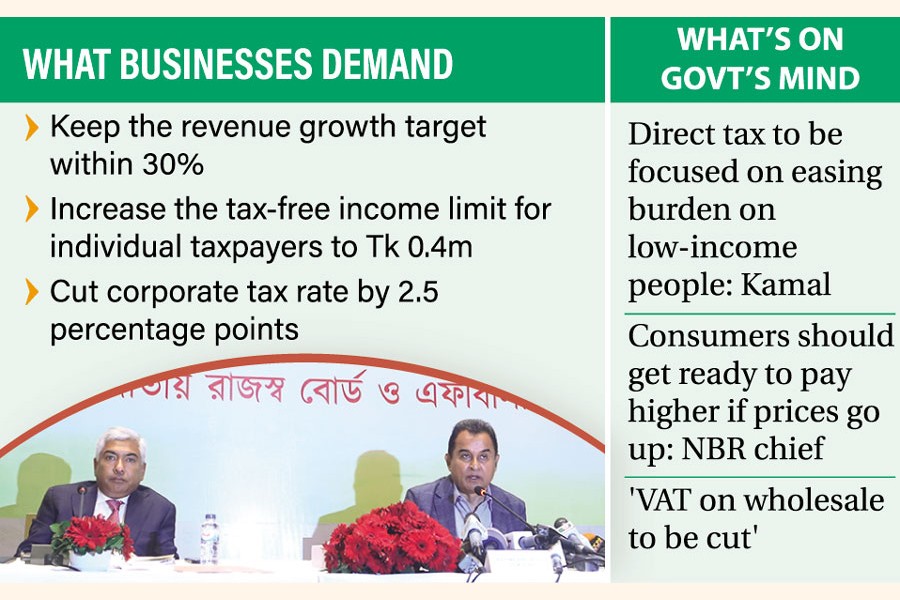
Fiscal measures for the upcoming budget are being framed to ensure a "win-win" situation between government and private sector, Finance Minister AHM Mustofa Kamal assures businesses.
The assurance from the government side came Tuesday at the 42nd budget consultative committee meeting at a hotel in Dhaka, where Bangladesh's apex trade body placed a package demand highlighting tax cutbacks as a way of taming the overheated market of essentials as well as changes in taxation policy.
Businesses will not be deprived of anything in the upcoming budget, the finance minister asserted during the budget discussion, in the wake of fallout from the Covid-19 pandemic coupled with the raging Russia-Ukraine war-both hurting economic rebound here and the world over and stoking commodity prices.
"We would frame tax measures without hurting the businesses. The government would consider tax-related issues pragmatically," the finance minister told his business audience.
Businesses, traders and association leaders from across the country attended the meeting jointly organized by the National Board of Revenue (NBR) and the Federation of Bangladesh Chambers of Commerce and Industry (FBCCI).
The finance minister attended the meeting as chief guest while NBR chairman Abu Hena Md Rahmatul MUneem presided the meeting. FBCCI president Md Jasim Uddin moderated the programme.
It is the largest pre-budget meeting held every year before national budget to discuss the new fiscal measures with the stakeholders.
The minister said businesses are welcomed to discuss their proposals as many times as they want.
He also suggests businesses not to pay bribe or speed money as it is also considered a crime.
The finance minister said during the last two years, tax-collection growth has been lagging behind the pace of economic growth.
"We need cooperation of businesses. Direct tax collection would be focused more to ease tax burden on low-income people," he adds.
The NBR chairman admits that sometimes honest taxpayers face pressure while taxmen launch drive to ensure compliance.
However, it would not persist for long after tax culture develops.
He notes that tax adjustments have little influence in controlling prices of commodities when prices are surging on the global market.
"Consumers should have also preparation to purchase at higher prices if prices go up internally," he says.
"I wonder why businesses are concerned over VAT. It is a consumer tax," he remarks at the meeting with the business community's highest forum that placed a 15-page recommendation that highlights tax cutbacks for taming inflation and also taxation-policy recast.
The NBR chairman said pressure of VAT on wholesale level has to be revised downward and the revenue board is working on it.
CUT IMPORT DUTY TO CHECK INFLATION: At the meeting, country's apex trade-body also proposed to waive import duty of essential commodities proportionately to control inflationary pressure in the upcoming national budget for the next fiscal year (FY23).
The apex chamber considered the coronavirus pandemic-induced shocks, the surge of commodity prices in international and local markets, and the Russia-Ukraine war in making its budget proposals.
Placing a 15-page set of recommendations, FBCCI President Md. Jashim Uddin said the exchange rate of dollar keeps increasing along with the global prices of almost all commodities.
Simultaneously, transaction charges, like - shipping cost, are growing alarmingly, and the growing cost is making controlling the inflation rate more difficult, he also said.
"It (the growing cost) creates pressure on general consumers. The skyrocketing prices of commodities are feared to affect the economic and business activities here."
To overcome the situation, the FBCCI president suggested limiting the revenue growth target within 30 per cent in the upcoming national budget.
"We also proposed to waive the import duty of essential commodities proportionately against the projected import duty in the coming budget."
Mr. Jashim Uddin also recommended expanding the bonded warehouse facility to all export-oriented sectors by gradually removing the incentive mechanism by 2026, which is inconsistent with the World Trade Organisation (WTO) policies.
He proposed raising the tax-free income limit for individual taxpayers to Tk 0.4 million from the existing Tk 0.3 million, considering living cost, inflation, and overall economic situation.
The FBCCI president also requested the government to keep the existing loans unclassified until June 30 of this year, considering the Covid-19 shocks, the Russia-Ukraine war, and growing business expenses.
Arman Haque, Acting President of the Dhaka Chamber of Commerce and Industry (DCCI), proposed lowering the corporate tax rate for listed and non-listed companies by 2.5 percentage points in the next fiscal.
Suggesting widening the tax net further, he said the revenue board should undertake an ambitious plan for taking the number of TIN (tax identification number) holders to 10 million in the next 10 years.
"It means, the authorities will need to include 0.8 million new TIN-holders annually. For that, the NBR will require huge resources in the coming days."
Mr. Haque, also senior vice president of the chamber, also opined that an integrated VAT and tax administration system needs to be implemented to establish a hassle-free and healthy tax culture.
Adeeb Hossain Khan of the Metropolitan Chamber of Commerce and Industry, Dhaka (MCCI) said the TDS (tax deducted at source) rate is much high here, which creates a burden for the businesses.
He noted that the companies which intend to expand their business by bringing foreign technologies and knowhow (to the country) are subjected to pay another 20 per cent of TDS.
"And the companies have to bear the expenses. How much tax will the honest taxpayers pay?"
Terming withholding VAT a totally disrupted element in the VAT system, he opined that the service providers pay VAT while delivering their services. The revenue officials charge VAT again when the customers pay money to the suppliers, and the adjustment is a very complicated process.
"So, pressure on the honest businesspeople keeps mounting. Please lower the TDS rate and bring back the withholding VAT to the previous state," he added.
Anwar-ul Alam Chowdhury, President of the Bangladesh Chamber of Industries (BCI), said there was allocation for young entrepreneurs in the national budget. But they could not get it in absence of required policy guidelines.
Mohammad Ali Khokon, President of the Bangladesh Textile Mills Association (BTMA), recommended providing the same tax facilities to manmade fibre like the authorities provide to natural fibre.
Mohammad Hatem, Executive President of the Bangladesh Knitwear Manufacturers and Exporters Association (BKMEA), suggested raising the volume of incentive for the sector in the coming budget.
doulot_akter@yahoo.com
jubairfe1980@gmail.com
© 2026 - All Rights with The Financial Express

