Apparel exporters are accelerating investment in advanced technologies to modernise production, raise productivity and strengthen long-term sustainability and global competitiveness Bangladesh's ready-made garment (RMG) industry in the fast-changing economic milieus.
From automation and robotics to AI-driven inspection and renewable energy, the industry is undergoing a quiet, but significant, transformation that minimizes manual work.
Industry insiders say the shift is being driven by rising compliance requirements in key export markets, tighter sustainability standards set by global brands, and the need to control costs in an increasingly competitive environment.
These trends were evident at Garment Technology Bangladesh (GTB) 2026, the country's largest garment-technology exhibition.
Entrepreneurs and technology suppliers shared their views with The Financial Express on the sidelines of the four-day event that began in the city last Wednesday.
President of BGAPMEA Md Shahriar said apparel manufacturers were increasingly aligning production processes with the sustainability targets of global brands and buyers.
"As a result, many factories are investing heavily in energy-efficient and automated technologies, including robotics and RFID system, to cut emissions, improve energy efficiency and boost productivity."
Referring to his own company, Mr Shahriar said two factories had recently been relocated to the firm's industrial park in Dhamrai, on the outskirts of the capital, Dhaka.
The facilities are housed in LEED-certified buildings and equipped with solar panels to expand the use of renewable energy and reduce carbon emissions.
Technology adoption is also transforming inventory and logistics management.
Managing director of r-pac (Bangladesh) Limited Imtiaz Ahmed Kamiss said his company introduced a scanning-based inventory -management solution in 2024 to help RMG exporters reduce shipment errors and avoid unnecessary costs.
So far, 34 companies, including Fakir Group, Pioneer Group and Palmal Group, have adopted the system.
Mr Kamiss also highlighted a newer application using RFID chips embedded in fan T-shirts for sports teams. The technology allows brands to share team videos and activities directly with fans, enhancing engagement.
He notes that Bangladesh has strong potential to use this technology, given its large-scale production of fan apparel for international sporting events, while countries such as Vietnam and China have already adopted similar solutions.
General Manager of AUTOMAC Technology Ltd Md Shofiqur Rahman says his company has introduced advanced automatic fabrics-cutting machines, with the latest models featuring built-in repeat-cutting facilities that significantly reduce processing time.
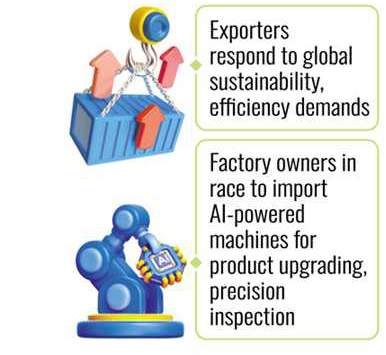
At the textile level, robotics and artificial intelligence are gaining ground despite higher upfront costs.
Kutubuddin Ahmed, founder-chairman of Envoy Textiles, the world's first LEED-certified denim mill, says the company has long used robotic machinery to improve efficiency, competitiveness and product quality.
"Envoy is now in discussion to import AI-driven technologies to enhance transparency across production lines," he told the FE.
Similarly, says Fazlee Shamim Ehsan, CEO of Fatullah Apparels Ltd, the company is importing an AI-enabled automatic cutting machine costing around $0.2 million to optimise fabrics usage and reduce waste.
The firm is also set to install an AI-driven fabrics- inspection machine from China, priced about $0.05 million, which will use sensors to ensure faster and more accurate quality control, replacing manual inspection processes.
newsmanjasi@gmail.com
© 2026 - All Rights with The Financial Express

