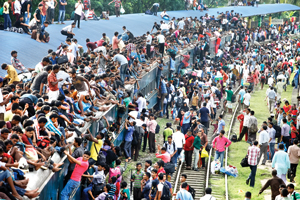
 HOME, SWEET HOME: Numerous people journeying on the rooftop of a train risking their lives with the hope of celebrating the Eid-ul-Fitr with their near and dear ones back home. The photo was taken from Airport Railway Station Sunday. — FE Photo by Shafiqu
A section of transport operators capitalised on the rush of home-bound people Sunday, as they carried the passengers on rooftops putting thousands of lives at risk.
The city's train, bus and launch terminals saw a rush of the homebound people on the day, as it was the last working day before the Eid-ul-Fitr that might be observed on Tuesday or Wednesday.
However, the passengers at the city's terminals had to wait for one to four hours before leaving for home to reunite with their family members because of non-availability of adequate transports.
Overcrowded buses, trains and ferries were making trips between the capital and other major cities and towns of the country putting the lives of passengers at risk. Most transport owners allowed the rooftop journey defying the government prohibition.
The government in 2010 banned carrying passengers on rooftops during any such festival to avert accidents like those that occurred on several occasions in the past.
While visiting the Mohakhali, Gabtoli and Sayedabad bus stations, the Kamalapur Railway Station and the Sadarghat Launch Terminal it was found that unscrupulous transport owners were not paying any heed to safety concerns.
The transport owners were doing the unethical practices under the nose of the law-enforcers. Passengers said they were undertaking perilous journey due to the shortage of tickets and transports.
"It has become a common practice for the transport owners. They do it only to earn extra money," said garment worker Sirajuddin, who obtained the permission to travel on the rooftop of a Joypurhat-bound bus by paying Tk 250.
When contacted, a member of the vigilance team at the Gabtoli Bus Station refuted the allegation that passengers were travelling on rooftops journey, saying that every bus was being monitored before departure from the station.
But bus employees applied a new trick. They were allowing the passengers to travel on rooftops after the buses' departure from the terminals to dodge the eyes of the vigilance teams deployed at those stations.
"Many people, especially the lower income group, will not be able to celebrate the Eid with families in their villages, if we do not allow passengers on rooftops," Mohammad Ripon, helper of a Kurigram-bound bus, said.
The scenario was almost same in the Kamalapur Railway Station (KRS) and the Mohakhali Bus Station.
Hundreds of home-goers, who failed to manage tickets, were seen rushing towards trains only to manage seats on the rooftops.
Seizing the opportunity of the rush of passengers, a section of railway employees were seen allowing passengers to travel on rooftops in exchange for kickbacks.
The Rajshahi-bound Dhomketo Express, Chittagong-bound Mohanagar Provati and Chapainawabganj-bound Rajshahi Express left three, two and three hours behind the schedule respectively.
On the other hand, the Rajshahi-bound Silkcity Express failed to reach the platform even three and a half hours after the scheduled departure time.
Bangladesh Railway Director General Tafazzal Hossain admitted the fact that the trains were making delayed trips. The delay was caused as the passengers took time to board and get down from the trains.
"But the situation improved remarkably this time from that we experienced during the last Eid," he said.
Station Manager at the KRS Khairul Bashir told the FE that excepting few trains, maximum number of trains departed on schedule.
About the rooftop journey, he said the country's existing transportation system does not have the capacity to tackle the rush of passengers during the Eid.
According to the Bangladesh Railway statistics, a total of 65 pairs of trains carry 60,000 passengers a day during the Eid days.
However, the current traffic situation on the country's major highways brought some sort of relief to the holidaymakers as no severe traffic congestion was reported till filing of the report.
Talking to the FE, Deputy Inspector General (Highway Police) Asaduzzaman Miah said they had so far managed to make the highways vibrant round the clock thanks to the concerted efforts of highway and district police in association with the community police and transport operators and workers.
"We face difficulties at the country's key road intersections like Chandra, Gazipur Chowrasta, Bhulta, Daulatdia and Paturia. At those points gridlock is caused by the heavy pressure of transports," he said.
© 2026 - All Rights with The Financial Express

