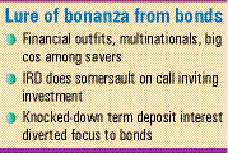
A large number of country's well-structured firms are being forced to withdraw their investments in bonds without yields, leaving savers in hot water, competent sources said.
A circular issued lately by the internal resource division (IRD) blocked the floodgates as it said gratuity money "cannot, by any means, be invested in bonds".
In a double-bind the prohibitive order further said those who invested are to take back the principal sans any return on the money.
An estimated amount of around Tk 4.0 billion had been invested in different types of bonds by the firms, mostly financial institutions, multinationals and leading local companies.
People familiar with the bond market told the FE that gratuity cannot be invested, anyway, but in 2007 there was a misleading explanation on the issue.
The then chief of the IRD had asked country's firms to invest in bonds, yielding mass investment of gratuity money in bonds managed by the national directorate of savings (NSD).
Gratuity is a benefit given by the well-structured firms to their respective blue-and white-collar job holders on retirement.
Ms Rupali Chowdhury, president of the Foreign Investors Chamber of Commerce and Industry (FICCI), expressed deep dismay over the latest developments on the financial front.
She in a recent luncheon meeting with Finance Minister AMA Muhith said this would affect many firms.
Ms Chowdhury, also managing director of Berger Bangladesh, urged the government to take a remedial step on the matter.
The firms mostly invested in two bonds: 5-year bond and investment bond.
The yields on the investment in the bonds on maturity are around 12 per cent.
A finance official working with a large company told the FE that this would inflict losses on his company.
"I've invested Tk 100 million three years back and now I won't get anything excepting the principal amount," he said.
He said they had specific plans with the returns on the investment "for the betterment of the employees".
On the other hand, there are some fortunate companies who had taken back principal and interests both on maturity.
Abdul Gani, a retired official of the central bank, who had worked on the bond market for long, told the FE that this was "simply a misleading explanation" by the authorities concerned.
He hinted that the NSD once did it to raise the sales of bonds.
An accounts official at a commercial bank told the FE that the NSD had "bluffed" them into giving "false" space for investment through a misleading explanation.
Sources in the know of things told the FE that the government prohibited investment of gratuity in the bonds mainly for development of equity market.
They said the bonds are especially for charity and similar outfits when it comes to institutional investment.
However, a number of people involved with the matter think that this would help reduce overall burden on government in terms of payment of interest.
The net sales of NSD-sponsored bonds remained all-time high this fiscal year -- obviously as a deposit gains dwindled for deeper cuts in interest.
Experts are of the view that the net sales of NSD bonds have leapt up rapidly in recent times following sharp differences between yields from the time deposits and the investments in bonds.
jasimharoon@yahoo.com
© 2026 - All Rights with The Financial Express

