Turning an estimated deficit of US$3.5 billion in Bangladesh's financial account into a surplus of over as much at next fiscal yearend is being seen by economists as "unrealistic", as crises persist.
Such optimism underpins the latest monetary policy statement (MPS) unveiled on June 18 last by Bangladesh Bank, which the economists take with a grain of salt in view of the country's stressed macroeconomic parameters.
They believe the outlook prepared by the central bank of Bangladesh is not feasible and is ambitious as confidence of the overseas banks in Singapore, Hong Kong and even India in the country's financial system has been "weakened".
The erosion in confidence occurs as there were "many undue payments and delays in settling obligations", the critics point out.
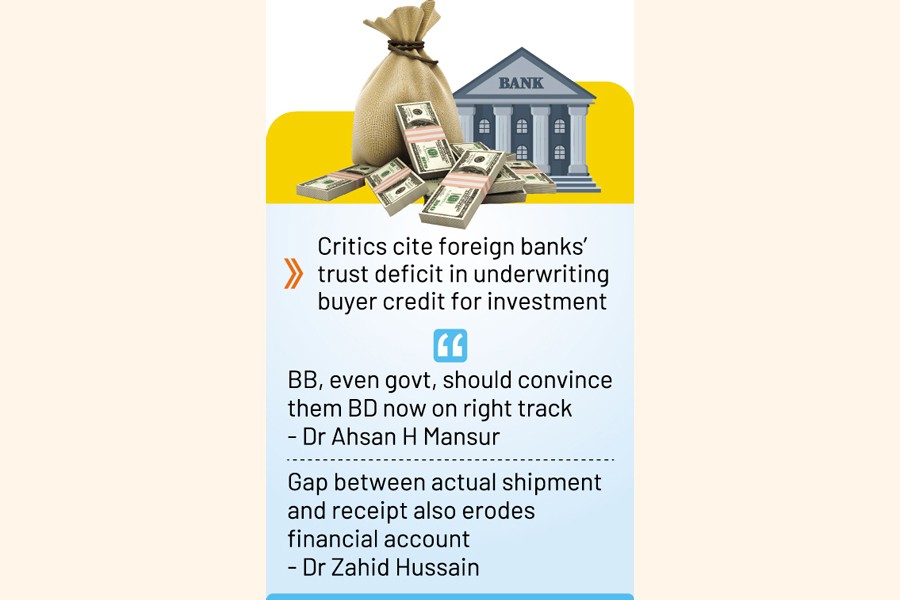
Dr Ahsan H. Mansur, executive director of the Policy Research Institute of Bangladesh or PRI, told the FE that the foreign banks "have lost confidence".
He suggests now it is for the central bank to convince them that Bangladesh is now on the right track.
"Such assurance may bear some fruits," he says, adding that even such assurance may come from government level.
Dr Mansur adds: "This is the right time to convince them. Otherwise, the deficit in the financial account will worsen further at the end of the FY 2024."
Bangladesh Bank governor Abdur Rouf Talukder, unveiling the MPS at a press conference on June 18, struck an upbeat note that the financial account would have a turnaround with foreign direct investment (FDI) getting a boost in the next fiscal year.
He also mentioned a huge aid commitment that remained in the pipeline for long and so the outlook in terms of the financial account is right, not ambitious.
Financial account is a key component of the balance of payments (BoP). the financial account records all transactions associated with changes of ownership in foreign financial assets and liabilities.
The financial account is classified, firstly, mainly by four functional categories: (a) direct investment (b) portfolio investment (c) other investment and (d) reserve assets, secondly, by direction of investment (assets and liabilities) and thirdly, by the instrument of investment (equity, bonds and notes, loans etc).
Dr Zahid Hussain, former lead economist at the World Bank's Dhaka office, rates the outlook as "too ambitious".
He thinks this is not possible mathematically when the state of GDP growth, national savings, and national investments is considered.
He mentioned that attracting new foreign investment amid Moody's downgrade is very hard.
He also mentions that those foreign banks that used to provide support with buyer credit are not showing interest following "erosion of confidence".
"There is another possible reason for such deterioration in the financial account in recent times-the gap between the actual shipment and its corresponding receipt."
However, the BB has projected that the overall BoP surplus will stand at $1.5 billion at the end of FY 2024 from a deficit of $8.7 billion in FY 2023.
The current-account-deficit outlook for FY 2024 is $2.7 billion in a reduction from $4.0 billion in the outgoing fiscal (FY 2023).
The capital-account surplus will increase by $20 million to $400 million in FY 2024, according to the Bangladesh Bank Outlook
jasimharoon@yahoo.com
© 2026 - All Rights with The Financial Express

