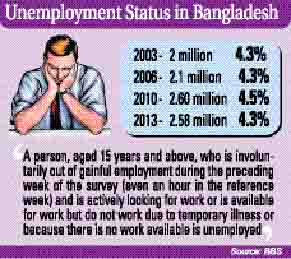
Bangladesh's unemployment rate has dropped to 4.3 per cent, according to the latest Labour Force survey.
In the 2010, it was 4.5 per cent.
The figure has been prepared by the Bangladesh Bureau of Statistics (BBS), the country's national statistical organisation.
The BBS conducted the survey called Labour Force Survey-2013 on extensive and representative samples numbering 36,000 across the country.
However, the statistical organisation will release the findings of its latest survey on the country's labour force sometime this month or early next month.
The latest survey has revealed that the country's total unemployed persons stood at 2.58 million (2,580,000) in 2013 against 2.60 million (260,000) in 2010.
However, employed persons in the economy stood at 58 million, with 4.0 million new jobs created in three years ending in 2013 from 2010.
Officials, familiar with the survey, said the trend of labour force is that they (labour force) are moving towards the service sector from agriculture.
The latest survey found that the service sector employed more than 35 per cent of the labour force in 2013, nearly 10 per cent higher than that of 2010.
In the latest survey, agriculture labour force is still dominating at 45 per cent. It was earlier at more than 47 per cent.
On the other hand, people not categorised either as employed or unemployed include housewives, students and elderly persons.
However, the 4.3 per cent unemployment rate in the economy is not new.
In the previous two surveys other than that of 2010, the unemployment rate was also 4.3 per cent.
Economists say the growth in jobs is a positive sign for the overall economy amid many hurdles facing Bangladesh's US$153 billion economy.
They argued the improved employment picture was the result of a steady growth of the GDP in the period under review.
Dr Zahid Hussain, lead economist at the World Bank's (WB) Dhaka office, said the GDP growth was stable in 2011, 2012 and 2013 that helped raise growth of jobs in the economy.
He said migration of people from the country to Middle East or other destinations has also helped shrink the size of available labour force in the country leading to ultimate fall in the rate of unemployment.
Dr Hussain has identified another major reason for fast shrinking of working population in the society that ranges between the age groups of 16 and 59.
He said the population growth has been falling since 1990s that was at its peak in the 1970s leading to the fall in the working age population.
"Adequate surplus of available labour force is not seen now as it was earlier," he said.
He said the growth in the working population is around 2.0 per cent that was even 3.0 per cent a few decades back.
"In my view, slow growth in the working population ages is also contributing to reduction of the size of the active labour force," Dr. Hussain, who works in the WB's macro and fiscal management wing, told the FE.
Towfiqul Islam Khan, research fellow at the country's private think-tank Centre for Policy Dialogue (CPD) said the definition of employment by the ILO is 'weak'. He said there is a large incidence of unemployment and underemployment in the economy.
According to the ILO, a person who works at least two hours a week is considered as employed in the society.
This includes even unpaid family workers who work at least two hours in a week.
The CPD researcher said there is around one-fourth of the total working force remaining in the underemployment zone, who gives labour at much cheaper rates than their expectation.
Mr Khan, who works on employment affairs, said Bangladesh now needs to turn its surplus labour force available in the agriculture sector into other productive sectors.
The labour force survey is funded by the Geneva-based UN Agency International Labour Organisation (ILO).
Jasimharoon@yahoo.com
© 2026 - All Rights with The Financial Express

