Concern over availability of urea during the upcoming Aman-cultivation season has intensified, as the state-run Bangladesh Chemical Industries Corporation (BCIC) struggles to secure sufficient imports amid the Middle East crisis and several local fertiliser factories remained shut due to gas shortage.
Although Bangladesh has adequate non-urea fertiliser stocks for the next few months, the BCIC currently has only around 0.35 million tonnes of urea in reserve, which is expected to meet demand only until June.
According to the Department of Agricultural Extension (DAE), the country will require at least another 0.66 million tonnes of urea during the Aman season between July and September. Aman contributes around 38-40 per cent of the country's total rice output.
Officials said BCIC has so far failed to secure major urea imports since the Middle East conflict disrupted shipping through the Strait of Hormuz.
However, BCIC officials claim the situation may still remain manageable as three local fertiliser factories resumed operations earlier this month, while several shipments from Saudi Arabia, Egypt and Russia have been confirmed.
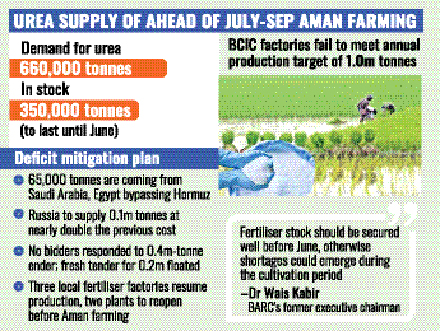
Under government policy, Bangladesh is required to maintain a safety stock of at least 0.4 million tonnes of urea at all times. But BCIC has repeatedly failed to maintain such reserves in recent years.
The corporation has also long relied on keeping factories shut for extended periods, largely due to gas shortages, resulting in continued failure to produce its annual target of 1.0 million tonnes of urea locally.
As a result, Bangladesh remains heavily dependent on imports from Saudi Arabia, the United Arab Emirates and Qatar to meet its annual demand of 2.6-2.8 million tonnes.
The situation worsened further after BCIC failed to attract adequate supplier response despite floating international tenders for urea imports.
BCIC sources said the corporation began searching for alternative suppliers after Middle Eastern countries failed to deliver fertiliser under existing agreements.
An official said BCIC floated two international tenders on March 25 and April 1 for importing a combined 0.4 million tonnes of urea. However, one tender received no bids, while the other secured only a partial offer for 25,000 tonnes. Later, on April 27, BCIC floated another tender for 0.2 million tonnes.
He said suppliers were reluctant to sign contracts because of uncertainty surrounding shipping through Hormuz, while some also raised concerns over certain tender conditions.
Former executive chairman of the Bangladesh Agricultural Research Council (BARC) Dr Wais Kabir warned that the Aman season could still face fertiliser supply pressure if the Hormuz crisis continues and alternative imports fail to arrive on time.
He noted that imported fertiliser shipments usually take one to one-and-a-half months to arrive and sometimes even longer.
"Fertiliser stock should be secured well before June, otherwise shortages could emerge during the cultivation period," he said.
A BCIC official said concerns over Aman-season supply are gradually easing as two shipments totalling around 65,000 tonnes of urea from Saudi Arabia and Egypt have been confirmed under government-to-government arrangements.
"These shipments will arrive through alternative sea routes bypassing Hormuz and are expected this month," he said.
At the same time, negotiations are at the final stage for importing another 0.1 million tonnes of urea from Russia, which may enter the country's supply chain next month, he added.
The official said while Saudi urea would be supplied at previously agreed prices, fertiliser from Russia would have to be purchased at prevailing international market rates, which have surged to above US$870 per tonne.
Before the conflict, international urea prices averaged around $450 per tonne. Officials said prices are unlikely to ease unless tensions in the Middle East subside, as the Hormuz disruption has tightened global supply.
Meanwhile, the agriculture ministry said the government has sufficient non-urea fertiliser stocks to continue supply until October.
At present, the government has around 1.2 million tonnes of non-urea fertiliser in reserve, including 0.39 million tonnes of TSP, 0.47 million tonnes of DAP and 0.29 million tonnes of MOP.
BCIC Chairman Md Fazlur Rahman said urea shipments from Saudi Arabia and Egypt under government-to-government agreements are scheduled to arrive this month.
The Saudi shipment will come from Yanbu Port without passing through Hormuz, while the Egyptian shipment will also avoid the strait, he said.
He added that negotiations with Russia for a 0.1 million-tonne deal are now at the final stage, and the shipment is expected to enter Bangladesh's supply chain by the end of next month.
Mr Rahman also said three fertiliser factories are already operational and the remaining plants may reopen before the Aman season begins.
Jointly owned Karnaphuli Fertilizer Company Limited (KAFCO), Shahjalal Fertilizer Company Limited and the Ghorashal-Polash Fertilizer Plant resumed operations this month.
The remaining three factories -- Jamuna Fertilizer Company Limited, Chittagong Urea Fertilizer Limited and Ashuganj Fertilizer and Chemical Company Limited -- are still closed.
Except for Ashuganj, the government plans to reopen the other two factories by late June or July, according to BCIC sources.
tonmoy.wardad@gmail.com
© 2026 - All Rights with The Financial Express

