Trade ties between Bangladesh and the United States strengthened notably in 2025, with Washington temporarily overtaking India to become Dhaka's second-largest trading partner during several months of the year.
While China and India continue to dominate Bangladesh's trade landscape, the shift highlights evolving dynamics driven by changing import patterns, policy shifts and rising demand for key goods from the US.
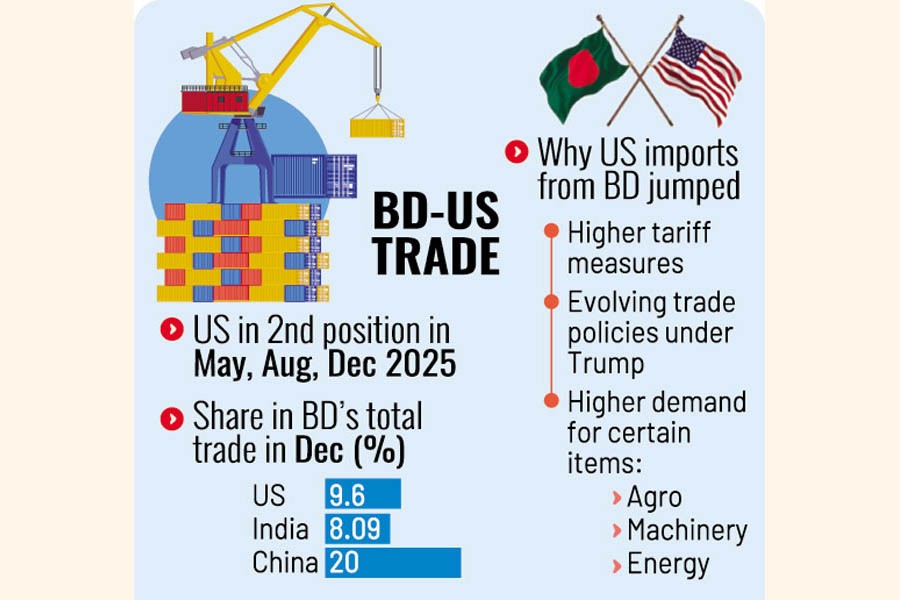
According to trade data released by the Bangladesh Bureau of Statistics (BBS), the US climbed to the second position in May, August and December 2025, reflecting a surge in Bangladeshi imports from the world's largest economy.
In December alone, the US accounted for 9.6 per cent of Bangladesh's total trade, edging past India, whose share slipped to 8.09 per cent during the month.
China, however, maintained its lead with close to a 20 per cent market share.
Economists say the development reflects less of a structural shift and more of a cyclical adjustment driven by policy and pricing factors.
Higher tariff measures and evolving trade policies under the administration of President Donald Trump, combined with Bangladesh's increased demand for certain imports - particularly agricultural commodities, machinery and energy-related products - contributed to the spike.
"Trade rankings can change when import volumes fluctuate significantly," said Dr Zahid Hussain, an independent economist.
"The US is already Bangladesh's largest export destination. When imports from the US rise, it naturally elevates its position in overall trade."
Bangladesh's exports to the US, primarily ready-made garments, have long underpinned the relationship, making Washington the single largest destination for Bangladeshi goods.
However, the country has historically imported far less from the US compared with China or India, limiting its overall trade share.
Business leaders suggest that 2025 saw a temporary narrowing of that gap.
"China remains our most competitive sourcing destination due to pricing, supply chain efficiency and flexible payment terms," said Anwar Alam Chowdhury Parvez, managing director of Evince Textile Group.
"But when Bangladesh increases imports from the US, especially in key sectors, its ranking naturally improves."
China's entrenched role in supplying industrial raw materials and capital machinery continues to anchor its dominance, while India benefits from geographic proximity and deepening regional integration.
Zaidi Sattar, Chairman of the Policy Research Institute of Bangladesh (PRI), said rising imports from the United States are reshaping Bangladesh's trade balance.
"In my view, imports from the US are increasing steadily," he told *The Financial Express*.
He said the growing purchases of liquefied petroleum gas (LPG) and other commodities are significant. He added that Bangladesh has further scope to expand imports from the world's largest economy, particularly in the energy and cotton sectors.
Dr Sattar also highlighted a new US cotton policy enacted in 2025, which could have implications for Bangladesh's export-oriented garment sector.
Under the new law, countries that use US-origin cotton in their manufacturing processes would be eligible for zero-tariff access when exporting finished goods to the US market.
"If Bangladesh imports cotton worth $1.0 billion from the US, it could secure duty-free export opportunities of an equivalent value," he said.
He noted that US cotton is machine-picked, whereas Indian and Pakistani cotton is hand-picked.
jasimharoon@yahoo.com
© 2026 - All Rights with The Financial Express

