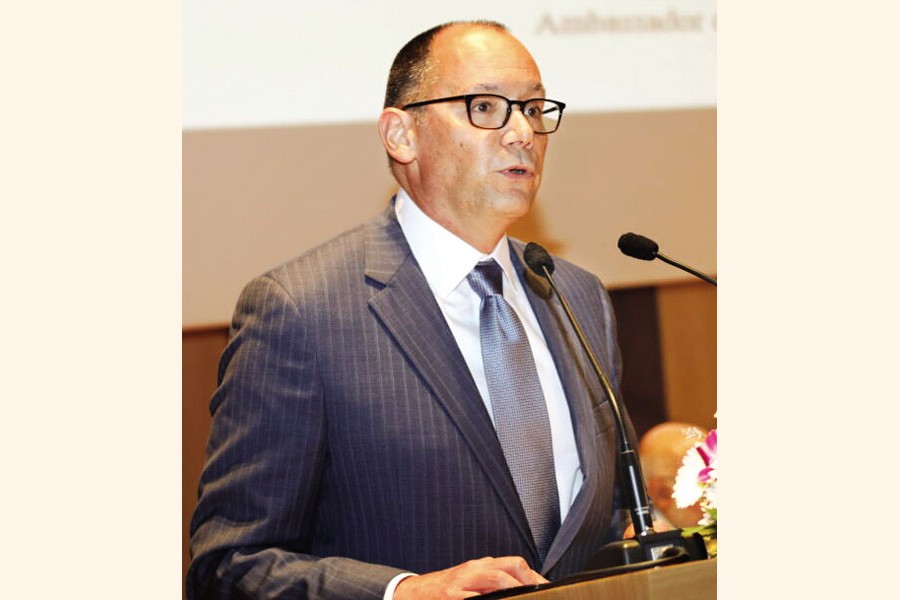
 Peter Haas
 Peter Haas, the United States (US) Ambassador in Bangladesh, firmly said on Sunday that his government would not take any side in the upcoming general election here.
Reiterating the US government's commitment across the world to help countries strengthen democracy, he noted that the US wants to see such an election where people can vote freely, journalists can investigate without fear, and ability for civil-society organisations to advocate broadly can be utilised.
"Let me be clear, the US will not take a side in the upcoming election. Our hope is simply that Bangladeshi people have a democratic process, which allows them to choose their government," said the ambassador while addressing a seminar.
The Bangladesh Institute of International and Strategic Studies (BIISS) organised the seminar - "Bangladesh and the United States Relations: Moving Towards Enhanced Cooperation and Partnership" - at its auditorium.
Talking about the recent sanctions by the US, the envoy said, "I will be honest; there is no scope to repeal the sanctions against RAB without concrete actions and accountability."
He noted that the US wants to see RAB just as effective as now in combating terrorism and is also capable of respecting basic rights.
"But the sanction on RAB does not mean we cannot enhance our strong law-enforcement and security cooperation. We will continue to work with Bangladesh to combat transnational crime and terrorism, enhance border security, and prevent violent extremism."
He opined that the relations between the two countries grew with a series of recent engagements, while two more important engagements would be held in the following months.
The ambassador also talked about two proposed agreements - the General Security of Military Information Agreement (GSOMIA) and the Acquisition and Cross Servicing Agreement (ACSA) - which are "essential" to enabling a closer defence relationship, expanding opportunities for defence trade, information sharing, and military-to-military cooperation between the two countries.
Mr. Haas mentioned that there were many misperceptions about these two proposed agreements. "These are technical agreements, not the military pact."
Talking about the economic cooperation, he said his government would appoint the first-ever full-time attaché of the US Department of Commerce in the embassy here this summer.
"This is a testament to the importance we place on growing our two-way trade and investment relationship," he added.
Speaking as the chief guest, Foreign Minister Dr A K Abdul Momen hailed the US government for its recent recognition of the persecution on the Rohingyas as genocide.
He expected continuation of the support regarding safe repatriation of the Myanmar citizens, now taking shelter in Bangladesh.
Sharing outcomes of his recent meeting with the US secretary of state, the foreign minister said he placed the matter of suspension against RAB that played a key role in preventing terrorism here.
"Yes, I do agree with you that the men (RAM members) need to be accountable and we are looking into it very seriously. But this is against the institution that has been creating stability across Bangladesh and in the region. So, I request him to examine the whole issue."
About the democratic developments here, he noted that the government established all the instruments that were necessary in holding free, fair and transparent elections.
He also invited all international observers to observe the upcoming polls.
Professor of Department of International Relations of Dhaka University Dr Ruksana Kibria, Brigadier General (retired) Dr. M Sakhawat Hossain, Ambassador Humayun Kabir, and Ambassador Tariq A Karim, among others, also spoke at the seminar.
jubairfe1980@gmail.com
© 2026 - All Rights with The Financial Express

