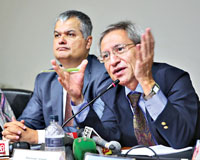
 World Bank (WB) lead economist Zahid Hussain speaks at a press conference while WB acting country head Salman Zaidi seen beside him. — FE Photo
The World Bank (WB) found a mismatch between Bangladesh's public expenditures and economic growth which the funding agency says is not rising at an expected level despite higher spending.
Such observations came from the multilateral development financier during an anatomy of the country's proposed next budget wherein, again, the WB finds the target of revenue earning to meet higher expenditures as a "challenging task".
"Development expenditure is boosting, the overall public expenditure is increasing too. But Bangladesh's economic growth is still in the 6.0 per cent trap," said World Bank's lead economist, Zahid Hussain, at a briefing on the national budget proposed for next financial year (FY), 2015-16.
"If you go to the field, you will see that public fund expenditure is going on. But the country fails to build proper asset against its increased investment."
The economist cites examples to substantiate his observations on low output from high costs borne by the exchequer for the heads of expenditure.
"Look on the Dhaka-Chittagong 4-lane project. The government spends huge money for this road development. But this expenditure fails to add asset to the economy as there is still lack of adequate physical improvement."
Mr Hussain said the public investment has been proposed to go up by nearly 3.0 percentage points to 17.2 per cent in the FY2016 budget, of which maximum money will go for development works.
"This target is by no means higher by international standards, but question is doability of development expenditures. History does not provide much comfort as there are traditional risks of erosion of spending quality," says the WB analysis of budgeting.
Identifying the private investment as another major challenge, Mr Hussain said if the government fails to take the gross domestic product (GDP)-investment ratio to 33.5 per cent from the current level of 29 per cent, getting to even the lower 7.0 per cent economic-growth target in the next FY would be difficult.
He, however, hailed government's initiative to award four Special Economic Zones (SEZs) to India, China and Japan, saying it will improve the country's investment climate.
"If the government cannot ensure more investment, even 2.0 to 2.5 percentage points more compared to the GDP, the 7.0 per cent growth target in the next fiscal will be challenging," he told the media.
The WB economist said the mega-size development expenditure target doesn't mean that it would ensure quality public investment.
"The size of the budget doesn't matter. Rather the obsession of the government agencies on spending funds could affect the quality. So, the government has to look into how to improve its capacity for the quality expenditure," he said.
Mr Hussain noted that the government was trying to spend more money from the annual development programme (ADP) for the development works but is hardly working for improving the physical quality progress of the development activities.
Although the finance minister in his budget speech had shown some intentions on the structural reforms but the limited initiative is the challenge for quality development as well as boosting the economy, the WB economist said.
The WB pointed out that the budget missed delivering on structural reforms in business regulation, financial-sector reform, infrastructure management, and quality and coverage of service delivery.
The WB analyst expressed reservation about allowing more commercial banks in Bangladesh's small economy rather than doing adequate reforms in the financial sector.
About the size of the national budget, Mr Hussain said this is a "mega" and "traditional" budget but is relatively realistic than the previous one in line with the development needs of the country.
The government has placed in parliament an ambitious Tk 2.95 trillion budget for the next fiscal.
In the way of budget implementation, the global lender has identified some risks like resurgence of disruptive politics, vulnerability of the financial sector, weak Euro and weaker labour-force demand from Gulf countries, and faltering transition and labour unrest in garments.
It says Bangladesh's tax effort is estimated at 64 per cent, meaning actual revenue collections constitute 64 per cent of potential collections given the country's characteristics.
On budget deficit projected at 5.0 per cent, it says unusual expenditure shortfalls exceed revenue shortfalls, thus leading to undershooting of the deficit target.
The budget documents, as per its view, need to provide clearer information on what the expenditures are buying in the soft sectors like education, health, power and energy, physical infrastructure, food security and IT.
"Information on the projects taken in the previous budget should be presented in the new budget as it will help evaluate the budgetary measures and people can understand where money is going," said Mr Hussain.
Public debt-to-GDP ratio, projected at 44 per cent of GDP by end-June 2016, is sustainable even in the event of large shocks, including significant borrowing to finance new power plants and partially recapitalise state-owned banks as falling oil prices on the international market will bring cushion to the budget.
The WB economist said it is time energy pricing was adjusted and regulatory reforms done, as many countries like next-door India has already taken advantage of falling oil prices by adjusting prices of petroleum products.
The WB expressed concern over rising interest payments to the GDP ratio. "Interest costs are beginning to dwarf spending on many sectors like health, primary education, fuel and energy, which are critical for development."
The analysis finds inflation target (6.2 per cent) in the budget realistic against the backdrop of falling oil prices on the global market and restoration of supply chain after a massive political gridlock early this year.
The Washington-based Bank appreciated adequate number of projects taken in the new budget without including the higher numbers.
"This is an improvement but the problem is there are too many unapproved projects in the ADP and this practice of symbolic allocation remains pervasive," Mr Hussain said.
He lauded the central bank's cautious monitory policy that sustained the exchange-rate stability in Bangladesh.
Asked about any possible inflationary pressure due to public-sector pay hike, the WB economist felt that it would not impact much on the economy as the cool international and local markets favour the situation. World Bank acting country director Salman Zaidi was also present at the press briefing.
kabiarhumayan10@gmial.com
© 2026 - All Rights with The Financial Express

