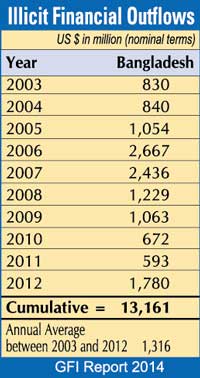
The latest findings of Washington-based Global Financial Integrity (GFI) - that was formed in 2006 to analyse unrecorded money disappearing out of developing countries - show that 'illicit financial outflows' from Bangladesh averaged, on an annual basis, at $1.3 billion between 2003 and 2012.
The GFI's report 2014, prepared by Dev Kar and Joseph Spanjers, was made available on its website on December 15, 2014. Its data are drawn from International Monetary Fund (IMF) balance of payments and IMF international statistics.
The latest report of the GFI on "Illicit Financial Flows from Developing Countries: 2003-2012" is the sixth in its annual series. It reaffirms the $1.0 trillion estimate "of unrecorded money shifting yearly out of emerging market and developing countries".
Its findings, as far as they relate to Bangladesh, put the aggregate of cumulative illicit financial outflows from the country at a level of $13.16 billion, between 2003 and 2012.
While the annual trends of annual outflows from Bangladesh were of varying nature during the period under report, the latest figure that relates to the year, 2012, stood at $1.78 billion, showing a quantum leap from $593 million in 2011. No figure about such flows in 2013 was made available by the report.
Earlier, the highest amount of such outflows from Bangladesh - at $2.667 billion - was estimated for 2006, reflecting a similar big jump from $1.05 billion in 2005.
The data and statistics, on which the GFI report is based, and also their derivatives are, according to it (GFI), "used every day by international institutions, governments, corporations, banks and individuals making millions of decisions on investments, loans, interest rates, exchange rates and more".
"They are, in short, the statistics on which economic and financial worlds work, influencing as well political and security concerns for all nations", it further noted in its latest report.
About calculations of illicit financial flows, the GFI made it clear that it "did not invent the methodology nor create the statistics" for preparing its report. "Both had been around for decades. What GFI did do was apply these existing analytical methodologies to data from the whole of developing countries", it added.
Elaborating further, Raymand W. Baker, President, GFI, noted, in his forward to the latest report, that its findings "are now widely referenced by international institutions and governments as compelling reasons for addressing the illicit flows issue."
"In the future, we expect to relate the estimates we produce more closely to the harms they cause. The goal is to help developing countries retain resources - contributing to prosperity, justice, and peace for billions of people", he stated.
Mr. Baker observed: "We choose to use published statistics, knowing that - while these provide an estimate of massive illicit flows - they still fall short of measuring all unrecorded flows."
In this connection, he mentioned that several major components - services and intangibles which constitute a favourite area for trade 'misinvoicing' and comprise 20 per cent of world trade, cash movements primarily for criminal activities such as drug trading, human trafficking and much of counterfeiting, errors in balance of payments and trade statistics, "same invoice faking" etc. - were not included in GFI's estimate.
Mr. Baker further pointed out, "we know that our estimates are very conservative."
Admitting such shortcoming, he, however, asserted these "cannot alter the basic findings that unrecorded capital outflows from the developing world are immense, generating severe consequences for poverty alleviation and economic growth.
Errors at the level of individual countries could either increase or decrease the aggregate trillion dollar estimate but they cannot alter the basic finding of the GFI report, he noted.
He urged governments and international institutions "to improve the data and, at the same time, work to curtail this most debilitating reality impacting poorer countries around the globe."
"Greater transparency in financial system - in both national and cross-border dealings - is one of our major recommendations," the President of the GFI observed.
Illicit financial flows from all developing countries stood at $991.25 billion in 2012 alone. On a cumulative basis, the amount aggregated at $6.58 trillion between 2003 and 2012, giving an annual average of $658.71 billion during the period under report.
In its report, the GFI noted two primary, detectable routes though which flow of illicit capital takes place, as it moves out of a country. These include: the deliberate misinvoicing of external trade transactions and leakages from the balance of payments.
Trade misinvoicing has been measured by GFI, using the gross excluding reversals (GER) methodology. This methodology draws upon the IMF's Direction of Trade Statistics (DOTS) database, in conjunction with its International Financial Statistics (IFS) database. On this basis, extent of trade misinvoicing has been measured, by looking for imbalances in reported export and import values between a country of interest and the world.
The GFI has estimated leakages from the balance of payments by capturing the same through use of the Hot Money Narrow (HMN) method. This method is based on the Net Errors and Omissions (NEOs) in the IMF's Balance of Payments Statistics database. By definition, the NEO term includes statistical errors which are impossible to disaggregate from deliberate diversions of many. "That said, economists have used the HMN figure as its results have been consistently negative (implying outflows) and increasing for many years", the GFI report pointed out.
© 2026 - All Rights with The Financial Express

