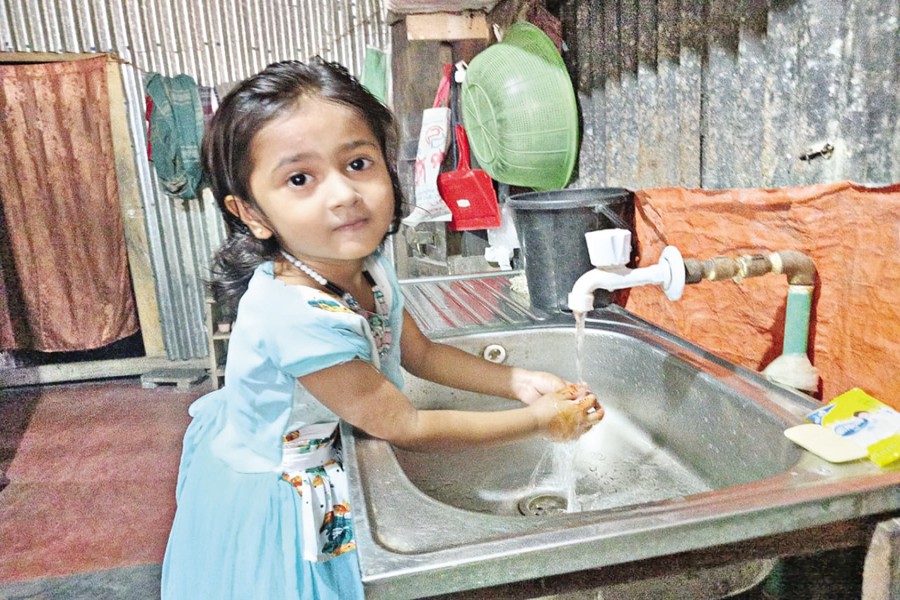
 Marzia washes hands as part of her hygiene practices
 Handwashing may seem a small act in everyday life, but for many families in coastal Bangladesh it has become the line between illness and health, between despair and hope. In the western corner of Kalikapur Union, in West Dibuapur village under Patuakhali, a little girl named Marzia has become a living symbol of that transformation.
Born in April 2022, Marzia spent her earliest months battling infections and malnutrition. Her father, Md. Siraj Kazi, worked as a day labourer, and her mother, Moss. Moni, managed the household within the meagre means. Poverty made medical treatment almost impossible, while awareness about hygiene was minimal. In their home, handwashing was neither a habit nor a priority.
A Turning Point through the Right2Grow Project
Change arrived with the Right2Grow project, launched in Patuakhali by Max Foundation in partnership with local NGO SDA. A baseline survey revealed that 23-month-old Marzia was stunted, alarming her mother. Community volunteer Hasi Akter, chair of the local Civil Society Organisation (CSO), and field worker Hawa encouraged Moni to join courtyard sessions.
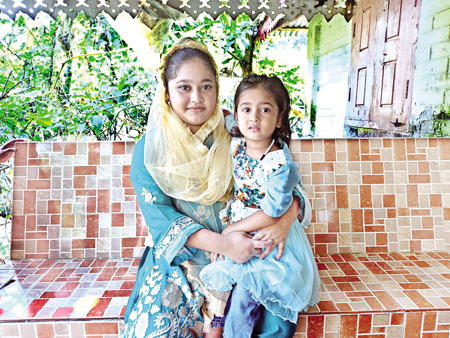
Marzia with her mother
There, Moni learned about the close relationship between safe water, sanitation, nutrition, and handwashing. Inspired, she decided to change her family's habits. She installed a simple handwashing basin at home and began a new routine: washing hands before and after meals, before feeding the child, after using the toilet, and before touching water.
Visible Change and Renewed Hope
Moni continued to attend courtyard meetings, where she learned about proper nutrition and hygiene. Within months, she saw clear results. Marzia's weight and height increased steadily, and her Growth Monitoring and Promotion card moved from the danger-marked orange to the healthy green zone.
"The Right2Grow project changed my daughter's life," said Moni. "Now she washes her hands regularly, follows hygiene rules, and studies attentively. I have realised that good hygiene and proper handwashing are the strongest guarantees of a child's well-being. In fact, they are vital for everyone's health."
Moni now inspires other mothers in her community to develop the same habit.
Community Effort and Institutional Support
The Union Parishad, in collaboration with the project's monitoring committee, carried out household visits, installed sanitary latrines, distributed handwashing basins, and provided nutritional support to poor families.
According to CSO chairperson Hasi Akter, "Through Right2Grow, we identified stunted children and vulnerable households and submitted the list to the Union Parishad. As a result, stunting and malnutrition have significantly declined in our area."
The five-year Right2Grow initiative, funded by the Government of the Netherlands, operates across five upazilas in Barguna, Khulna, Satkhira, and Patuakhali. Under the leadership of Max Foundationthis consortium project is implemented by six organisations - Action Against Hunger, Max Foundation, Save the Children, The Hunger Project, World Vision Bangladesh, and the Centre for Economic Governance and Accountability in Africa (CEGAA) - in association with local partners SDA, Jago Nari, and HLP Foundation.
Health, Hygiene and Nutrition: A Single Chain
"Good hygiene and nutrition are inseparable," said Iqbal Azad, the project's Country Consortium Team Lead. "Regular handwashing protects children from waterborne, faecal-oral, and other infectious diseases. Strengthening hygiene and nutrition systems at every level will help children grow into healthy, intelligent citizens. Proper handwashing alone can prevent nearly eighty per cent of communicable diseases."
In the four southern districts where Right to Grow operates, around two hundred thousand families have now adopted daily handwashing practices. Local health departments report a marked decline in diarrhoea and other infectious illnesses.
Handwashing and Bangladesh's SDG 6.2 Commitments
Under Sustainable Development Goal 6.2, Bangladesh aims to ensure adequate and equitable sanitation and hygiene for all by 2030. While progress has been steady, challenges persist in rural and coastal areas, where access to clean water and hygiene facilities remains limited.
Handwashing with soap is among the most cost-effective interventions to reduce child mortality - a critical public health concern. Consistent handwashing can reduce diarrhoea by up to forty per cent and respiratory infections by more than twenty per cent, contributing directly to lower child death rates. Expanding hygiene education and ensuring access to clean water and soap for every household and school are essential steps toward achieving the country's SDG targets and nurturing a healthier generation.
A Simple Habit, A National Impact
The United States' Centers for Disease Control and Prevention notes that countless germs spread because people fail to wash their hands properly with soap and running water. Handwashing is crucial after using the toilet, before preparing or eating food, and after coughing, sneezing, or cleaning the nose. It is a low-cost yet highly effective habit that reduces illness and saves lives.
Research shows that teaching handwashing can reduce diarrhoeal diseases by about twenty-three to forty per cent, decrease school absenteeism caused by gastrointestinal problems by twenty-nine to fifty-seven per cent, lower diarrhoeal illness among people with weak immunity by around fifty-eight per cent, and lessen respiratory infections such as cold and flu by sixteen to twenty-one per cent. The benefits are far-reaching - fewer child deaths, fewer days lost to illness, and stronger communities overall. Across the coastal belt, mothers like Moni now see handwashing not as an instruction from outsiders but as a daily act of care and empowerment.
For Marzia, this simple habit has meant a new chance in life. Her laughter and good health now echo through the courtyards of West Dibuapur, a reminder that the smallest acts can spark the greatest transformations. Handwashing, once neglected, has become the foundation of a healthier, cleaner, and more hopeful Bangladesh.
© 2026 - All Rights with The Financial Express

