The Asian Infrastructure Investment Bank (AIIB) has expressed consent to extend a $164.57-million loan to procure 30 metre-gauge (MG) diesel-electric locomotives for Bangladesh Railway under the Railway Capacity Expansion (RACE) project, officials at the Economic Relations Division (ERD) say.
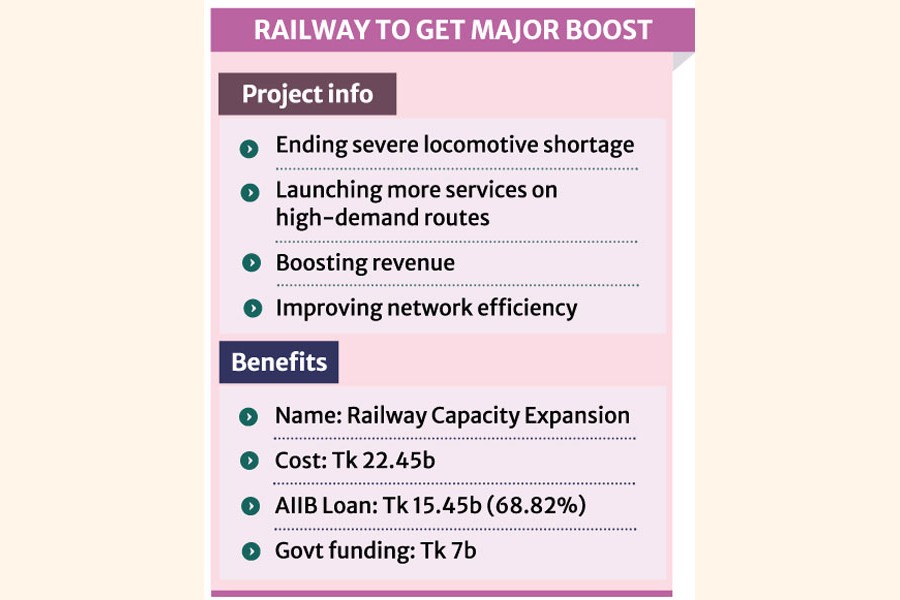
The Ministry of Railways has already submitted the Preliminary Development Project Proposal (PDPP) to the Planning Commission, with an estimated cost of over Tk 22.45 billion, officials concerned have confirmed.
Of the total cost, around Tk 15.45 billion, or 68.82 per cent, is expected to be financed through the AIIB loan, while the remaining Tk 7.0 billion will be met from the government's own funds, according to the PDPP.
Officials say the initiative is aimed at easing persistent bottlenecks in railway operations stemming from a mismatch between rapid infrastructure expansion over the past decade and inadequate rolling stock.
"To address the critical shortage of serviceable locomotives in Bangladesh, the government plans to procure 60 new metre-gauge locomotives," according to a project summary prepared by the AIIB.
Of the total, 30 locomotives will be financed by the AIIB, while the remaining 30 will be procured under the Chattogram-Dohazari railway project with support from the Asian Development Bank (ADB), the summary adds.
The total cost of the RACE project is estimated at $241.47 million, with the government contributing $76.9 million.
Sector insiders say the shortage of locomotives has prevented Bangladesh Railway from fully utilising newly built and upgraded lines, leaving substantial passenger and freight demand unmet.
The proposed procurement is expected to enable the operator to introduce additional services on high-demand routes, particularly intercity and freight corridors, thereby boosting revenue and improving network efficiency.
The project will also help better align operational capacity with recent infrastructure investments, allowing the railway to derive greater returns from capital-intensive developments.
Under the project design, the first component involves procurement of locomotives along with spare parts and commissioning support, while the second component focuses on project management and capacity building, including training and study tours.
The replacement of ageing locomotives with modern, fuel-efficient units is also expected to improve energy efficiency and reduce greenhouse gas emissions, contributing to the country's climate mitigation efforts.
Analysts say the move underscores the need to synchronise infrastructure expansion with rolling stock procurement, warning that without such alignment, the full economic benefits of railway investments may remain unrealised.
jahid.rn@gmail.com
© 2026 - All Rights with The Financial Express

