Bangladesh's textile manufacturers, apparel exporters and global buyers alike feel mounting financial pressure under chain effects of the Middle East turmoil that disrupts major shipping routes and hikes freight, energy and raw material costs, industry insiders say.
Initial shock is already being reported by global retailers as shipping expenses and lead times rise, while manufacturers are bracing for higher production costs due to surging prices of petroleum-based raw materials.
Industry players have noted that the conflict has triggered volatility surrounding petroleum and its by-products -- key inputs for man-made fibre (MMF) and other synthetic textile materials -- raising the cost of producing blended fabrics and MMF-based apparel.
Exporters are also concerned about potential container shortages and higher freight charges as shipping lines reroute vessels to avoid conflict-prone areas.
Industry insiders warn that if geopolitical tensions persist, the combined impact of higher freight costs, rising energy prices and costlier raw materials could weaken Bangladesh's textile-and apparel-export competitiveness.
Buyers have already begun discussions with shipping carriers to renegotiate freight costs, according to the sources.
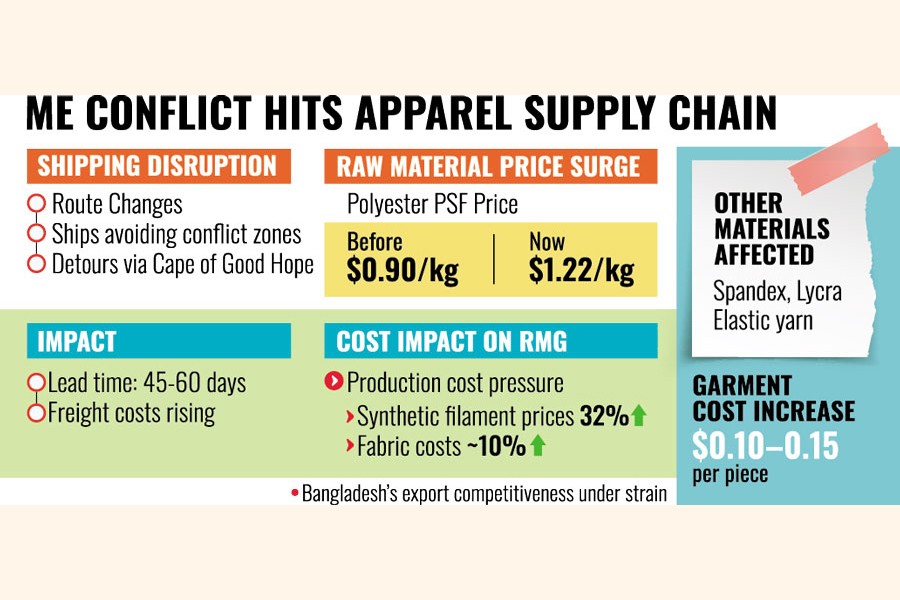
They say polyester PSF prices have risen from around 90 cents per kilogram to about $1.22 per kilogram on the local market, reflecting the rising cost of petroleum-based inputs.
Manufacturers also say prices of other synthetic materials such as spandex, lycra and elastic yarn have been fluctuating, adding uncertainty to production costs.
Meanwhile, local textile producers have said prices of key raw materials used in textile manufacturing are also rising in line with shifts in domestic demand and supply.
Talking to The Financial Express, Shofiqur Rahman, Executive Director (Marketing) of Zaber and Zubair Fabrics Ltd, said nearly half the raw materials used in blended fabrics or MMF-based garments are petroleum-derived products.
"MMF-based raw materials account for around 50 per cent of a blended fabric or MMF apparel," he said, adding that prices of filament and related synthetic fibres have already risen sharply.
According to supplier data, synthetic- filament prices have increased by about 32 per cent, which could push fabric costs up by roughly 10 per cent, or about 19-20 cents per piece of garments.
He said the final cost of apparel products could rise by 10-15 cents per piece, requiring price renegotiations with buyers.
"This additional cost will have to be discussed with buyers, otherwise it may affect overall sales," he said.
He also warns that LNG-and other fuel -import costs could increase further due to the war. Without higher energy subsidies, the situation could add to production costs for local manufacturers.
Bangladesh Textile Mills Association President Showkat Aziz Russell says rising global oil prices are also pushing up the cost of petroleum by-products.
"As primary textile producers, we will pass the additional costs on to garment manufacturers," he says, adding that the extra burden would eventually fall on end consumers.
If the war drags on in the petroleum hub, demand for MMF or blended yarn-based apparel could weaken as consumers may shift towards cotton garments, he predicts.
However, cotton prices may also rise as domino effect of freight-cost rises.
President of Bangladesh Knitwear Manufacturers and Exporters Association Mohammad Hatem says disruptions to key maritime routes could push global oil prices even higher and trigger a gas-supply crunch, particularly affecting liquefied petroleum gas (LPG) and liquefied natural gas (LNG) supplies.
"When production costs rise, demand tends to fall."
He notes that with the blockade of the Strait of Hormuz, as a reprisal for the US-Israel war on Iran, many vessels may be forced to take a lengthy detour via the Cape of Good Hope.
This would add thousands of kilometres to voyages, extending lead times and increasing freight costs in a double blow.
"The higher costs will also affect product prices and market demand," he adds.
newsmanjasi@gmail.com
© 2026 - All Rights with The Financial Express

