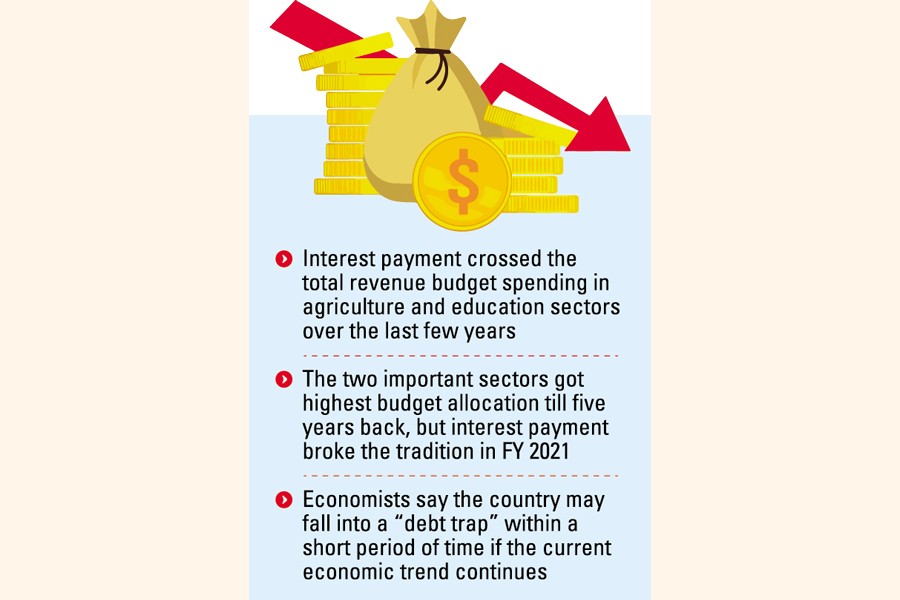
Bangladesh is inching towards a 'high debt-burden nation' as the country's interest payment has entered into "highest expenditure club" over the last few years posting 17 per cent increase in revenue budget allocation year-on-year in the last fiscal, official data showed.
The expenditure has crossed the total government spending in two important sectors-agriculture and education-- over the last few years in the country's revenue budget, Ministry of Finance (MoF) statistics showed.
Although the country's very important two sectors - agriculture and education--had got highest allocation from the revenue budget till five years back in FY2020, the interest payment has broken the tradition in the fiscal year (FY) 2021, the data showed.
The expenditure for the interest payment has exceeded even the government's revised budget allocation of Tk 1.21 trillion, as it has been forced to spend Tk 129.30 billion additional funds to Tk 1.34 trillion for the higher internal and external debt servicing in the last FY2025, the MoF data showed.
In the previous FY2024, the government repaid Tk 1.14 trillion, in FY2023 Tk 839.44 billion, and in FY2022 Tk 703 billion, MoF data showed.
Economists say Bangladesh has already entered into the 'higher debt burden nation' and the country may fall into the "debt trap" within a short period of time if the current economic trend continues.
Economists, external development partners and some government executives opined that Bangladesh is facing a mounting fiscal challenge as the cost of servicing its national debt, both domestic and foreign, continues its steep year-on-year ascent.
Recent analysis indicates that debt servicing is rapidly consuming a greater share of the government's limited revenue, diverting crucial funds that might otherwise be allocated to vital sectors like health, education, and development projects.
According to the MoF data, interest payments have surpassed traditional major allocations like agriculture and education to become the largest component of the revenue budget.
Official data suggests that the July-December 2024 interest payments alone amounted to Tk 625.6 billion, representing over 55 per cent of the total annual allocation for debt servicing and a 27 per cent increase compared to the same period in the previous FY2024.
Bangladesh's external debt has seen a significant jump, rising 42 per cent over the last five years to reach over $104 billion at the end of 2024. Debt-service payments have surged to 16 per cent of export earnings, highlighting increased repayment strain.
According to the World Bank's (WB) International Debt Report 2025, released recently, Bangladesh's repayments have grown the fastest in the South Asian region. In 2024, the country paid $7.3 billion in total, a 617 percent jump from 2010. No other country in the region saw an increase on this scale.
Of the total repayment last year, $4.9 billion went towards paying back the original loan amounts, a mountainous jump from $821 million in 2010. Meanwhile, interest payments rose to $2.4 billion, compared to just $203 million in 2010, the WB report said.
Analysts say Bangladesh has increasingly relied on market-based, higher-interest loans from the foreign lenders like AIIB, ADB, China and French donor AFD as access to concessional loans with interest rates of 2.0 per cent or less has become less available.
Besides, the government borrowing from the domestic banking system, often via treasury bills and bonds, has increased. Yields (interest rates) on these instruments have surged, with T-bills exceeding 10 per cent and treasury bonds around 11 per cent in recent months, directly increasing the cost of domestic debt, they remarked.
The substantial depreciation of the local currency against the US dollar has inflated the Taka cost of repaying and servicing foreign loans too, they said.
The country's persistently low tax-to-GDP ratio, which has plunged from over 10 per cent a few years back to around 7,0 per cent in recent years, leaves the government with limited fiscal space and forces it to rely more heavily on borrowing to meet its budget deficit.
Several large infrastructure and 'mega-projects' nearing completion are now transitioning from the drawing board to the repayment stage, escalating debt-service obligations.
The National Board of Revenue (NBR) chairman has recently issued a stern warning, stating that Bangladesh has "slipped into a 'debt trap'" and is moving towards a "dangerous and obligatory dependency."
Dr Mustafizur Rahman, distinguished fellow of the Centre for Policy Dialogue (CPD), echoed these concerns, emphasising that the increasing allocation to interest payments leaves less room for essential public services and development, which is detrimental to long-term structural growth.
The rising interest burden, combined with a fragile banking system marked by soaring default loans and a prolonged slump in private investment, paints a challenging picture for the country's economic management.
Former World Bank Lead Economist Dr Zahid Hussain told the FE that the interest payment in the current FY2026 is likely to increase further resulting in a weak fiscal space.
"If the government needs to pay nearly Tk 1.40 to Tk 1.50 trillion fund out of Tk 7.90 trillion national budget allocation for the interest payment purpose alone, then the government's fiscal space is squeezed. In that case, the budget would not be a development friendly one," he added.
Dr Hussain said: "The subsidy payment is another big spending sector in the budget which may have a scope for reducing the expenditure. Besides, the government has only tool in hand at this moment generate more revenue with tighten budget expenditure aimed at reducing the income-expenditure deficit."
Former Economics Professor of Chittagong University Dr Muinul Islam told the FE that the highest debt burden is the result of the past autocratic regime.
"Since the interest payment is growing year-on-year, we have no way to come out from the higher expenditures. So, only way is to generate more revenue," he added.
"So, we may have already fallen into a debt trap," Dr Muinul said.
© 2026 - All Rights with The Financial Express

