The government has unveiled comprehensive guidelines for developing onshore wind-power projects, with industry leaders saying the new framework could pave the way for greater private investment.
The new framework, released last week, is also expected to help Bangladesh tap its "immense potential" in wind energy as it pursues ambitious renewable-energy targets.
The guideline establishes a "clear, transparent and bankable framework" for the development of land-based (onshore) wind power projects, according to the Sustainable and Renewable Energy Development Authority (SREDA).
Wind power is a clean, inexhaustible and increasingly cost-competitive source of electricity.
As a form of kinetic energy harnessed from the movement of air masses, it produces no direct greenhouse gas emissions during operation and carries none of the fuel-price risks associated with imported fossil fuels -- an important advantage for an import-dependent economy such as Bangladesh.
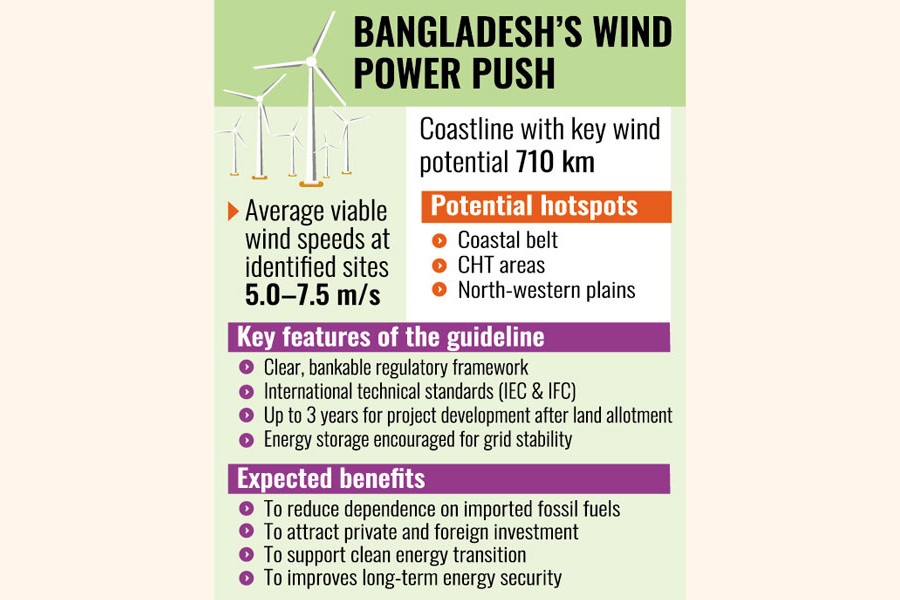
SREDA said Bangladesh possesses modest but commercially viable onshore wind resources, concentrated mainly along its 710-kilometre coastline, in the Chittagong Hill Tracts and across selected open plain areas in the north-west.
Detailed wind mapping conducted by SREDA and its international partners has identified multiple sites with average annual wind speeds of 5.0-7.5 metres per second at hub height, sufficient for utility-scale electricity generation using modern turbine technology.
Under the Renewable Energy Policy 2025, the government has set a target of generating 20 per cent of the country's total energy from renewable sources by 2030 and 30 per cent by 2040.
At present, the country generates only 62 megawatts (MW) of electricity from wind, out of a total renewable energy generation capacity of 1,807 MW, according to SREDA.
Wind power, alongside solar and other renewable sources, is expected to play a key role in achieving the country's clean energy targets.
The guideline aims to facilitate the orderly, efficient and sustainable development of onshore wind power in Bangladesh by establishing technically robust minimum requirements aligned with international standards, including IEC 61400-1, IEC 61400-12 and IFC Performance Standards.
It seeks to ensure that projects are designed and built to operate safely and efficiently throughout their design life, typically 25 years or more.
It also aims to create a financially bankable framework by providing developers, lenders and investors with a clear, predictable and transparent regulatory pathway, thereby reducing perceived project risks and improving access to commercial and development finance.
According to the guideline, developers must ensure that all land required for a project - including turbine locations, access roads, substations, meteorological mast sites, lay-down areas and cable routes -- can be lawfully used for wind power development and that all applicable land-use regulations, zoning requirements and environmental restrictions are complied with.
Where the government allocates land or grants site clearance for wind power development, developers will have a maximum of three years from the date of allotment or approval to complete project development activities and commence commissioning.
Extensions may be granted through a formal appeal to the government, subject to satisfactory evidence of project progress and extenuating circumstances, the guideline said.
Developers must also confirm that grid connectivity is both technically and commercially feasible at the proposed project site before making any investment commitment.
All wind power projects will be required to comply with the Bangladesh Environment Conservation Act, 1995, and the Environment Conservation Rules, 1997, as administered by the Department of Environment (DoE).
Developers must obtain all necessary environmental clearances before commencing construction, the guideline said.
The guideline also encourages developers to install energy storage systems alongside wind power plants, saying such systems can significantly enhance the value of wind energy to the national grid while improving overall grid stability.
"Developers are encouraged, and in some circumstances may be required by SREDA or the grid operator, to integrate co-located energy storage systems with their wind projects," it said.
Developers have also been instructed to verify that grid connectivity is technically and commercially feasible at the proposed project site before committing to project implementation.
Bangladesh Sustainable and Renewable Energy Association (BSREA) President Mostafa Al Mahmud said wind power has "immense potential" in Bangladesh and electricity generation from the resource is expected to increase once projects are developed under the new guidelines.
"As the government has now started allocating land to the private sector for clean energy projects, wind power generation will also increase gradually," he told The Financial Express.
Mr Mahmud said the government had recently announced a number of incentives to help boost electricity generation from renewable sources.
"Government offices need to ensure that the industry can actually benefit from those facilities," he added.
syful-islam@outlook.com
© 2026 - All Rights with The Financial Express

