Bangladesh has emerged as an attractive market of soybean, as it has become the 13th-largest nation in terms of the global demand, market insiders said on Friday.
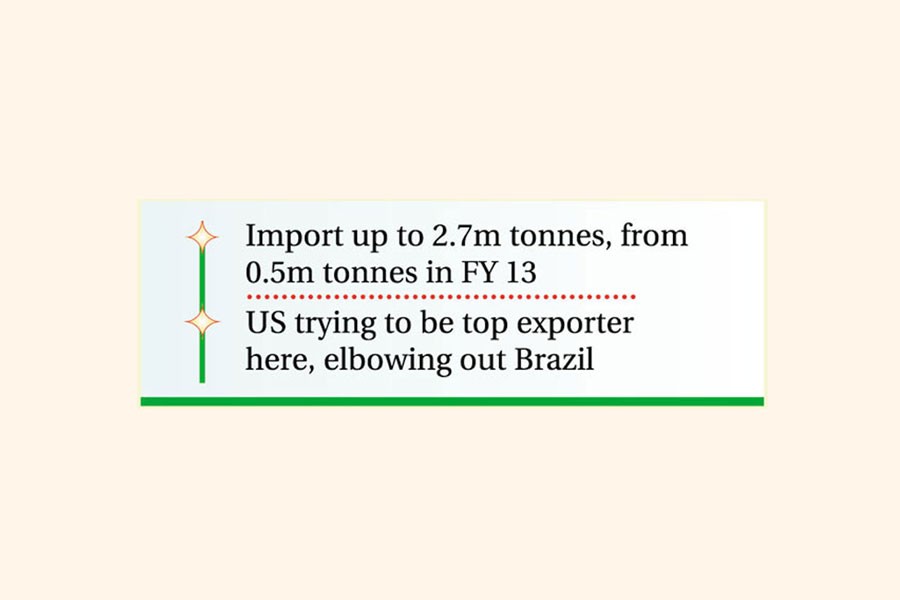
The country's import of soybean, the major raw material of cooking oil as well as poultry, fish and livestock feed, is expected to rise to 2.7 million tonnes in the current fiscal year (FY), 2022-23, from that of 2.1 million tonnes in FY 2022, they added.
Brazil is the country's largest soybean supplier, followed by the US and Argentina.
Amid the attractive growth of Bangladeshi soya market, the US producers are trying to expand their share in the market to beat the top exporter Brazil.
The US soybean producers have emerged as the second largest supplier to Bangladesh, as they have grabbed nearly 37 per cent of the country's import market, the insiders noted.
Along with local edible oil industry, the growing poultry, fish and livestock sectors are consuming soybean, as it is one of the key feed production materials.
"The local soybean market is likely to expand at 7.7 per cent rate in the current FY. The consumption is likely to rise further in the coming years," Khabibur Rahman Kanchan, team leader of the US Soybean Export Council (USSEC), told the FE.
"We emphasise Bangladesh Prime Minister Sheikh Hasina's campaign on consumption of nutritional foods. Our soybean can help in this regard, as it has more food value than others," Kevin Roepke, USSEC Regional Director of South Asia and Sub-Saharan Africa, told the FE.
In the last FY, Bangladesh imported 2.1 million tonnes of soybean to produce cooking oil, feed for poultry, fish and livestock sector, and other purposes.
Of the total annual soybean import, the US supplied 37 percent after the largest supplier Brazil, Mr Rahman further said.
"We have found Bangladesh as one of the most potential markets of soybean, as the country has become 13th in the global demand in recent days."
He added that Bangladesh is the world's third largest soybean oil importer. Soybean meal is predominately used in the local poultry sector.
According to the USSEC, Bangladesh' soybean import was less than 0.5 million tonnes in FY 2012-13, which now reached at nearly 2.7 million tonnes annually.
Mr Kevin said Brazil and Argentina are the major suppliers of soybean in the world, and these countries are now trying to expand their market in the emerging countries like Bangladesh.
He opined that as the US soybean is more nutritious than other types - produced in different countries - their produce is expected to grab Bangladesh's key market share in the near future.
The US soybean exporters have a commitment to help Bangladesh achieve its sustainable development goals (SDGs) that include zero hunger, clean water and sanitation, and responsible consumption and production.
They have comparatively low carbon emitters than other countries in production of soybean, he added.
The Meghna Group, City Group and TK Group are the major importers of soybean in Bangladesh. Some other groups are also looking to import soybean in the country, said Mr Khaibur.
"As the lead time is currently a factor for export of the US soybean to Bangladesh, they are trying to handle the complexities through some effective measures."
Besides, Bangladesh poor port infrastructure is a disadvantage in export, which also consumes more time, he added.
kabirhumayan10@gmail.com
© 2026 - All Rights with The Financial Express

