BNP chairman Tarique Rahman has outlined the BNP's vision for region-specific development for balanced national uplift, youth-focused culture and inclusive growth in his party's election manifesto.
Tarique Rahman unveiled his party's broad development vision, placing balanced regional growth, youth empowerment, culture, sports, and social harmony at the heart of its election manifesto.
He read out the salient features of the party's five-part manifesto at the Ball Room of Sonargaon Hotel in presence of diplomats, representatives of international agencies, journalists, senior BNP leaders and other invited guests.
 If elected, the party promised to decentralise wealth, create jobs beyond Dhaka, and ensure that marginal and neglected communities become active participants in national progress.
At the core of BNP's plan is regional balanced development, designed to reduce longstanding disparities between the capital, Dhaka, and the rest of the country.
The party pledged to establish Chattogram as the commercial capital of Bangladesh, transforming it into a major employment hub through trade, logistics, port-centric industries and services. According to the manifesto, this move would ease pressure on Dhaka while unlocking the economic potential of the country's maritime gateway.
The Bangladesh Nationalist Party promised to end what it describes as decades of neglect of the potential agrarian northern region through planned agro-based industrialisation.
The party plans to set up specialised export zones to generate large-scale employment, while a comprehensive agricultural revolution would ensure balanced economic growth
The Barendro Project would receive top priority, including canal excavation to improve irrigation.
Special cold storages would be established to preserve mangoes and other farm produce, helping farmers secure better prices.
Water security is another key plank.
BNP proposes implementing the Teesta and Padma Barrages, which it thinks would provide irrigation to 7.5 million hectares of land and protect over 50 million people from floods, while also preventing desertification in both northern and southern regions.
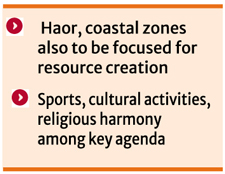
For the Haor and wetlands areas, the manifesto emphasises strengthening sustainable embankments, water-control systems and modern disaster management to cope with floods and flashfloods.
Improved communications, electricity and healthcare services are planned, alongside rebuilding the Haor economy by integrating agriculture, fisheries, duck farming and tourism.
The former ruling party also vows to make the Haor Development Board more powerful, modern and effective to realise the development dreams.
In the coastal regions, the party has outlined measures for coastal security through sustainable levees and modern early-warning systems
Job creation would be driven by the Blue Economy and salinity-tolerant agriculture.
It also proposed forming a dedicated Coastal Development Board and constructing the Bhola-Barisal Bridge to ensure seamless connectivity and open new economic opportunities.
Reforms to the Ganga-Kopotakkho (GK) Irrigation Project are also promised, benefiting thousands of farmers across 13 upazilas in four districts.
On urban development, BNP stresses safe and sustainable urbanisation, with special focus on Dhaka.
Planned multi-storey and cluster housing would be built to protect fertile land, while affordable flats would target low-income groups.
To reduce Dhaka's pressure, major hospitals and universities would be relocated to secondary cities.
If elected, the party in its manifesto also proposes a corruption-free Land Bank, modern waste and water management, and expanded public transport, including metro-rail extensions, monorail systems, electric vehicles and women-only "Pink Bus" services.
Completing circular waterways and ring roads around Dhaka, along with technology-driven traffic management and digital civic services, are part of the party's "Smart City" vision.
Tourism is identified as a strong driver of jobs and cultural exchange. BNP pledges to simplify visas, introduce AI-based travel apps and deploy skilled tourist police.
District-based community tourism, eco-tourism and river-based water tourism would be promoted, while an annual Dhaka Food and Culture Fest would preserve rural heritage and strengthen Bangladesh's global brand.
On social cohesion, BNP reaffirms the principle that "religion is individual, the state is for all", emphasising a unified Bangladeshi identity. The party promises full religious freedom, security of life and property for minorities, and protection of places of worship.
Monthly honoraria and festival allowances for religious leaders of all faiths, increased budgets for religious trusts, improved Hajj management and expanded mosque-based education programs are also pledged.
For ethnic minority communities, BNP has proposed a separate Small Ethnic Communities Development Directorate to preserve languages and cultures, re-evaluating the Chittagong Hill Tracts Peace Accord to ensure lasting peace, modernising district hospitals, investing in eco-tourism and handicrafts, and ensuring full coverage of social-safety nets.
Youth, sports and culture feature prominently.
BNP outlines reforms to identify talent through mandatory curriculum-based programmes, strengthen BKSP and universities, recover playgrounds, establish a National Olympic Academy, and create a politics-free sports arena.
tonmoy.wardad@gmail.com
© 2026 - All Rights with The Financial Express

