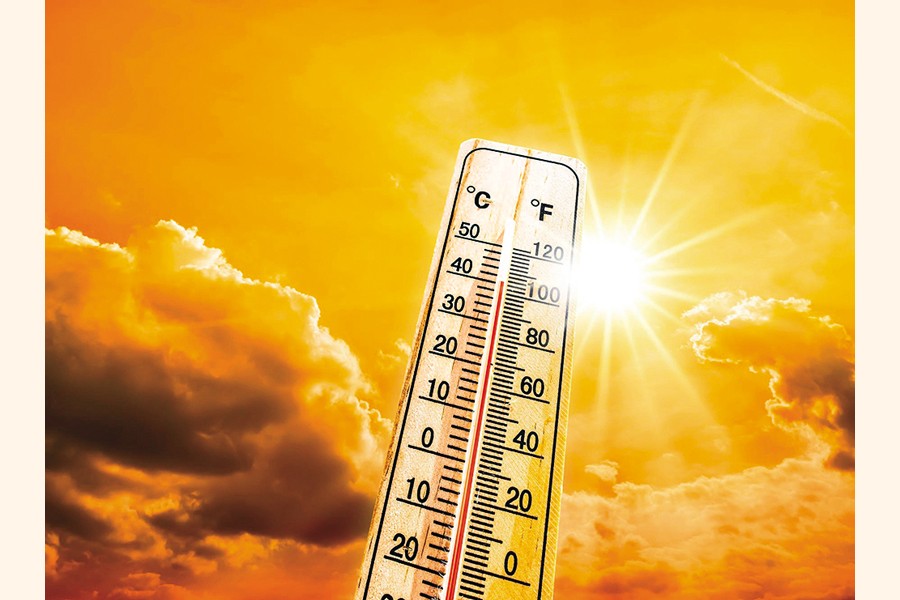
LONDON, July 18 (Agencies): Britain and France went on heatwave alert on Monday facing record temperatures as southwest Europe wilted under a scorching sun and ferocious wildfires devoured more forests.
Britain was on course for its hottest day on record on Monday with temperatures forecast to hit 40C for the first time, forcing train companies to cancel services and some schools to close while ministers urged the public to stay at home.
Much of Europe is baking in a heatwave that has pushed temperatures into the mid-40s Celsius (over 110 Fahrenheit) in some regions, with wildfires raging across tinder-dry countryside in Portugal, Spain and France.
Britain's government triggered a "national emergency" alert as temperatures on Monday and Tuesday were forecast to surpass the 38.7C (102F) recorded in the Cambridge University Botanic Garden in 2019.
By midday, readings of almost 35C were being recorded in southern England.
"We've got a difficult 48 hours coming," Kit Malthouse, a minister in charge of government coordination, told BBC radio. He will later chair a meeting of the government's emergency response committee.
The national rail network urged passengers not to travel unless necessary and said some services - including a key route between northeastern England and London - would not run during parts of Tuesday.
London's metro network imposed temporary speed restrictions, meaning it would run a reduced service with journeys taking longer than normal. It urged commuters to stay at home.
Scientists blame climate change and predict more frequent and intense episodes of extreme weather.
Across the Channel firefighters failed to contain two massive fires in France's southwest that have created apocalyptic scenes of destruction.
For six days, armies of firefighters and a fleet of waterbombing aircraft have struggled against blazes that have mobilised much of France's entire firefighting capacity.
Forecasters have put 15 French departments on the highest state of alert for extreme temperatures, including in the western Brittany region where the Atlantic coastal city of Brest was expected to hit 40 Celsius Monday, nearly twice its usual July temperature average.
By early afternoon, Brest had already beaten its all-time record of 35.2 C set in 1949.
The European heatwave, spreading north, is the second to engulf parts of the southwest of the continent within only weeks.
Blazes burning in France, Greece, Portugal and Spain have destroyed thousands of hectares of land and forced thousands of residents and holidaymakers to flee.
In France's Landes forest, in the southwest Aquitaine region, temperatures "will be above 42 degrees Celsius" on Monday, forecaster Olivier Proust said.
In the Gironde region, further north, firefighters on Monday continued their battle against forest blazes that have devoured nearly 14,000 hectares (35,000 acres) since Tuesday.
An area of nine kilometres (5.5 miles) long and eight kilometres wide was still ablaze near the Dune de Pilat, Europe's highest sand dune, turning picturesque landscapes, popular campsites and pristine beaches into a scorching mess.
Another 8,000 people were being evacuated near the dune Monday as changing winds blew thick smoke into residential areas, officials said.
"The smoke is toxic," firefighter spokesman Arnaud Mendousse told AFP. "Protecting the population is a matter of public health."
The evacuations added to the 16,000 tourists or residents already forced to decamp in France, many to emergency shelters.
"In some southwestern areas, it will be a heat apocalypse," meteorologist Francois Gourand told AFP.
In Spain, fire burning in the northwestern province of Zamora claimed the life of a 69-year-old shepherd, regional authorities said, the second death after that of a fireman a day before in the same area.
Authorities have reported around 20 wildfires still raging from the south to Galicia in the far northwest, where blazes have destroyed around 4,500 hectares of land.
In Portugal, almost the entire country remained on high alert for wildfires despite a slight drop in temperatures which had hit 47C -- a record for the month of July -- last Thursday.
Fires have killed two, injured around 60 and destroyed between 12,000 and 15,000 hectares of land in Portugal.
In Britain, the government, already on the ropes after a series of scandals and Prime Minister Boris Johnson's resignation, drew fresh criticism for failing to take the situation seriously enough.
"This is serious heat that could actually, ultimately, end in people's deaths because it is so ferocious," College of Paramedics chief executive Tracy Nicholls told Sky News.
The Sun tabloid headlined its coverage of the heat "British Bake Off", observing that the "scorcher" was making the UK hotter than Ibiza where, indeed, temperatures were a comparatively paltry 30C on Monday.
"It is a bit frightening," Karina Lawford, 56, told AFP as she took a stroll by the sea in Tankerton on the north Kent coast, saying the heat reminded her of Australia where she lives.
© 2026 - All Rights with The Financial Express

