Textile millers have urged the Bangladesh Bank to further extend the import credit period for cotton and other industrial raw materials to 360 days.
They warned that a return to the earlier 180-day limit would severely disrupt export-oriented textile production and strain working capital.
The appeal comes as the existing extended facility, granted through central bank circulars and currently set to expire on December 31, nears its deadline.
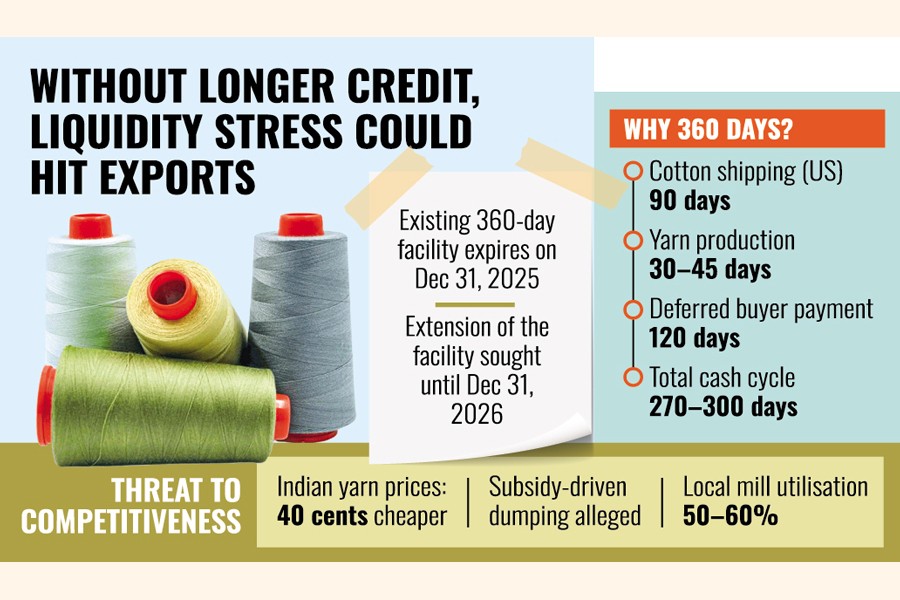
The Bangladesh Textile Mills Association (BTMA) has sought a one-year extension of the facility until December 31, 2026, citing prolonged production cycles, global market uncertainties and mounting cost pressures.
It argues that the current credit facility, previously extended from 180 days through Bangladesh Bank circulars, remains inadequate for cotton imports, particularly for spinning mills.
In a letter sent to Bangladesh Bank Governor Ahsan H Mansur on Tuesday, BTMA President Showkat Aziz Russell said the full cycle from cotton import to receipt of export proceeds typically takes between 270 and 300 days.
"The 180-day credit limit is practically unworkable for spinning mills. Without extending the tenure to 360 days, mills will face severe liquidity stress and operational disruptions," he said.
The central bank had extended the import credit period for industrial raw materials until December 31, 2025 through FE Circular No. 08 issued on January 20, 2025, which was later reaffirmed by FE Circular No. 27 dated August 18, 2025.
With both circulars nearing expiry, millers fear renewed pressure on cash flows and foreign exchange management.
BTMA said it represents 1,869 member mills, including spinning, weaving, and dyeing, printing and finishing units, with cumulative investments of around US$23 billion, the largest single private-sector investment block in the country.
The association noted that the textile sector supplies about 70 per cent of inputs to the ready-made garment industry.
Together, the two sectors account for nearly 85 per cent of Bangladesh's export earnings, while retaining around 30 per cent of foreign exchange domestically.
The letter also highlighted multiple challenges facing the industry, including currency depreciation, a 250-percent increase in gas prices, a 70 per cent wage hike, political instability, labour unrest, and persistent shortages of gas and electricity.
These factors, BTMA said, have reduced capacity utilisation and significantly increased production costs.
According to the association, continued global uncertainty driven by geopolitical conflicts and economic slowdown has further strained exporters' cash flows, making longer import credit periods critical for sustaining operations.
"Considering the overall situation and to facilitate import-export trade, it is essential to urgently extend the credit period for industrial raw material imports for BTMA member mills," the association said, urging the central bank to act before the current facility expires.
Speaking to The Financial Express, Salehudh Zaman Khan Jitu, Managing Director of NZ Group, said the government is encouraging millers to import US cotton, which takes nearly 90 days to reach factories from US ports, while payment obligations begin once shipments are dispatched.
He said it takes another 30 to 45 days to produce yarn, adding that spinners typically receive a minimum of 120 days' deferred payment.
However, due to prevailing banking constraints, the process often takes longer.
"Considering the entire cycle, spinners now need at least 280 to 290 days to receive payment. If there are delays at buyers' banks, the duration increases further," he said.
Previously, he noted, garment manufacturers paid at sight, making a 120-day credit period sufficient to run operations.
Explaining the broader challenges facing the spinning industry, Mr Jitu said domestic spinners are also under demand-side pressure, as yarn buyers increasingly source cheaper imports. As a result, many mills are operating at only 50-60 per cent capacity.
He added that Indian spinners are offering yarn at prices at least 40 cents lower than local production costs, largely due to government subsidies in India.
Referring to a letter from the Bangladesh Tariff Commission to the Ministry of Commerce, he said the government is aware that Indian subsidies are enabling spinners to dump yarn in the Bangladeshi market, threatening the survival of local producers.
The commission, he added, also found that yarn prices in the Indian domestic market are higher than those offered for export.
"If the government initiates anti-dumping measures against Indian spinners, the process will take at least two years," he said, adding that the sector is now waiting for decisive policy support to survive.
newsmanjasi@gmail.com
© 2026 - All Rights with The Financial Express

