The slump in demand for key building materials, including MS rod and cement, continues due to a sluggish economy, investment slowdown, and limited implementation of public-sector development projects, sector insiders say.
They say the demand for construction materials remains almost half compared to that of the normal period mainly due to political uncertainties.
In this time of the year, the demand usually remains at a high level.
The lower demand has forced manufacturers to cut prices, a move they describe as a strategic obligation to stay afloat.
They say a turnaround is expected after a peaceful transition of power through the general elections due in February next year.
According to retailers, the standard quality MS rod sold between Tk 80,000 and Tk 83,000 per tonne last week, depending on brands.
The price hovered between Tk 82,000 and Tk 88,000 per tonne in August this year.
In May 2023, rod prices went as high as Tk 1,02,000 per tonne.
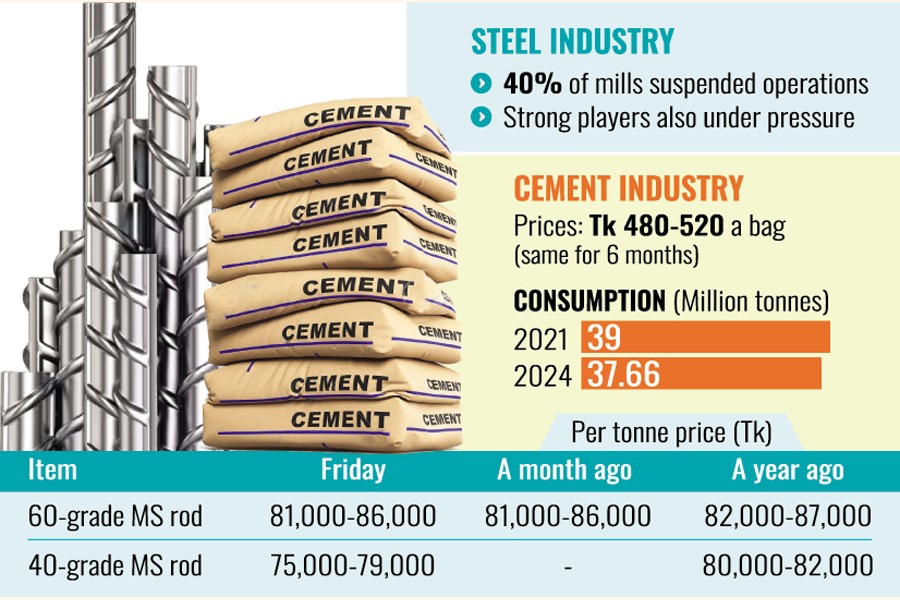
According to the Trading Corporation of Bangladesh (TCB) data, per tonne 60-grade MS rod sold between Tk 81,000 and Tk 86,000 on Friday.
The price was unchanged compared to a month ago, but declined by 1.18 per cent compared to a year before.
On the other hand, per tonne 40-grade MS rod sold between Tk 75,000 and Tk 79,000 on Friday, which was almost 5.0 per cent lower than a year ago when prices ranged between Tk 80,000 and Tk 82,000.
Anwar Hossain, a retailer in the capital's Mohammadpur area, says both the prices and demand for rod are on a downward trend.
"Sales have plummeted to almost half of the usual figures," he says.
Managing Director of Shahriar Steel Mills Sheikh Masadul Alam (Masud) says following several years of tough times, the steel sector was expected to turn around by now, but has yet to do so.
According to him, the upcoming national elections have created additional uncertainties.
"Because of the elections, everything is a bit stagnant. Maybe the situation will improve once the elections are over," he tells the Financial Express.
He says development activities have remained largely halted for nearly five years.
"In the last five years, no new major government development project began," says Masud, also a former chairman of Bangladesh Steel Mills Association.
He says government projects usually contribute 50 to 60 per cent of the total steel demand, which has now declined to around 10 per cent.
Masud describes the current steel price drop as unusual.
"The prices have not fallen for normal reasons. They have declined abnormally because demand has fallen sharply."
He also estimates that nearly 40 per cent of the steel mills have suspended operations and even the strong players are under pressure.
Meanwhile, cement prices remain unchanged between Tk 480 and Tk 520 per bag, depending on brands, for nearly six months.
According to the Bangladesh Cement Manufacturers Association, the industry has been in decline since 2022.
Consumption fell from 39 million tonnes in 2021 to 37.66 million tonnes in 2024. Besides, production in recent years remained below the 83-million-tonne annual capacity.
saif.febd@gmail.com
© 2026 - All Rights with The Financial Express

