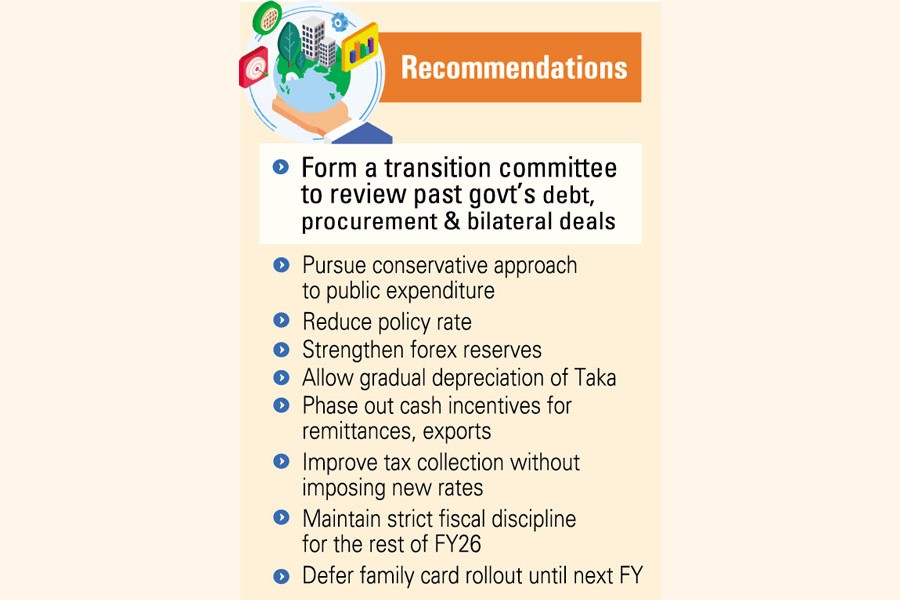
Citizen's Platform for SDGs, Bangladesh on Thursday called for strict fiscal discipline for the rest of the current fiscal year, alongside a cautious, evidence-based approach to preparing a realistic and implementable budget for FY27.
It advised deferring the rollout of the BNP's election- manifesto promise of family cards until the next fiscal year to ensure a reliable beneficiary-selection process and re-evaluating the plan to distribute tablets among teachers.
The recommendations were made at a media briefing titled "Point of Departure of the New Government: Economic Review" and arranged by the platform in a conference room in the capital.
Dr Debapriya Bhattacharya, a distinguished fellow at the Centre for Policy Dialogue (CPD) and convener of the platform, presided over the event.
Professor Mustafizur Rahman, another CPD distinguished fellow and core group member of the platform, spoke following the keynote by Towfiqul Islam Khan, additional research director of CPD.
Dr Debapriya claimed the interim government had left an even more difficult debt burden for the new BNP government, compounding the liabilities inherited from the fallen Awami League regime.
To determine the overall situation, he recommended the swift formation of a transition committee to review the government's debt position, public procurement decisions, procurement contracts, and other bilateral agreements signed by the previous administration.
He also said alongside party policymakers, neutral experts should be included in the committee to develop a clear set of economic priorities and policy directions for the country.
The economist said the government should not consider printing money, not even in theory, if the goal is to control inflation.
Toufiqul identified fragile macroeconomic stability, weak private sector investment and employment, and shrunken fiscal space as the primary hurdles for the new government.
He said the failure to increase revenue mobilisation and contain public expenditure resulted in a revenue deficit - defined as the shortfall of revenue earnings against recurrent operating expenditure - amounting to Tk 237.42 billion, marking the first such shortage since the 1980s.
Besides, he noted that in the last fiscal year, the government was compelled to borrow Tk 602.94 billion to finance this revenue gap after meeting all expenditures and repaying foreign debt outside the Annual Development Programme (ADP).
Borrowing undertaken to repay the existing loans surged by Tk 386.10 billion in a single year - an increase of 178.06 per cent from Tk 216.84 billion recorded in FY24.
The keynote recommended pursuing a conservative approach to public expenditure, noting that such a stance would help reduce the fiscal burden, although it might delay the implementation of development projects and have some implications for economic growth, job creation, and revenue mobilisation.
It also recommended reducing the policy rate by the central bank, further strengthening the foreign exchange reserve, allowing a gradual depreciation of the Bangladeshi taka, phasing out cash incentives for remittances and exports, improving tax collection without imposing new rates, and prioritising the recovery of stolen assets as well as non-performing or bad assets.
Professor Mustafizur said incentives on remittances created pressure on government revenue, noting that a 2.5 per cent incentive on $30 billion in remittances generated roughly $750 million in subsidy costs.
Gradually reducing remittance incentives would not negatively affect remittance flows if currency depreciation was managed carefully, he said.
He explained that some depreciation could lead to imported inflation, but if the market and the central bank managed it properly, the impact would be limited and the trade-off between depreciation and remittance incentives should be carefully considered.
Speaking about energy security, he emphasised the importance of renewable energy and cross-border imports, citing Nepal's hydroelectric power supply to Bangladesh via India.
Regarding graduation from the least developed country (LDC) status, he noted that the interim government delayed the application to maintain trade benefits, while the current one had sent applications seeking such provisions.
He said Bangladesh must carefully justify its position with data and structural arguments in international forums, including the United Nations (UN), to secure support from other countries during the graduation.
Proposing a blue Book, Dr Debapriya said a transition team should first assess the government's current liabilities, commitments, and outstanding contracts.
This forensic evaluation would provide transparency on debt, subsidies, and contingent liabilities, enabling informed planning for the next fiscal year, he said.
He emphasised the blue book should document government responsibilities, disclose conflicts of interest of ministers and members of parliament (MPs), review past debts and contracts, and ensure overall financial transparency.
Moreover, he suggested postponing the distribution of family cards for the current fiscal year until a transparent beneficiary list was developed after the local elections.
He stressed that distribution should be based on a fully transparent digital database to minimise corruption and ensure that beneficiaries were selected according to actual needs.
jahid.rn@gmail.com
© 2026 - All Rights with The Financial Express

