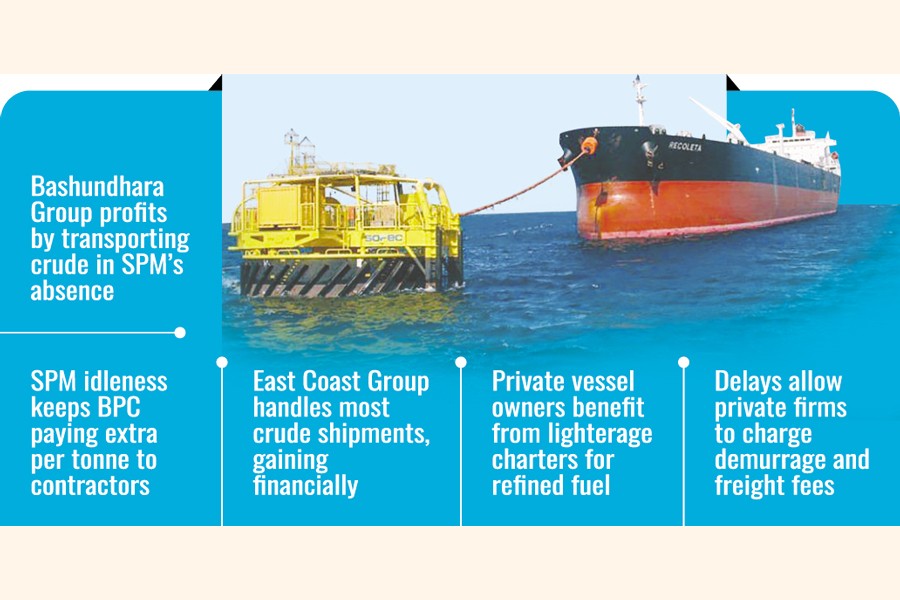
The delay in starting operations of the country's maiden single-point mooring (SPM) system -- designed to unload fuel quickly and cheaply -- is allegedly benefiting private operators, who are earning hefty profits at the expense of public money, industry insiders said.
Allegations are rife that allege that a vested interest group, working in collusion with private-sector beneficiaries, is playing a key role in delaying the SPM and its associated fuel pipelines and infrastructure.
A senior Bangladesh Petroleum Corporation (BPC) official said that, in the absence of the SPM, privately owned Bashundhara Group has been transporting crude oil from mother vessels to onshore tanks. Previously, the state-run Bangladesh Shipping Corporation (BSC) carried crude to Eastern Refinery Ltd (ERL) using its two lighterage vessels.
"However, both vessels were set on fire within five days in October last year, taking BSC out of crude transport and opening the way for private operators. Although the managing directors of both BSC and BPC suggested the incidents 'might have been sabotage,' the probe committee failed to identify the culprits," he added.
Despite repeated attempts, Banshundhara Group could not be reached for comment.
BPC currently pays around US$7.25 per tonne to lighterage vessels to ferry fuel from mother vessels to onshore tanks. Once the SPM becomes operational, these payments will no longer be required, saving public funds.
An ERL official said the BPC imports crude oil under a free-on-board (FOB) mechanism, meaning the corporation is responsible for transporting fuel from the load port to ERL tanks.
"East Coast Group has been handling crude in most cases after being assigned by BSC. Without the SPM, mother vessels often wait one to two weeks at the outer anchorage to unload, sometimes incurring demurrage charges. The SPM would significantly reduce freight and demurrage costs," he added.
"With the SPM, BPC would be able to unload a 100,000-deadweight-tonne tanker within 48 hours, compared to around 11 days at present. For refined products, BPC imports on a cost-and-freight (CFR) basis.
"Suppliers currently charter lighterage vessels to deliver fuel from outer anchorage to BPC tanks, giving local private vessel owners an advantage. The SPM would remove this need and reduce import premiums," the official added.
The SPM, equipped with a double pipeline, was completed last year at a cost of around Tk 80 billion (US$650 million) to carry petroleum products from mother vessels at the outer anchorage to onshore tanks.
China Petroleum Pipeline Engineering Co Ltd (CPPEC) built the facility after being selected under the now-defunct Quick Enhancement of Electricity and Energy Supply (Special Provision) Act 2010. CPPEC handed over the infrastructure to state-run BPC in August 2024, the same month the caretaker government took office.
The government has yet to appoint an operations and maintenance (O&M) contractor, keeping the SPM idle for 16 months.
Energy Adviser Muhammad Fouzul Kabir Khan acknowledged that private interests might be delaying operations and said efforts are underway to assign a contractor quickly.
BPC Chairman Md Amin Ul Ahsan said the government initially attempted a government-to-government (G2G) procurement, which failed. Later, an international tender was floated, but the lone bidder -- Indonesia's PT Pertamina -- quoted US$117 million, well above the US$88 million budget, resulting in cancellation. "A re-tender will be issued soon."
When contacted, the Chairman of East Coast Group Azam J Chowdhury said, "We are being affected in carrying crude, as BPC usually fails to unload the fuel on time and does not pay demurrage properly."
"After the damage to our two lighterage vessels by fire last year, our profit from carrying BPC's fuel through the private sector has been squeezed," said BSC Managing Director Commodore Mahmudul Malek.
"We have recently urged BPC to revise the current fuel carrying charges," he added.
The SPM and double-pipeline project was implemented with Chinese concessional loans worth US$554 million, including US$467.84 million as preferential buyers' credit and US$82.5 million as a soft loan.
The Exim Bank of China provided the financing, to be repaid over 20 years at an interest rate of 2.0 per cent per annum with a five-year grace period. Once operational, the SPM is expected to significantly reduce BPC's costs for fuel unloading.
A senior BPC official said Bangladesh could save around Tk 8.0 billion ($75.5 million) annually, solely by reducing the unloading costs of petroleum products from outer anchorage to onshore fuel tanks.
azizjst@yahoo.com
© 2026 - All Rights with The Financial Express

