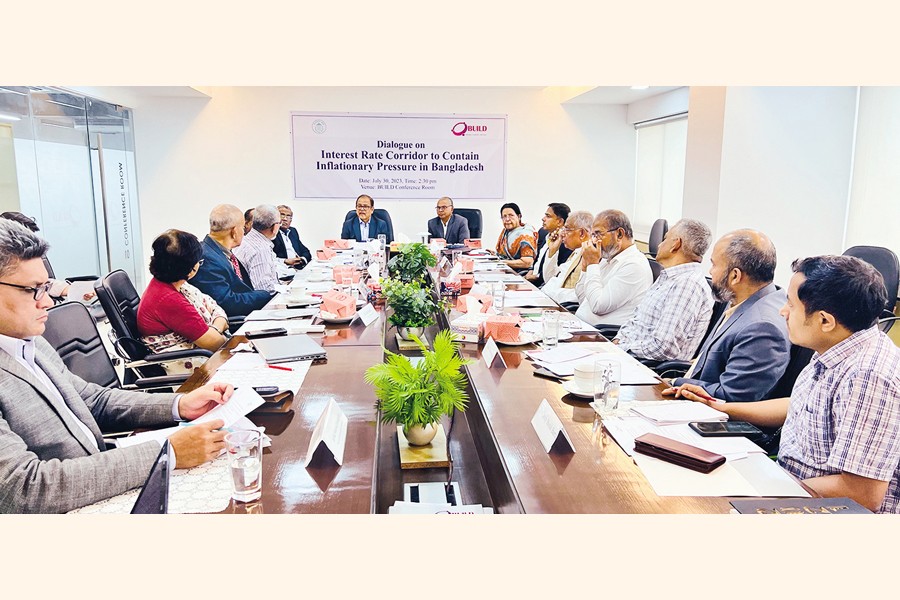
 Business Initiative Leading Development (BUILD) organised a dialogue on 'Monetary Policy Statement (MPS) and Containing Inflationary Pressure in Bangladesh' at the BUILD Conference Room in Dhaka on Sunday. Dr Md Ezazul Islam, executive director (Research), Monetary Policy Department of Bangladesh Bank, was present as the chief guest.
 Just-introduced interest-rate corridor (IRC) and reference lending rate known as SMART will not be enough to hold high inflation in check under the targeted 6.0 per cent, experts said.
In stocktaking on outcomes the new monetary policy and its interest-rate regime at a dialogue Sunday in Dhaka, they felt that alongside the two instruments, measures like slowing down growth with proper filtering in taking development projects to lessen the volume of fiscal deficit and coordination of fiscal and monetary policy are an imperative.
Business Initiative Leading Development (BUILD) organized the dialogue on 'Monetary Policy Statement (MPS) and Containing Inflationary Pressure in Bangladesh' in its conference room.
President of Metropolitan Chamber of Commerce and Industry (MCCI) Md. Saiful Islam chaired the discussion where executive director of Bangladesh Bank (BB) Dr Md Ezazul Islam was the chief guest.
The MCCI president said the economy keeps growing to reach US$465 billion and become 35th-largest economy of the world. In such an economy, it will be difficult for the central bank and the government to control the inflation without tools like IRC and SMART.
"I think these are timely steps taken by the government," he told the stocktaking meet on latest macroeconomic situation of the country.
Mr Islam notes the public-sector growth is higher than private sector's, which is critical to the country's infrastructure building. Private sector cannot invest more if there is no infrastructure, so both public-and private-sector growth is interlinked.
Prof Dr Mahmood Osman Imam, a teacher at the Department of Finance, Dhaka University, mentioned that IRC would be used as a tool for the banking sector and not for others, while SMART rate would work as a reference rate for determining interest rate against lending.
There are three instruments through which the government can borrow from the central bank to meet its fiscal deficits. These are ways and means, overdraft and print money.
"If the newly circulated money or high-powered money goes for development works, it is okay. If not, it will fuel up the inflation," he says about the merits and demerits of government borrowing through the windows of central bank.
Under such challenging circumstances, he suggests that the government could slow the growth momentum to lessen the fiscal deficit with lesser concentration on taking fresh projects.
"If it happens, the pressure of domestic borrowing by government from the banking sector will be reduced and it will lessen pressure on the money market," the finance professor gives the cue on how to do a delicate balancing between development spending and wayward inflation.
Mr Imam told his audience that the central bank sold $13 billion ($13.58 billion, to be exact) to the commercial banks in FY'23 assisting them clear their overseas transactions and it significantly raised the BB's NDA or net domestic assets.
Despite releasing too many greenbacks to the market, he mentioned, exporters and "deemed exporters" are suffering in operating their production amid ongoing forex dearth.
He was raising question over proper monitoring by the BB to ensure that the money goes to the proper sector.
BUILD CEO Ferdaus Ara Begum was highlighting the challenges of MPS and interest-rate corridor and focused on ways of addressing inflation through different tools of the central bank.
She said inflation is linked to many factors, such as the state of the economy, the level of inflation expectations, the credibility and independence of the central bank and the confidence of businesses in business-enabling ecosystem.
Former managing director of NCC Bank Mohammad Nurul Amin presented the keynote and said the establishment of a policy on interest-rate corridor as a monetary tool is a paradigm shift.
In that respect, he added, the reference-interest rate for bank-deposit and-lending rates naming SMART is a transition from monetary- targeting framework to interest-rate-targeting framework.
He said to contain inflation, MPS is contractionary, as announced accompanied by specific policy initiatives, but fiscal measures are expansionary.
The banker raised a dilemma in banking operations, as such, as he posed the question: "Whether we will go for market-driven treasure rate or we will follow the donors' prescription to follow IRC."
Speaking as the chief guest, BB executive director Dr Md. Ezazul Islam said the central bank had followed monetary targeting-policy framework before announcement of the latest monetary policy statement (MPS).
"It (BB) is now practicing interest rate-targeting framework for the last 30 days. We hope we will get better outcomes from the policy shift," he told the meet.
In this transition mechanism, he said, there are different channels. These are interest-rate channel, credit-rate channel, bank-lending channel and exchange-rate channel. Monetary Policy Committee of Bangladesh Bank continuously reviews the policies so that it can keep balance with a number of factors.
He put emphasis on financial literacy so that people can understand the central point of MPS.
Managing Director of SME Foundation Dr Md. Mafizur Rahman, former General Secretary of Bangladesh Economic Association (BEA) Dr Jamaluddin Ahmed, President of ERF (economic reporters forum) Mohammad Refayet Ullah Mirdha, former executive director of Bangladesh Bank Dr Lila Rashid and Adviser of the FBCCI Manzur Ahmed, among others, also spoke at the dialogue.
jubairfe1980@gmail.com
© 2026 - All Rights with The Financial Express

