Bangladesh's push to expand exports of man-made fibre (MMF) garments could face a setback as the government proposes higher import duties on key synthetic raw materials, stoking concerns among exporters and textile manufacturers about the sector's future competitiveness.
Industry stakeholders have warned that diversification from cotton-based products, which dominate exports, to non-cotton or MMF-based apparel would face challenges if the proposed duty hike is implemented.
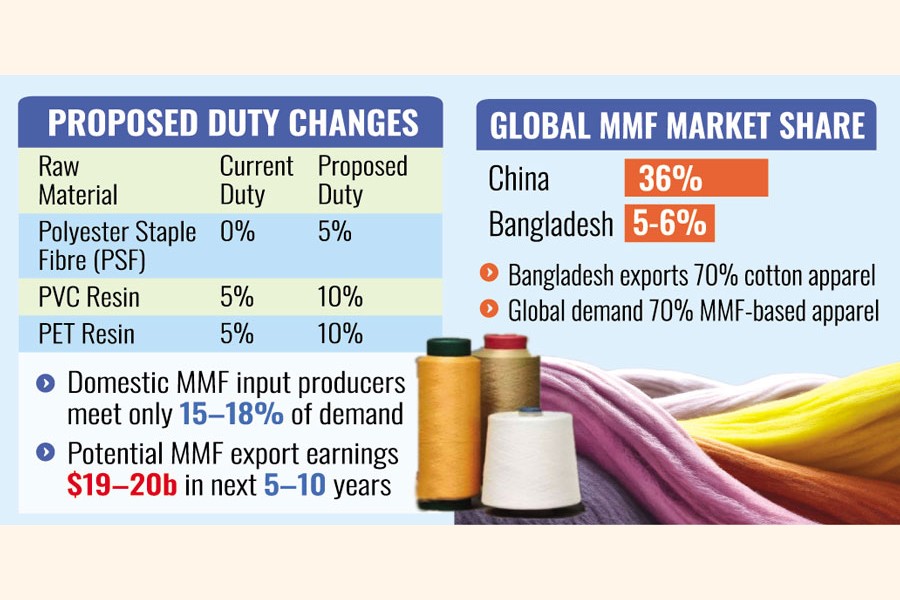
In his budget speech, the finance minister proposed imposing a 5.0 per cent import duty on polyester staple fibre (PSF) and raising the import duty on PVC resin and PET resin, both widely used in MMF-based garment production, to 10 per cent from the existing 5.0 per cent, citing the need to protect domestic industry.
Industry insiders, however, said the proposal comes at a time when Bangladesh is gradually increasing its focus on MMF-based production to align with changing global apparel demand, particularly in Western markets where consumers are increasingly shifting away from cotton garments.
They noted that with garment exports facing pressure from weaker global demand and intensifying competition, expanding MMF production has become essential for sustaining export growth and competitiveness.
Bangladesh currently remains heavily dependent on cotton-based apparel, which accounts for more than 70 per cent of its total garment exports.
Globally, around 70 per cent of apparel demand is for MMF-based products, highlighting a significant mismatch between Bangladesh's export profile and international market trends.
According to industry data, Bangladesh's cotton apparel exports grew from around US$3 billion in 2001 to US$33 billion in 2021.
Over the same period, MMF apparel exports increased by about US$8 billion, indicating steady progress in expanding the country's presence in the global non-cotton apparel market.
Speaking to the FE, Bangladesh Textile Mills Association (BTMA) Vice-President Md Saleudh Zaman Khan said the proposed 5.0 per cent duty on polyester staple fibre would discourage MMF-based garment exports and could prompt manufacturers to revert to cotton-based production.
He suggested that the government could instead provide incentives or subsidies to support the development of domestic MMF backward-linkage industries.
According to Mr Khan, local manufacturers currently meet only 15-18 per cent of the demand for MMF-related inputs from knitwear and woven garment producers.
He argued that the backward-linkage industry for MMF products would struggle to develop because production costs are already higher than those of cotton yarn and fabric, whose imports enjoy duty-free access.
"Setting up MMF production facilities requires substantial investment, and the proposed duty will further increase raw material costs," he said.
Bangladesh Knitwear Manufacturers and Exporters Association (BKMEA) President Mohammad Hatem said policymakers should carefully assess whether imposing a 5.0 per cent duty on polyester staple fibre is timely and realistic.
"The country's only producer currently meets less than 10 per cent of total domestic demand," he said.
While supporting measures to protect local manufacturers, Mr Hatem stressed the need to ensure that such policies do not undermine Bangladesh's competitiveness or result in lost export opportunities.
Responding to the FE, Bangladesh Garment Manufacturers and Exporters Association (BGMEA) Vice-President Shehab Udduza Chowdhury said the proposed measures would negatively affect efforts to diversify into MMF-based apparel.
In its budget reaction, the BGMEA urged the government not to impose the proposed 5.0 per cent duty on polyester staple fibre or raise duties on PVC and PET resin, citing the strong export potential of MMF-based garments.
Policy Exchange Bangladesh Chairman Dr M Masrur Reaz said the government generally avoids increasing the tax burden on the garment sector, but described the proposed duties as unhelpful for the future development of MMF and synthetic apparel production.
He argued that protective duties are more effective when domestic industries have already achieved a minimum level of production capacity.
"Tariff protection alone is not sufficient to develop local industry. It also requires a broader sectoral development strategy, greater efficiency and enhanced production capacity," he said.
Industry insiders noted that despite Bangladesh's strong position in cotton apparel, the country has considerable room for expansion in MMF and blended garments, where its global market share stands at only 5-6 per cent compared with China's dominant 36 per cent.
Studies also show that competitors such as Vietnam have established a strong foothold in MMF and blended apparel, particularly in key markets such as the United States and Japan.
According to industry estimates, Bangladesh could generate between US$19 billion and US$20 billion in MMF garment exports over the next five to ten years if existing constraints are addressed and the sector receives adequate policy support.
Munni_fe@yahoo.com
© 2026 - All Rights with The Financial Express

