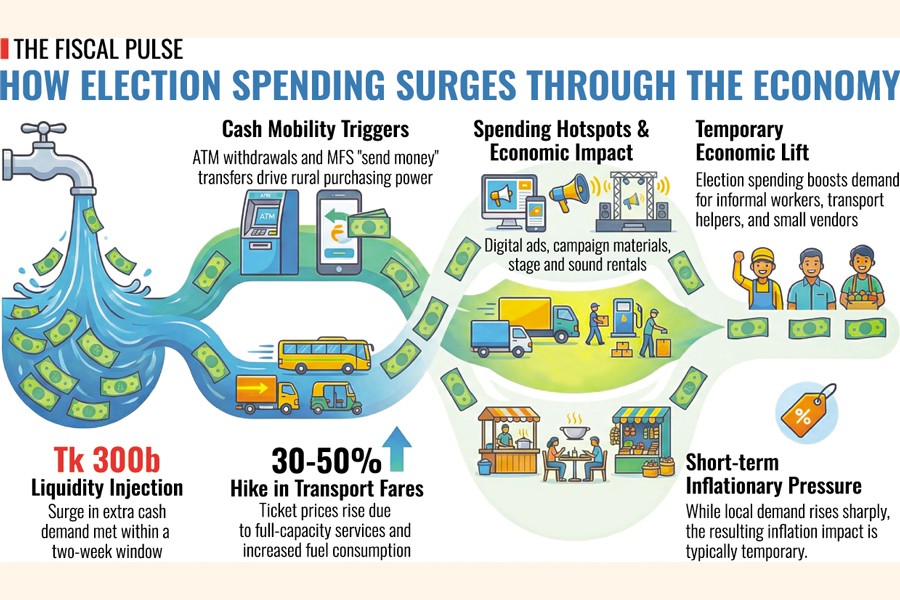
The 13th national election, being held today (Thursday), is widely believed to have injected a short-term burst of liquidity into the economy, pushing up prices in several local markets.
Transport, food, campaign materials and related services have seen noticeable spikes in demand in the run-up to polling day.
While economists expect the impact on national inflation to be limited and temporary, evidence from Dhaka and other major cities suggests that election-driven spending has already created pockets of localised price pressure.
In Dhaka and other major cities, transport fares surged as millions of voters travelled to their home districts to cast ballots.
Bus operators reported running at full capacity for several days, particularly on Wednesday, with ticket prices on some popular routes rising by 30 to 50 per cent, according to people familiar with the developments.
Higher mobility also pushed up fuel consumption, roadside food sales and small retail transactions, creating a ripple effect of localised inflation, especially in peri-urban and rural markets.
"Whenever there is a national election, cash circulates more rapidly and demand rises suddenly in certain pockets," said Dr Zahid Hussain, an independent economist.
He noted that food, transport, digital advertising, vehicle rentals, stage construction, sound systems and temporary labour have all seen a surge in orders over the past two weeks.
Such activity does not always feed immediately into national inflation data, but localised price pressures become visible, he added.
"A significant portion of election spending goes into the food sector, such as tea stalls and small eateries," said Dr Zahid Hussain, a former lead economist at the World Bank.
"Such temporary price pressures can contribute to inflation, especially when supply-side constraints limit the economy's ability to absorb the surge in liquidity."
He observed that part of this effect may already be reflected in January's point-to-point inflation rate of 8.5 per cent.
Beyond transport and travel, election campaigning itself has generated a wave of short-term economic activity.
Dr M Masrur Reaz, chairman and chief executive of Policy Exchange Bangladesh, said demand for certain goods and services, particularly transport, food and advertising, may add to inflationary pressure, although part of the spending also contributes to output and services growth.
He cautioned, however, that the impact on inflation is likely to be temporary and may fade once the election passes.
Dr Masrur said election-related spending can also have positive effects, as increased bus trips and higher demand for services provide a short-term boost to economic activity.
The Election Commission has, however, warned about rising campaign expenditure, including higher spending on social media outreach.
Bankers and mobile financial service (MFS) providers reported a rise in cash withdrawals and person-to-person transfers, as urban residents sent money to families in rural constituencies ahead of the vote.
The shift has temporarily strengthened rural purchasing power, supporting local trade.
"Election periods typically increase liquidity outside major cities. We were adequately prepared at our ATM booths and observed a surge in withdrawals," said Syed Mahbubur Rahman, managing director and chief executive officer of Mutual Trust Bank.
A central banker said that around Tk 300 billion in additional demand for money had been met over the past two weeks.
Although the "cash-out" option of MFS services remained restricted, many users relied on the "send money" feature to transfer funds.
Despite these micro-level pressures, economists expect only a limited impact on national inflation.
The country has been grappling with persistent inflation in recent months, particularly in food items.
One notable feature of election-driven spending is its strong effect on the informal economy - including day labourers, transport helpers, temporary campaign workers and small vendors.
Many earn short-term income during election periods, helping to stimulate grassroots consumption.
Street vendors near transport hubs reported brisk business in snacks, tea and low-cost meals as travellers crowded stations and highways in recent days.
jasimharoon@yahoo.com
© 2026 - All Rights with The Financial Express

