Economists and experts suggested Sunday effective measures in the upcoming budget for boosting the sagging business confidence and ensuring good governance to attract investment into the country, as they found a slowdown on the economic front.
They also laid stress on having policy consistency in the tax measures to attract especially foreign direct investment (FDI).
The Institute of Chartered Accountants of Bangladesh (ICAB) and daily Prothom Alo jointly organised the pre-budget discussion in the city, with the objective of suggesting ways for the government to prepare a budget focused on right priorities.
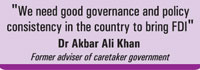
"We need good governance and policy consistency in the country to bring FDI. Otherwise, the problem (of sluggish FDI inflow) will be intensified," said former adviser of caretaker government Dr Akbar Ali Khan.
Mr Khan also said the foreign investors always take such things into their consideration for making investment and move together to the countries having a congenial environment.
He also expressed his apprehension about further taking supplier's credit to meet the expenses of some projects, including the nuclear power plant, which is not being discussed for the budget.
"Though such credit is given at low rate of interest, the suppliers charge much higher price on the products that they provide for the respective projects," he said about the covert cost of such funds.
The upcoming budget for 2015-16 should have strong measures to address the weak areas in the economy, but it seems to be an 'unconventional budget' like the previous year's that is normally prepared immediate after and before the national polls, he noted.
"Such type of budget is not prepared in the long term."
Blasting a minister's recent remark on poverty eradication, Dr Khan said the statement is true in the perspective of national poverty line, but 80 per cent of country's people are still below the poverty line in international perspectives.
"The nutritional status of our people is worse than that of Sub-Saharan people," he opined.
Criticising government's reluctance to lower prices of petrol despite its earlier assurance of balancing local prices as per the international rates, he said the policy that saved a small amount of funds, compared to the economy, eventually tarnishes image of the government.
Joining their voice with Mr Khan, some other experts raised allegation of large-scale 'waste of money' in education, health and infrastructure sectors due mainly to corruption, politicisation, lack of sincerity and delays in project implementation.
Former chairman of the securities regulator Faruq Ahmad Siddiqi also raised question about implementation of ADP efficiently and free from corruption, though the size of the development budget is getting bigger.
Blasting the tax management at the revenue board, he said, "It is a very badly managed sector."
He also demanded simplification and rationalisation of especially corporate tax along with consistent tax policy.
Former chairman of the National Board of Revenue (NBR) Dr Muhammad Abdul Mazid told the meet that the supplementary budget is being ignored from the discussion though it (such discussion) is very important even for taking effective measures about the next budget.
"We are not being able to fully utilise our potential to increase the tax-GDP ratio," which is resulting in budget deficit, Dr Mazid said.
Laying stress on creating and having confidence in the stock market, he said, "Without confidence, the stock market will not strengthen."
Aftab ul-Islam, president of the American Chamber of Commerce (AmCham), said the local investors are not making investment amid uncertainty and fear in the country, let alone the foreign investors.
He urged the government to enhance confidence among the local businesses first. And "then the foreign investors will follow them".
ICAB past president Md Abdus Salam underlined the need for ensuring accrual-basis and quality audit system in the public entities in order to efficiently spend and manage the large sums of money allocated in the national budget.
Some speakers alleged that any case filed relating to the tax disputes took 'indefinite' time to be settled, discouraging the investors.
They also called upon the NBR authorities to expand the tax net, and demanded automation in the taxation to collect maximum income tax and value-added tax (VAT).
The meet was also addressed, among others, by ICAB President Masih Malik Chowdhury, Bangladesh Institute of Bank Management (BIBM) director (training) Dr. S.M. Ahsan Habib, ICAB past presidents Abbas Uddin Khan and Md Syful Islam and Prothom Alo associate editor Abdul Qayyum. ICAB council member Md Humayun Kabir FCA moderated the discussion.
md.ali.du@gmail.com
© 2026 - All Rights with The Financial Express

