Share of vast non-RMG swathe of the economy to Bangladesh's export earnings has been on a downturn, rendering the country riskily dependent on a single exportable, economists say over the latest lopsided turnover.
They are of the opinion that ignoring the trade-basket diversification over the years, excepting some 'insignificant' measures, has brought the country' into such a state.
Readymade garment industry accounted for an overwhelming 84.59 per cent of the country's total export earnings worth US$55.55 billion in the just-concluded fiscal year of 2022-23, according to official data.
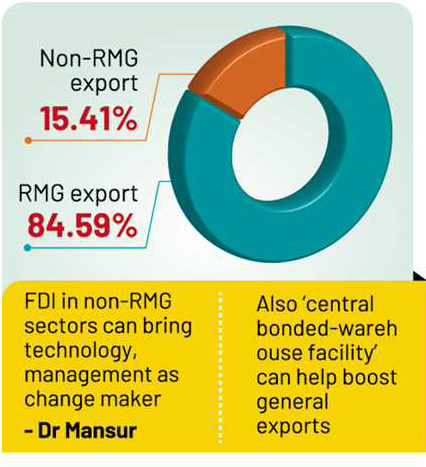
On the other hand, contribution from non-RMG sectors, including leather and leather goods, jute and jute goods, agricultural products, frozen and live fishes and engineering products, plastic, pharmaceuticals, specialized textiles and home textiles, stood at a peanut 15.41 per cent in the last fiscal.
Out of the $55.55 billion worth of export earnings, RMG earned US$46.99 billion and non-RMG sectors US$8.56 billion.
In fiscal 2012-13, Bangla-desh received US$27.02 billion, and out of the amount, RMG's share was 79.61 per cent or US$21.51 billion while share of non-RMG goods was 20.39 per cent or US$5.51 billion.
Over the last one decade, RMG earnings have more than doubled while there was a rise of about $3.0 billion from non-RMG sectors, data analysis showed.
The earnings would be yet less if specialized textile and home-textile earnings were not taken into account.
In the just-past fiscal, top major exportable goods except RMG, non- leather footwear and plastics, including leather, agricultural, engineering products, pharmaceuticals, frozen and live fishes, jute and jute goods, witnessed negative growth.
"There is hardly any non-RMG sector that performs well consistently," many an expert says, on a downbeat note as the country is in the cusp of graduation to a higher level of socioeconomic condition.
Asked about imbalance in trade growth, Shymal Das, director of Bangladesh Frozen Food Exporters Association (BFFEA), said over the years, there had been no approval for vannamei cultivation here in the country despite high demand for the high-yielding species due to its small size and a low rate.
Though the government has approved commercial production of vannamei recently, it has yet to allow cultivation of fish fry of the Vannamei species.
"Government gives me gun without bullet," he said explaining that cultivation of the species by importing fry at a high cost is not viable as cost of production goes up and thus eats up competitiveness.
It costs Tk 1.10 per fish fry to import from Chennai of India while an Indian farmer pays only rupee 0.40, he said for an example. Moreover, 10 per cent of the imported fish fry dies during transporting.
Besides, they (Indian) get electricity at a cut rate as agricultural goods while a Bangladeshi farmer has to pay commercial rate, he notes.
On the demand side, says Mr Das, also managing director of M U Sea Foods Ltd, the demand for local shrimp has fallen drastically due to the Russia-Ukraine war as consumers in major markets have prioritized their purchasing based on basic needs and put visit to restaurants on less-or no-priority list.
"They prefer vannamei due to its price and availability against high-rated local shrimp."
Talking to the FE on Wednesday, Bangladesh Fruits, Vegetables and Allied Products Exporters Association secretary-general Mohammad Mansur cited a number of reasons for the fall in the sector's growth, including fluctuating rates of the dollar, high freight fares and production cost.
"Cost of production is high, resulting in high prices of the perishable vegetables," says about the dilemma facing the farm-sector export.
Bangladesh and India export goods with same criteria but India sends the goods to the same destinations at a reduced rate of at least 40 per cent than Bangladesh's, he points out.
"As a result, buyers prefer to place orders to India."
Moreover, vegetable exporters are small growers and the fluctuating dollar rates put them in dire situation as there is a gap of Tk 7.00 to 8.00 per dollar.
Also due to global economic slowdown, buyers make deferred payments beyond usual 120 days but local exporters didn't get the latest rate, he adds. "There have also been issues related to cold-storage facility while no improvements in handling at airport."
A government official concerned, however, opined in favour of continuation of government support to RMG sector for its further growth, saying that the industry is performing well.
Cash incentives have been provided to a total of 43 sectors while 39 are non-RMG and get incentive up to 20 per cent, the official said, adding that RMG gets 1.0 to 4.0 per cent.
Similar to RMG, non-RMGs also get tax waiver on capital machinery and raw-material imports and funds for technological upgrading.
"Despite all this, the diversification in export basket has not taken place as required. Diagnosis must be done to dig out the reasons and work accordingly," says the official.
Bangladesh's competitor countries are advanced than Bangladesh in terms of competitiveness.
Policy Research Institute of Bangladesh (PRI) executive director Dr Ahsan H Mansur says the non-RMG sectors are not growing as expected and most of them belong to SME category. And there is hardly any sector that is doing well consistently.
The government has been providing cash incentive but this has not been working.
"They need dedicated supports--industry-wise and as per industry- required production cycle-based supports like technological," the economist suggests.
Ship- building industry's production cycle is two to three years and three-to-six-month-long assistance is not helpful to this industry, he explains.
"Access-to-finance issue must be addressed through bank," he says, suggesting attracting foreign direct investment in non-RMG sectors for bringing technology, management and setup of good institutions.
He also recommends central bonded-warehouse facility.
Munni_fe@yahoo.com
© 2026 - All Rights with The Financial Express

