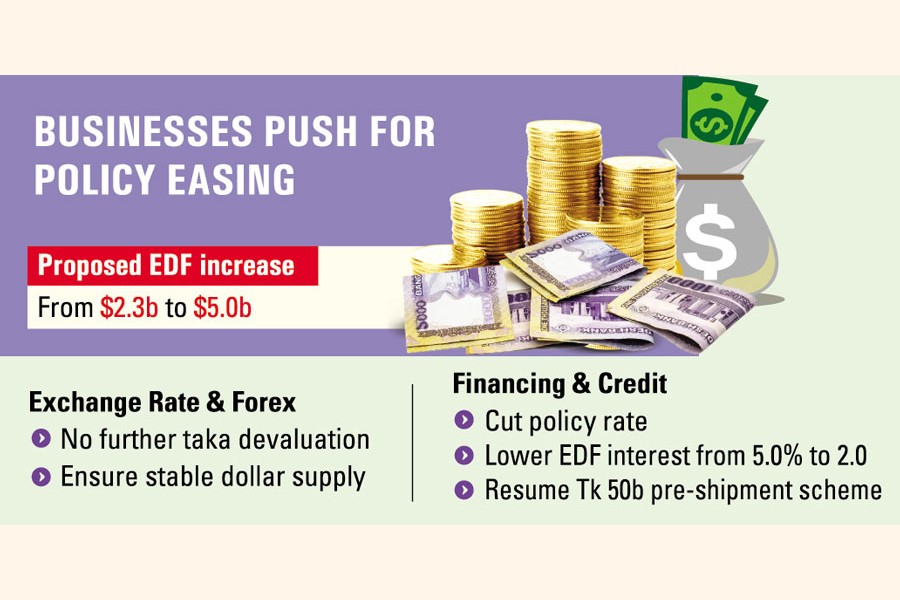
Business leaders on Monday urged the central bank to maintain exchange-rate stability and ease financing conditions, arguing that current macroeconomic pressures are already weighing heavily on investment and production.
With remittance inflows strengthening foreign-exchange reserves, they see little justification for further currency depreciation.
At the same time, trade bodies are pushing for a broader set of policy measures, including expanded export financing and lower borrowing costs, to revive private sector activity amid a prolonged slowdown.
The Federation of Bangladesh Chambers of Commerce and Industry (FBCCI) urged the central bank not to further devalue the Bangladeshi taka, citing adequate foreign currency reserves supported by rising remittance inflows.
During a meeting with Bangladesh Bank (BB) Governor Mostaqur Rahman, an FBCCI delegation led by its Administrator Abdur Rahim Khan submitted a 12-point proposal, including a request to expand the Export Development Fund (EDF) to $5.0 billion from the current level of around $2.30 billion.
Leaders of the country's apex trade body emphasised that there is no shortage of US dollars in the market and requested the regulator to keep the exchange rate stable.
Speaking to reporters after the meeting, FBCCI Secretary General Alamgir Hossain said the federation had asked the central bank to refrain from further depreciation of the taka.
He added that the governor assured them there is no dollar crisis and warned of regulatory action against any unauthorised moves to raise exchange rates.
He noted that the EDF had previously stood at around $7 billion but has now declined to about $2.2 billion. The federation proposed increasing the fund to $5.0 billion to better support exporters.
In addition, the business body recommended reducing the interest rate on EDF loans from 5 per cent to 2 per cent.
The EDF had earlier been scaled down following concerns over loan defaults, misuse of funds and concentration of large exposures among a few business groups, as well as to comply with conditions set by the International Monetary Fund (IMF) under its ongoing $5.5 billion lending programme aimed at stabilising the macroeconomic situation.
President of the Bangladesh Knitwear Manufacturers and Exporters Association (BKMEA), Mohammad Hatem, said they had proposed raising the EDF to $5.0 billion initially and expanding it gradually to $8.0 billion in the coming years.
He also raised concerns over rising production costs due to higher lending rates under the tight monetary policy stance.
"We requested the central bank governor to take steps to reduce the policy rate to facilitate business and employment under the current sluggish business scenario," he said.
The business leader further noted that a pre-shipment credit scheme of Tk 50 billion, offered at an interest rate of 5.0 per cent to support exports, has remained suspended since April last year.
"We requested the central bank to resume the financing scheme, and the governor responded positively," he added.
Meanwhile, members of the Board of Directors of the Dhaka Chamber of Commerce and Industry (DCCI), led by its President Taskeen Ahmed, paid a courtesy call on the central bank governor on the same day.
At the meeting, Taskeen Ahmed said private sector credit growth has declined to 6.03 per cent, the lowest in 22 years. He also noted that the policy rate currently stands at 10 per cent, pushing lending rates up to around 16-17 per cent.
This, he said, reflects tight liquidity conditions in the banking system, making financing increasingly expensive and, in many cases, less accessible for businesses, particularly SMEs and manufacturing industries.
To address the situation, DCCI proposed a gradual reduction in the policy rate to lower lending costs and boost private investment.
Alternatively, providing subsidised loans to priority sectors such as manufacturing, export-oriented industries and SMEs could help reduce borrowing costs and support economic recovery.
Emphasising the need to restore confidence in the investment climate, Taskeen Ahmed also highlighted the importance of strengthening governance in the banking and financial sectors.
He noted that recent changes in loan classification policy, reducing the timeframe from nine months to three months, along with high business costs, energy shortages and weak demand, have added pressure on businesses.
Considering these challenges, he proposed reconsidering loan rescheduling facilities for unintentional defaulters and extending the loan classification period to at least six months.
jubairfe1980@gmail.com
© 2026 - All Rights with The Financial Express

