 The Finance Division has proposed a Tk 1.70-billion project to provide technical support for building a Dynamic Social Registry (DSR), aimed at ensuring transparency in selecting beneficiaries for social- protection programmes.
The proposal comes just three months after the Executive Committee of the National Economic Council (ECNEC) approved a Tk 9.04 billion 'Strengthening Social Protection for Improved Resilience, Inclusion and Targeting (SSPIRIT)' project, to be implemented by the Department of Social Services (DSS).
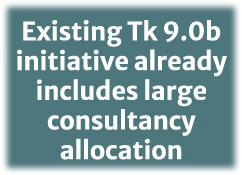
Planning Commission officials noted that the SSPIRIT project includes an allocation of over Tk 1.94 billion, approximately 21.46 per cent of its total cost, for consultancies to provide technical services.
They questioned the rationale behind the newly proposed Tk 1.70 billion technical support project, pointing out the unusually high consultancy budget in the existing initiative.
The Finance Division has submitted the Preliminary Development Project Proposal (PDPP), which includes World Bank support amounting to Tk 975.2 million, to the Planning Commission for inclusion in the current fiscal year's Annual Development Programme (ADP) as an unapproved project to expedite the approval process.
A letter forwarded with the PDPP for the project, titled 'Social Protection Digital Transformation and Coordination (SPDTC)', stated that the initiative would begin in July this year and run until June 2030.
The Financing Agreement worth Tk 200 million signed with the World Bank for the SSPIRIT project includes an allocation of $8.0 million for the proposed SPDTC project, the letter added.
It further noted that a Project Scrutiny Committee meeting held at the Finance Division had endorsed the proposal, which was sent following the decision of the meeting.
An inter-ministerial meeting held at the Programming Division of the Planning Commission also decided to include the project in the ADP, said officials.
According to the proposal, the primary aim of the project is to modernise the disbursement system of social protection allowances and to make the selection of beneficiaries more transparent and up-to-date.
Key project components include rolling out a Dynamic Social Registry (DSR) to improve transparency and targeting in social safety net programmes, developing system architecture, integrating ministry-level MIS platforms, establishing links with banks and telecom operators for Government-to-Person (G2P) payments, and using data analytics for policy formulation.
Earlier in April this year, ECNEC approved the SSPIRIT project with a plan to spend over Tk 1.94 billion on consultancy services to distribute Tk 5.89 billion in cash to around 4.5 million poor people.
An analysis reveals that consulting firms under SSPIRIT are set to receive Tk 1.73 billion, while eight individual consultants will collectively be paid another Tk 210.19 million-each earning an average monthly salary of Tk 0.48 million, with some drawing as much as Tk 0.60 million.
Economic experts have stressed the importance of closely scrutinising consultancy spending in public projects. While they acknowledged the role of consultants in designing and implementing such programmes, they also urged greater fiscal prudence-especially in light of the country's economic challenges.
"In a time of economic hardship, when inflation is high and the poorest sections of society struggle to make ends meet, it is crucial that the government ensure every taka spent on such projects directly benefits the people who need it the most," said Dr Zahid Hussain, former lead economist at the World Bank's Dhaka office.
Dr Fahmida Khatun, Executive Director of the Centre for Policy Dialogue (CPD), echoed similar concerns. "Reducing ancillary expenses in social protection projects would allow for an increase in the number of beneficiaries or a higher benefit amount per person," she said.
Despite the significant consultancy allocation in the SSPIRIT project, she questioned the necessity of launching a separate technical support initiative.
Previously, the Bangladesh Bureau of Statistics (BBS) had spent Tk 6.43 billion to implement the National Household Database (NHD) project, launched in 2013, to create a comprehensive database for targeting social safety net beneficiaries.
Although data was collected from 35 million households and the project was formally completed in 2022, the database has yet to become fully functional or usable for policymaking and targeting.
jahid.rn@gmail.com
© 2026 - All Rights with The Financial Express

