Bangladesh's readymade garment (RMG) exporters have formed a high-level committee to review provisions of the Bangladesh National Building Code (BNBC), particularly those affecting factory layouts.
This comes amid growing calls to align local regulations with international standards, such as the International Building Code (IBC), the National Fire Protection Association (NFPA), and the labour law.
Industry insiders say the committee, headed by former Bangladesh Textile Mills Association (BTMA) president and Knit Asia Chairman A Matin Chowdhury and comprising senior industry leaders and technical experts, will examine inconsistencies in the code and recommend necessary clarifications or revisions.
The body is also working on developing a unified industry position on the issue.
Industry leaders expect the committee to submit recommendations aimed at ensuring greater clarity in the BNBC while maintaining compliance with globally accepted safety standards.
The move comes as manufacturers face conflicting interpretations of BNBC provisions during safety audits.
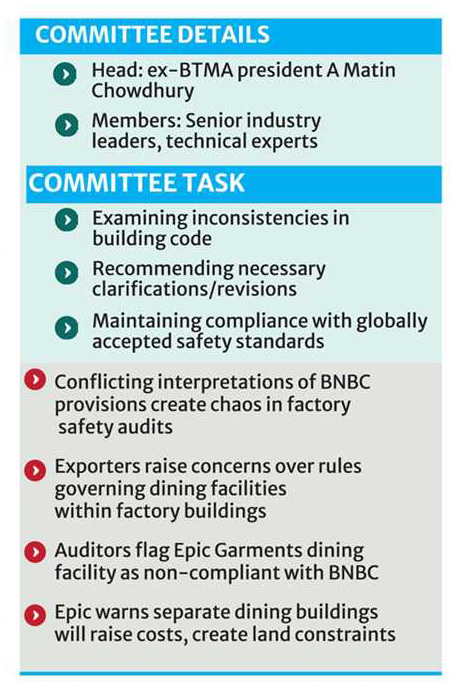
The initiative gathered pace following concerns raised by exporters over rules governing dining facilities within factory buildings, an issue highlighted in a formal letter from Epic Garments Manufacturing Co Ltd (Unit-7) to the Bangladesh Garment Manufacturers and Exporters Association (BGMEA) president.
In the letter dated December 18, 2025, the company noted that "the provision of eating/dining facilities for factory workers and employees is an integral part of the RMG sector and is mandated under local labour laws," adding that such facilities "are used exclusively by workers during working hours".
It pointed out that in most factories, dining areas are located within the same building but separated from production zones by fire-resistant walls, in line with Accord and Alliance standards.
However, recent audits had raised objections, it said.
"Auditors flagged our dining facility as non-compliant with the Bangladesh National Building Code (BNBC), citing its location within the production building," it noted.
Epic Garments also highlighted apparent contradictions within the BNBC.
While one provision allows mixed occupancies if separated by fire-resistant construction, another categorises dining (assembly occupancy) as "Not Permitted (NP)" alongside industrial use, it said.
"This appears contradictory and impractical for the garment industry," the company stated, saying that "such ambiguity creates challenges as different auditors interpret the code inconsistently, resulting in compliance concerns that affect worker welfare and operational continuity".
It also cautioned that requiring separate dining buildings would "significantly increase costs and create land constraints within factory premises".
Speaking to The Financial Express, Bangladesh Knitwear Manufacturers and Exporters Association (BKMEA) President Mohammad Hatem said leaders from both BKMEA and BGMEA had recently met Housing and Public Works Minister Zakaria Taher to discuss concerns over certain BNBC provisions that render factories non-compliant despite being built in accordance with the existing laws.
"The minister assured that if the industry provides a detailed account of the contradictions, the government will take the matter into consideration," he said.
On April 20, the BGMEA leadership also held a meeting with former presidents to review broader industry challenges, including compliance issues related to building codes.
Following the meeting, BGMEA President Mahmud Hasan Khan told The Financial Express there "are some misconceptions regarding the National Building Code" and discussions "are ongoing with engineers and relevant stakeholders".
"A technical team with engineers and experts is working on identifying the key challenges or misconceptions," he said, adding that the issues would be placed before the authorities concerned for clarification if "we have a lack of understanding of these issues".
Responding to a query, he said one key area of confusion was whether dining facilities could be allowed within the same building as production in newly constructed factories.
"Technical experts are currently reviewing such matters," he said, adding that further consultations would be held with the related bodies of the government to clarify or bring changes,
if necessary.
newsmanjasi@gmail.com
© 2026 - All Rights with The Financial Express

