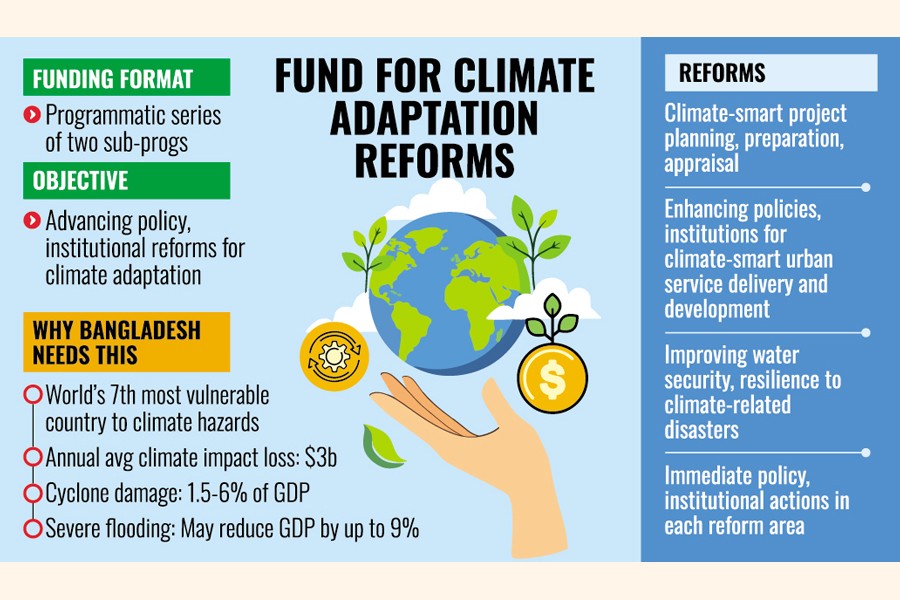
The government is discussing with the Asian Infrastructure Investment Bank (AIIB) a $400 million fund in budget support credit to advance policy and institutional reforms, focusing on climate adaptation in the urban and water sectors.
The programme aims to support the government in implementing critical policy and institutional reforms to promote sustainable water resources management and climate-smart urban service delivery.
The financing will come as a programmatic series of two sub-programmes, officials say.
A senior Finance Division official told The Financial Express Thursday the discussion with the AIIB was advancing, while the government ministries and departments concerned were scrutinising the conditions the bank had put forward.
"Our previous AIIB-funded reforms on climate resilience and inclusive development were very successful, and we are hopeful to get the fund for the new programme in a few months," he said.
Earlier, the China-led multilateral development bank gave a total of $800 million in two phases under the Climate Resilient Inclusive Development Programme to implement key policy reforms, which aimed to combat climate change and foster sustainable development.
The new loan programme focuses on climate-smart project planning, preparation and appraisal; enhancing policies and institutions for climate-smart urban service delivery and development; and improving water security and resilience to climate-related disasters.
It also focuses on immediate policy and institutional actions in each reform area, aligning with the short-term priorities of the government-led national climate plans, including the National Adaptation Plan (NAP) 2023-2050 and the Nationally Determined Contributions 2021 Update (NDC-U), with a particular focus on urban and water sectors.
The Finance Division; the Ministry of Environment, Forest and Climate Change; the Planning Commission; the Ministry of Local Government, Rural Development and Co-operatives; the Ministry of Water Resources; the Ministry of Housing and Public Works; and the Sustainable and Renewable Energy Development Authority (SREDA) will carry out the reforms under the programme.
The local government and water resources ministries will set up a project preparation facility to improve project selection and readiness; promote climate finance, including from the private sector; and coordinate among the relevant departments.
Also, under the programme, the Ministry of Planning will develop and roll out the updated Ministry Assessment Format (MAF) and Sector Appraisal Format for Technical Project Proposals (TPP/TAPP) and Revised Development Project Proposals (RDPP), embedding green climate resilient development (GCRD) principles, DRIP-based Disaster Impact Assessment (DIA), and climate-tagging.
It will also integrate the formats into PAMS/AMS with automated validation and submission control to ensure that all revised and technical projects incorporate climate and disaster risk considerations in accordance with the DPP.
Moreover, the Ministry of Planning will approve and operationalise the Disaster Impact Assessment (DIA) framework, as referenced in the MAF manual, to establish a standardised, evidence-based process for identifying, assessing, and mitigating disaster and climate risks in public investment projects.
The Advisory Council/Cabinet will approve the National Water Policy 2026, incorporating climate adaptation measures in alignment with the National Adaptation Plan.
Parliament will approve the Bangladesh Water Act, strengthening climate-resilient water governance.
The AIIB project summary says Bangladesh is the world's seventh most vulnerable country to climate hazards, with an average annual loss of about $3.0 billion.
"Climate change has posed disproportionate impacts to the vulnerable groups in the country, including women, whose livelihoods are increasingly affected," it says.
The damage from tropical cyclones in the country is estimated at between 1.5 per cent and 6.0 per cent of the Gross Domestic Product (GDP).
In case of severe flooding, the GDP could fall by as much as 9.0 per cent, it also says.
Bangladesh has a significant financing need to address the immediate and urgent intertwined challenges of climate change and development.
syful-islam@outlook.com
© 2026 - All Rights with The Financial Express

